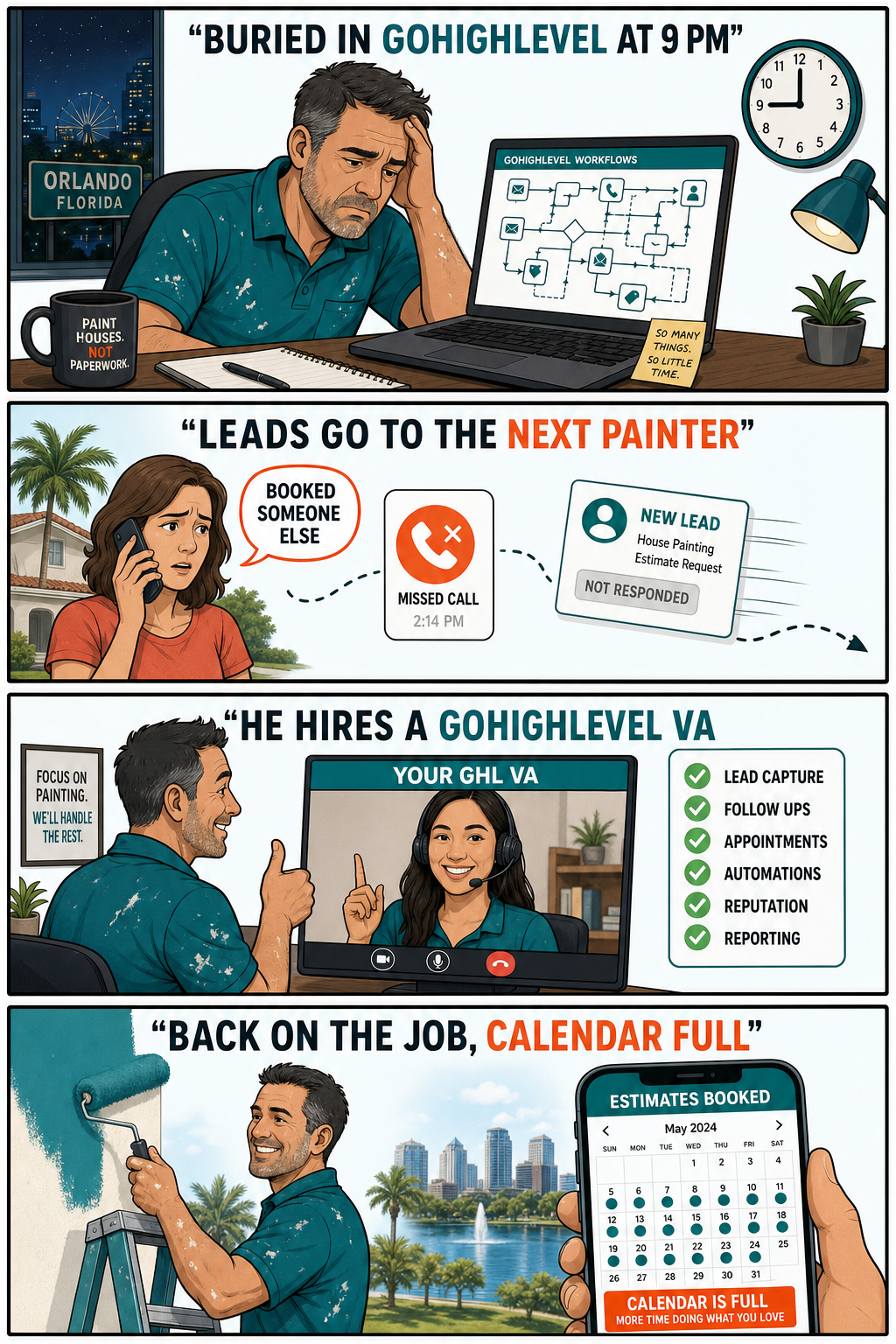
If you’re an Orlando painting contractor spending your evenings building GoHighLevel workflows instead of running crews, you’re paying for that CRM twice — once for the software, and again in the estimates you’re too buried to chase. The fix most owners land on isn’t dropping the CRM or hiring a $60,000-a-year coordinator. It’s hiring a dedicated GoHighLevel VA — a specialist who runs the pipeline for roughly $700/month so the response goes out in seconds and you get your nights back. This post lays out what running GHL yourself actually costs a painting shop — in lost leads, real wages, and your own hours — and why, in a market growing as fast as Orlando’s, that math has stopped being close.
In this post
- Orlando’s paint boom is a trap if you can’t keep up
- The real problem: you became your own CRM admin
- What running GoHighLevel yourself actually costs you
- The math: a $700 VA vs. a full-time hire
- “But can’t I just do it myself?”
- What a GoHighLevel VA actually does for a painting shop
- How hiring a GHL VA works
- Frequently asked questions
Orlando’s paint boom is a trap if you can’t keep up
Orlando is one of the best places in the country to run a painting business right now — and that’s exactly the problem. The metro added 37,690 residents between July 2024 and July 2025, the 10th-largest numeric gain of any US metro, pushing the region to roughly 2.94 million people; Osceola County alone grew 4.65% year over year (Orlando Economic Partnership, 2025). Every one of those new roofs, HOAs, and resale homes is a future interior repaint or exterior job.
Zoom out and the prize is enormous: US house-painting and decorating contractors are a $28.2 billion industry with about 223,000 businesses (IBISWorld, 2025). In a growth market, the leads show up whether or not you’re ready for them. The constraint on an Orlando painting shop in 2026 isn’t demand — it’s whether anyone answers the lead before the homeowner books the next painter on the list.
That’s where the trap springs. Owners hear “you need a CRM,” buy into GoHighLevel because it genuinely does everything — AI caller, chatbot, SMS follow-up, review harvesting, pipelines — and then discover that “does everything” also means “someone has to build and run everything.” And the someone is you, at 9 p.m., after a full day on a ladder.
The real problem: you became your own CRM admin
Here’s the pattern I see over and over as an operations consultant. A painter signs up for GoHighLevel to stop losing leads. Six weeks later, they are the bottleneck they bought the tool to fix. The workflows are half-built. The A2P registration stalled. The automated review request fires at the wrong time. And the owner is spending the one resource a growing shop can’t buy back — attention — on being an unpaid, self-taught CRM technician.
The time drain is real and measurable. Small-business owners lose an average of 96 minutes a day — about 7.5 hours a week — to administrative and low-value work, according to Salesforce’s 2024 small-business productivity research (Salesforce, 2024). For an owner-operator, that’s the most expensive labor in the company being spent on the least valuable work. Business-mentoring nonprofit SCORE likewise reports that a large majority of small-business owners already work more than 40 hours a week, with a meaningful share past 60 (SCORE). GoHighLevel doesn’t remove those hours if you run it yourself — it adds to them.
None of that is a knock on GoHighLevel. It’s a genuinely powerful platform — arguably the best all-in-one system a painting contractor can run. The issue is that a platform is only worth what a competent operator does with it, and right now that operator is the person who should be selling and delivering paint jobs.
What running GoHighLevel yourself actually costs you
The cost of being your own CRM admin isn’t abstract — it’s leads, and leads are jobs. The most-cited study on this is Harvard Business Review’s The Short Life of Online Sales Leads, which audited how fast companies actually respond to inbound web leads. The findings are brutal: the average first-response time was 42 hours, only 37% of companies responded within an hour, and 23% never responded at all (HBR, 2011).
Now overlay that on how leads behave. The same research found that firms contacting a web lead within one hour were nearly 7× more likely to have a meaningful, qualifying conversation than firms that waited even 60 minutes longer — and about 60× more likely than firms that waited 24 hours or more (HBR, 2011). Speed isn’t a nice-to-have; it’s most of the game.
Relative odds of qualifying a web lead by how fast you respond, indexed to a 24-hour-plus response (= 1×). Responding within the first hour makes you roughly 60× more likely to qualify the lead. Source: Harvard Business Review, 2011.
An owner running his own GoHighLevel account between estimates is the 42-hour gap. Not because he’s careless — because he’s on a ladder, in a truck, or asleep. The CRM can respond in 30 seconds, but only if someone has built and is watching the automations that make it do so. That’s the whole ballgame, and it’s the same speed problem we’ve written about in Stop Losing Painting Leads After Hours and Missed-Call Text-Back for Painters. A dedicated GHL VA closes that gap on purpose, every day, so the response goes out while the homeowner is still holding their phone.
The math: a $700 VA vs. a full-time hire
The instinct, once an owner admits he’s the bottleneck, is to hire someone in-house to “handle the marketing and CRM.” That’s where the real numbers matter — because a full-time hire is dramatically more expensive than most owners assume.
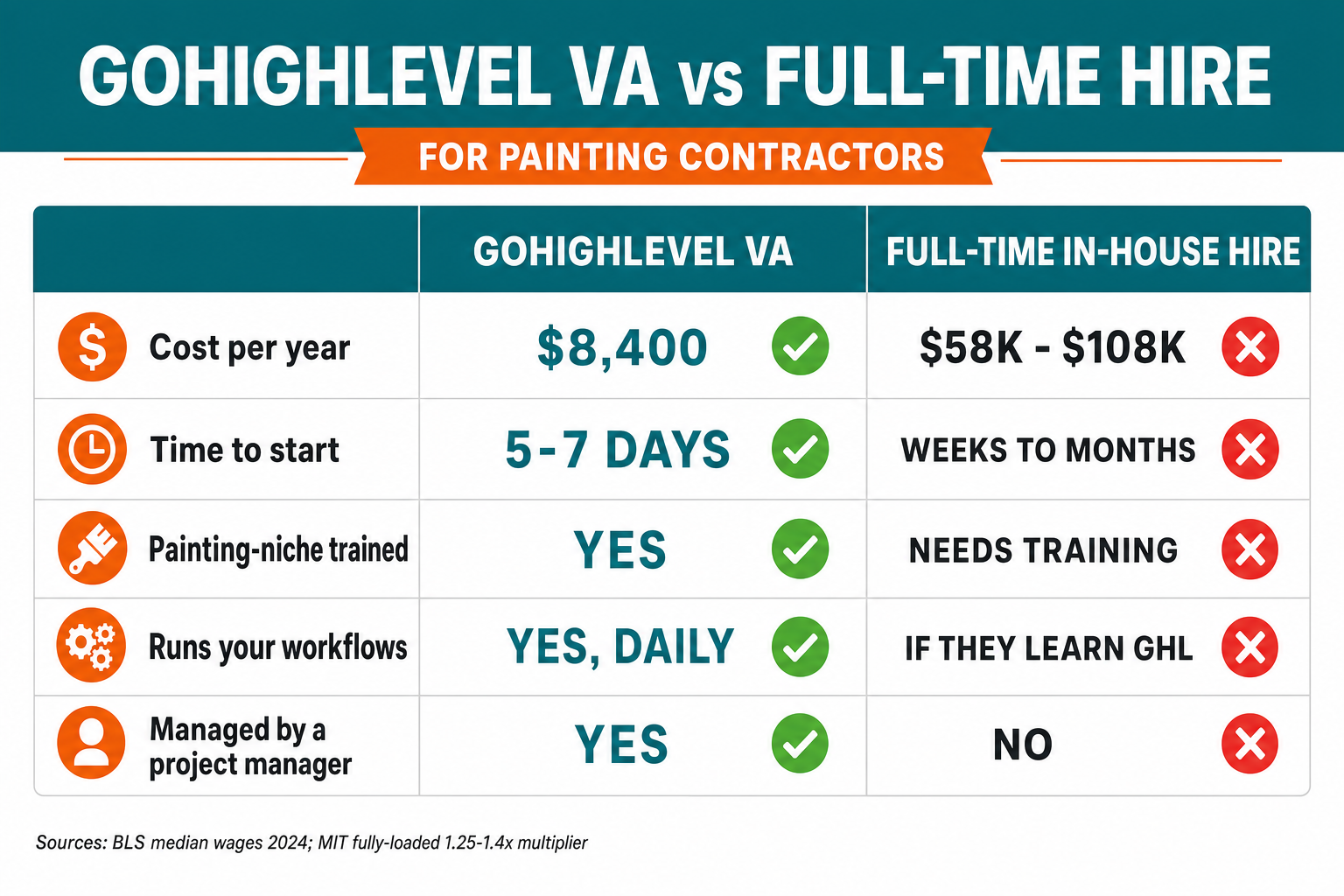
Start with base pay. The BLS median wage for office and administrative support roles is $46,320, and for market research analysts and marketing specialists it’s $76,950 (May 2024) (U.S. Bureau of Labor Statistics). But base salary isn’t the real cost. The widely used MIT rule of thumb (Joseph Hadzima, MIT Sloan) puts the fully-loaded cost of an employee at 1.25 to 1.4× base salary once you add payroll taxes, benefits, software, and overhead. Run the multiplier:
Estimated annual cost: a dedicated GoHighLevel VA at ~$700/month ($8,400/yr) vs. a fully-loaded in-house admin coordinator (BLS $46,320 × ~1.33) and marketing specialist (BLS $76,950 × ~1.33). Fully-loaded multiplier: MIT/Hadzima 1.25–1.4×. Sources: BLS OOH, 2024.
That’s not a rounding difference. A dedicated GoHighLevel VA at $8,400 a year costs roughly one-seventh of a fully-loaded admin coordinator and one-twelfth of a marketing specialist — and unlike a generalist new hire, a niche GHL VA already knows painting funnels, estimate pipelines, and seasonal follow-up. You’re not paying to train someone on what a color consultation is or how A2P registration works.
There’s a second cost the salary comparison misses: opportunity cost. The 7.5 hours a week you spend on CRM admin are hours you could spend estimating, closing, and delivering jobs — the highest-value work in the company. Handing the pipeline to a VA doesn’t just save the salary difference; it puts your own hours back into revenue. We ran the full build-vs-buy version of this decision in Painting Snapshot vs. Building It Yourself in GHL.
“But can’t I just do it myself?”
You can. The question is whether you should, and whether you realistically will. Three things usually decide it.
First, hiring locally is genuinely hard right now. The 2025 AGC of America workforce survey found 92% of construction firms are struggling to fill open positions, and 45% have delayed at least one project because of labor shortages (AGC of America, 2025). If you can barely staff your crews, adding a competent in-house CRM person to the payroll is one more hard, expensive hire you probably don’t have the bandwidth to make.
Second, GoHighLevel has a real learning curve. Workflows, triggers, A2P compliance, calendar logic, snapshot imports — it’s a professional tool, and doing it well is a skill. Most owners who “do it themselves” end up with a partially-built system that fires the wrong message at the wrong time, which is often worse than no automation at all.
Third, the DIY hours never actually free up. The whole reason to automate is to stop trading your time for tasks. If the automation itself becomes a permanent part-time job, you haven’t bought leverage — you’ve just changed which task is eating your evenings.
A GHL VA sidesteps all three: no local hiring market to fight, no learning curve to climb, and no new task on your plate. Prefer a fully hands-off system instead of a person? An AI receptionist can answer the phone channel 24/7 — but someone still has to build and maintain the workflows behind it, which is exactly the gap a VA fills.
What a GoHighLevel VA actually does for a painting shop
“VA” undersells it when the person is a GoHighLevel specialist tuned to the painting niche. A good one runs the operational spine of your lead machine:
- Builds and maintains your workflows — instant lead response, estimate follow-up sequences, no-show recovery, and the CRM pipelines and 50+ automations that run your back office.
- Watches the pipeline daily so a web lead that lands at 8 a.m. gets a first touch in minutes, not 42 hours — closing the exact gap the HBR data warns about.
- Runs review harvesting — requests a review after every completed job and routes unhappy customers to you privately first, turning finished work into 5-star local proof.
- Manages appointments — booking, confirmations, reminders, and reschedules, so your estimate calendar stays full and no-shows get recovered automatically.
- Handles A2P, DNS, calendars, and the unglamorous setup — the technical chores that stall most owner-run accounts.
- Flags gaps and suggests campaigns — a niche VA who has worked across many painting shops proactively spots what’s leaking and what seasonal push to run next.
In short: everything you’d do if you had unlimited evenings and had spent a year mastering GoHighLevel — done by someone who already has, backed by a project manager watching the work.
How hiring a GHL VA works
The process is deliberately simple, because the point is to take work off your plate, not add a hiring project to it. You check out, and we open the search that day — no paid bench, every VA matched to a real client, so you’re typically live within 5–7 business days. We hand-pick a VA who fits painting operations, and a project manager joins your Slack (or ClickUp, Asana, or Trello). The PM sees every message between you and the VA — they don’t interrupt, they monitor quality and step in only when it slips. And because your VA sits inside a wider team of workflow specialists, voice-AI engineers, and A2P experts, a tricky webhook or niche compliance case gets solved fast instead of stalling for a week.
For an Orlando painting shop riding a growth market, that’s the difference between leads you catch and leads your competitor catches. The demand is already there. The only question is whether someone is answering it in minutes — and whether that someone is you at 9 p.m., or a specialist doing it as their actual job. Compare the full menu of ways to run the system on our pricing page, or if you’d rather own the whole automated system outright, the done-for-you snapshot installs it in about 24 hours.
Frequently asked questions
What does a GoHighLevel VA cost for a painting business?
A dedicated GHL VA starts at about $700/month, which works out to roughly $8,400 per year. For comparison, a fully-loaded in-house admin coordinator costs about $58,000–$65,000 a year and a marketing specialist $96,000–$108,000, using BLS median wages at the standard 1.25–1.4× fully-loaded multiplier. A VA gives you specialist GoHighLevel help for a fraction of a full-time hire.
Why hire a GHL VA instead of just learning GoHighLevel myself?
You can learn it — but GoHighLevel has a real learning curve (workflows, triggers, A2P compliance, calendar logic), and the hours you spend on it are hours away from estimating and running crews. Small-business owners already lose about 96 minutes a day to admin work (Salesforce, 2024). A niche VA already knows painting funnels and does the CRM work as their actual job, so you get the automation without it becoming your second job.
How fast can I get a GoHighLevel VA started?
Typically within 5–7 business days. When you check out, we open the search that day and hand-pick a VA who fits painting operations, then add a project manager to your Slack or project tool to monitor quality. There's no paid bench — every VA is matched to a real client.
Does a GHL VA understand the painting business specifically?
Yes — that's the point of a niche VA versus a generalist. Our VAs have worked with 244+ painting companies and agencies, so they understand estimating pipelines, color-consultation booking, seasonal follow-up timing, review requests after a completed job, and crew-notification workflows. You don't spend the first month explaining the painting sales cycle.
Is a VA better than an AI receptionist for a painting shop?
They solve different problems and work best together. An AI receptionist answers the phone channel 24/7 and books calls; a GHL VA builds and maintains the workflows, watches the pipeline, runs review harvesting, and manages the calendar behind it. The AI handles volume; the VA makes sure the whole system is set up correctly and keeps improving. Many Orlando shops run both.
How does a VA actually reduce lost leads?
By closing the speed gap. Harvard Business Review found the average company takes 42 hours to first-respond to a web lead and 23% never respond at all — yet responding within the first hour makes you far more likely to qualify the lead. An owner between job sites can't watch the pipeline all day; a dedicated VA can, so first touches go out in minutes and fewer leads leak to competitors.
Travis is a recovering project manager who ran scheduling for a commercial and HOA painting outfit before moving into systems consulting. He is the person crews call when the pipeline is a mess of sticky notes and missed reminders. He maps the messy real-world back office of a painting business into clean GHL workflows, and he writes about appointments, no-show recovery, and the unglamorous automations — and the people who run them — that quietly save the most money.
Related posts
- Stop Losing Painting Leads After Hours — the after-hours speed gap a dedicated VA is built to close.
- Missed-Call Text-Back for Painters: Never Lose a Lead to Voicemail — the first automation your VA should be running.
- The AI Receptionist for Painting Contractors — the phone-channel counterpart to a GHL VA.
- Painting Snapshot vs. Building It Yourself in GHL — the full build-vs-buy decision.
- 5 Painting Automations Every Contractor Should Be Running — the workflow stack a VA maintains for you.
Painting Snapshot builds done-for-you GoHighLevel automation systems and provides dedicated GHL virtual assistants for house painting contractors. We are not a painting company and do not perform painting work or quote project pricing. Wage, response-time, industry-size, workforce, and population figures above are drawn from the cited third-party sources (Harvard Business Review, U.S. Bureau of Labor Statistics, MIT/Hadzima, IBISWorld, AGC of America, U.S. Census via the Orlando Economic Partnership, Salesforce, SCORE) and reflect general benchmarks, not a guarantee of results for any specific business. VA pricing and start times reflect current published terms and may change — verify on our Hire a VA page.