It is a Thursday evening and you are at the kitchen table with a cold coffee, writing up the best quote you have put together all month. Full exterior repaint, detached garage, a little carpentry on the fascia. The homeowner was friendly, clearly had the budget, and told you he liked your work. You send the number Friday morning. You feel good about it.
Ten days later you drive past the house and there is a different crew on ladders, spraying the siding you measured. Not a cheaper outfit either. A shop you know charges about what you quoted. You never got a no. You never got anything. The best lead you had all month quietly became somebody else’s job.
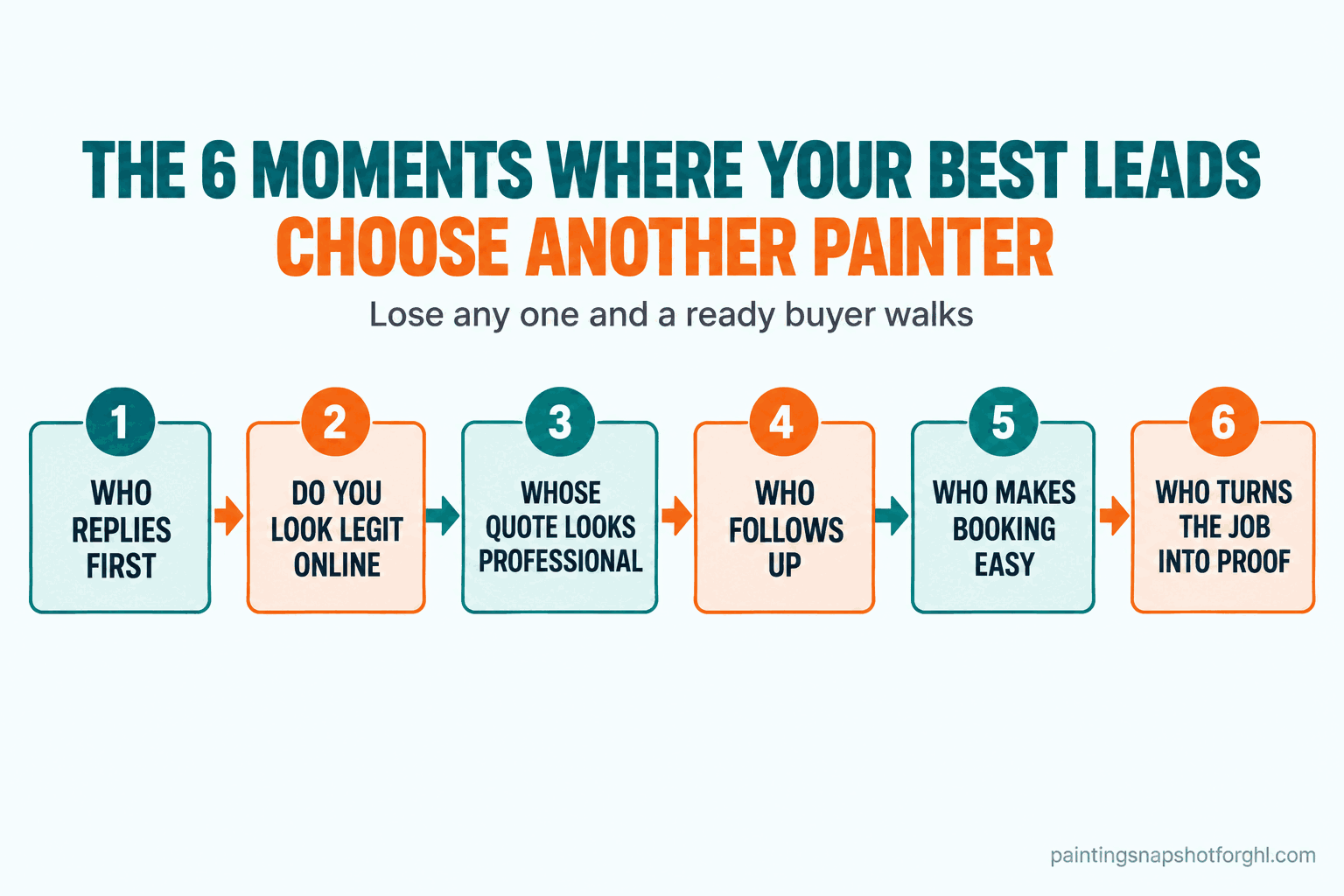
Your best painting leads, the homeowners with real budgets and real projects, usually book another painter for reasons that have nothing to do with your price. They book the painter who replied first, looked more trustworthy online, sent a cleaner quote, actually followed up, and made it easy to say yes. Lose any one of those six moments and a ready buyer walks, often without ever telling you why. This post walks each moment, how it breaks, and the exact fix and message for it, so you stop handing your best work to the painter down the road.
In this post
- The best leads do not leave on price
- Moment 1: Who replies first
- Moment 2: Do you look legit online
- Moment 3: Whose quote looks like a professional’s
- Moment 4: Who actually follows up
- Moment 5: Who makes it easy to say yes
- Moment 6: Who turns the job into proof for the next lead
- How this plays out for a solo painter, a 5-person shop, and a multi-crew company
- The compliance part that bites painters
- Objections I hear every week
- Frequently asked questions
The best leads do not leave on price
There is a story owners tell themselves when a good job slips away: “they went with someone cheaper.” Sometimes true. For your best leads, usually not.
The homeowner with a $9,000 exterior and a tidy house is not shopping for the cheapest brush in town. That person has money and has been burned before, by a contractor who ghosted or did sloppy work. What they are buying is the feeling that you will not be one of those stories. Every moment in their decision tests that: can I reach him, does he look real, does his quote look professional, does he follow through. Price is one input, and for the good leads it is rarely the deciding one.
That matters because the market is not short on demand. The U.S. had about 342,200 painter jobs in 2024, with a median wage of $48,660, and the trade is projected to grow about 4 percent through 2034 (U.S. Bureau of Labor Statistics). The question is whether the good jobs pick you, and that gets decided in six small moments most owners never watch. Let us walk them.
Moment 1: Who replies first
Your best lead did not call one painter. She filled out three forms in ten minutes, because that is how a careful, high-intent buyer shops. Whoever replies first gets to frame the whole conversation and becomes the painter the other two get measured against.
This is one of the most studied numbers in lead handling, and it holds for painting. In the classic lead-response study of more than 15,000 leads and 100,000 call attempts, reaching a new lead within five minutes instead of thirty made a company about 21 times more likely to qualify that lead (InsideSales/MIT). Harvard Business Review found the same pattern across 1.25 million leads: firms that responded within an hour were far more likely to reach a decision-maker than those that waited (Harvard Business Review). The good lead is gone fastest of all, because a serious buyer moves fast.
Relative odds of qualifying a new lead by first-response speed. A five-minute reply was about 21 times more likely to qualify the lead than a thirty-minute reply. Source: InsideSales/MIT lead response study. Vendor-platform data, directional.
How it breaks: you are on a job when the lead lands, so you reply at lunch. By then the buyer has already talked to the painter who answered in two minutes, and you are the third quote she is being polite about. The fix is not answering your phone faster while you are holding a roller. It is an automatic text that fires the moment any lead lands, so the conversation starts without you. That is the whole idea behind missed-call text-back for painters, and why a slow quote response quietly costs you jobs.
Moment 2: Do you look legit online
Once you reply, the good lead does the thing cheap leads skip: she checks you out. She Googles your name, looks at your reviews and photos. A careful buyer spending real money will not hire a painter who looks thin or invisible online, no matter how nice the first text was.
This is where a lot of good painters lose quietly, not because the work is bad, but because the proof is not there to find. Reviews are now the default trust check: BrightLocal’s 2025 survey found only about 4 percent of consumers never read online reviews, meaning roughly 96 percent read them at least sometimes, and 74 percent check at least two review sites before they decide (BrightLocal Local Consumer Review Survey 2025). If your newest Google review is from fourteen months ago, the buyer’s gut says “risky,” and she moves on.
How homeowners vet a local business before hiring. Source: BrightLocal Local Consumer Review Survey 2025. Percentages of consumers surveyed.
How it breaks: you do good work but you never ask for the review, so your online proof is a trickle while the painter down the road has 180 recent five-star reviews and fresh job photos. Same work, completely different story on the screen. The buyer is not choosing the better painter. She is choosing the one who looks safer, and looking safer is something you can build on purpose. We lay out the full playbook in how to get more 5-star painting reviews. The short version: ask every happy customer, automatically, the day the job wraps, which is Moment 6 below and the reason this whole thing is a loop.
Moment 3: Whose quote looks like a professional’s
Now the buyer has two or three numbers in hand, and the one that wins is often not the lowest. It is the one that looks like a professional sent it.
A verbal “yeah, probably around eight grand” texted at 9pm reads as a guess. A clean written quote, with the scope spelled out, the prep described, the paint named, and a clear price and next step, reads as a pro who will not surprise her later. For a careful buyer spending five figures, that clarity is worth more than a few hundred dollars off.
How it breaks: you deliver the number as a one-line text with no scope, because you are tired and it is late. The buyer cannot tell what she is getting, so she cannot say yes with confidence, so she waits, and waiting is where the other painter wins. The fix is a repeatable quote format you send every time. A fast, credible instant estimate on your site can get a ballpark range in front of her within minutes, then you confirm the firm number at the walk-through.
Moment 4: Who actually follows up
This is the one that stings, because the job was basically yours. The buyer liked you, your quote was solid, and then she said “let me talk to my husband.” Then life happened on both sides. Eleven days later she hired the painter who sent a friendly check-in on day two, because he was still in front of her when she was finally ready to pull the trigger.
Most lost jobs are not lost at the quote. They are lost in the silence after it. A careful buyer takes her time, so the good lead is the one most likely to go quiet for a stretch. If your follow-up depends on you remembering, it will not happen the week you are slammed, which is exactly the week the good leads are deciding. We go deep on this in the full painting estimate follow-up playbook.
How it breaks: you either never follow up, or you follow up like a telemarketer, five texts in three days, which pushes a thoughtful buyer away. The sweet spot is polite persistence: a couple of helpful touches over about ten days, each with a real reason to reply, fired automatically.
Moment 5: Who makes it easy to say yes
She is ready to book the walk-through or color consult. Do not let the finish line turn into phone tag. Every round of “does Thursday work, no how about Friday” is a chance for a ready buyer to cool off or book the painter who just sent a link she could tap.
A careful buyer reads friction as a warning: if scheduling with you is already a hassle, she assumes the whole project will be. The painter who sends a booking link she can tap at 9pm from the couch feels like the easy, safe choice, which is the exact feeling your best lead is buying. That is what appointment automation is for: she picks a slot, gets a confirmation and a reminder the day before, and if she no-shows an automatic nudge tries to rebook her instead of you chasing.
How it breaks: you book everything by hand, so a ready homeowner at 9pm waits for you to see her text tomorrow and offer times, by which point she has self-scheduled with a painter who made it one tap. You did the hard part. Do not lose the job at the easy part. The message is simple: “Great, grab whatever time works best here and you’ll get a confirmation and a reminder the day before: [booking link].”
Moment 6: Who turns the job into proof for the next lead
Here is where the loop closes. You won the job, did great work, the homeowner is thrilled. Then you pack up, drive to the next site, and never ask for the review. That finished job, your best proof, never makes it online. So the next careful buyer who checks you out in Moment 2 sees the same thin profile, and you lose her too.
The painter quietly beating you is not better with a brush. He asks for a review after every job, automatically, while the customer is still glowing, and routes the occasional unhappy one to himself privately before it lands in public. That is why his profile is fresh and deep and yours is a trickle, and the review you harvest today is the trust signal that wins the lead next month. We built that exact flow into review harvesting automation.
How it breaks: you ask “sometimes,” meaning when you remember, meaning almost never. Automate the ask so it fires after every job, make it one tap for the customer, and your proof compounds month after month instead of flatlining.
How this plays out for a solo painter, a 5-person shop, and a multi-crew company
The six moments are the same at every size. What you fix first is not.
The solo painter or owner-plus-one. You are the estimator, the crew, and the office, which is exactly why the good leads slip: you cannot reply, quote, and follow up while you are painting. Moments 1 and 4, the instant reply and the automated follow-up, are the whole game for you. Get those two running first and you stop leaking the jobs you already half-won. At your size, keeping one extra good job a month is a serious raise.
The 5-person shop with one or two crews. You have enough volume that good leads pile up faster than anyone can handle by hand, and the ones that slip are invisible because you never see what you did not catch. Your weak point is usually Moment 2 and the Moment 6 review loop, because nobody owns it. Automate the review ask on every job and fix the instant reply, and your online proof and your response speed both climb without adding a person.
The multi-crew company. Your enemy is inconsistency. On a good day someone replies in ten minutes and sends a clean quote. On a slammed day a five-figure lead waits four hours and gets a one-line text, and you have no way to know which happened. You need all six moments running as a tracked system, so no good lead’s outcome rides on which crew lead was free that afternoon.
The compliance part that bites painters
Every steal-this message above is a business text, and business texting is regulated. The system that wins the good leads can get you fined or silently filtered if you run it carelessly.
First, the TCPA and A2P 10DLC. You need a reasonable basis to text a customer, you must honor a STOP reply promptly, and to send business texts reliably in the U.S. you have to register your number and campaigns under A2P 10DLC, or carriers quietly filter your messages into nowhere (FCC). The good news: a homeowner who just asked you for an estimate has given you a reasonable basis to text about that project.
Second, lead paint and your license. If you work on homes built before 1978, the EPA’s Renovation, Repair and Painting Rule requires certification, because about three-quarters of pre-1978 U.S. homes still contain some lead-based paint (EPA). And some states go further on advertising: California requires your contractor license number on essentially all advertising, which includes the website feeding this whole system (California CSLB). Rules genuinely differ by state, so check yours. We pulled it all together in the painting contractor compliance checklist.
Objections I hear every week
“My best leads just want the lowest price.” Some do, and those are not your best leads, they are your most painful ones. The homeowner who can afford a quality repaint is buying confidence that you will show up, do clean work, and not vanish. The painter who makes the process feel safe and easy wins that buyer at a fair number, every time.
“I already pay for Jobber or Housecall Pro.” Good, and you may not need to replace them. The real question is whether your setup actually fires an instant reply, asks for a review after every job, and runs the quote follow-up on its own, or whether those still live in your head. If the automations are not running, the software is a filing cabinet. If you are weighing tools, we compared the main options in the best painting business software breakdown.
“Won’t an automated text annoy a high-end client?” Only if it reads like a robot. A message with your real name that asks one relevant question feels like a fast, on-the-ball painter, which is exactly the impression a careful buyer wants. The painter who annoys people is the one who goes silent for a week and then calls at dinner.
“Do I need to be technical to run this?” No. If you can send a text and use a calendar app, you can run it day to day. The one-time setup is the only technical part, and you can do it yourself, hand it off, or buy it done-for-you.
So the next time a great lead goes quiet and you drive past another crew on the house you measured, do not assume you got underbid. You probably lost one of these six moments: slow to reply, thin online, vague on the quote, silent after it, a hassle to book, or you never turned the last job into proof. Each one is a small system, not a talent. Fix them and the best leads, the ones with the budget and the real project, start choosing you on purpose.
Frequently asked questions
If my best painting leads aren't leaving on price, why do they go with another painter?
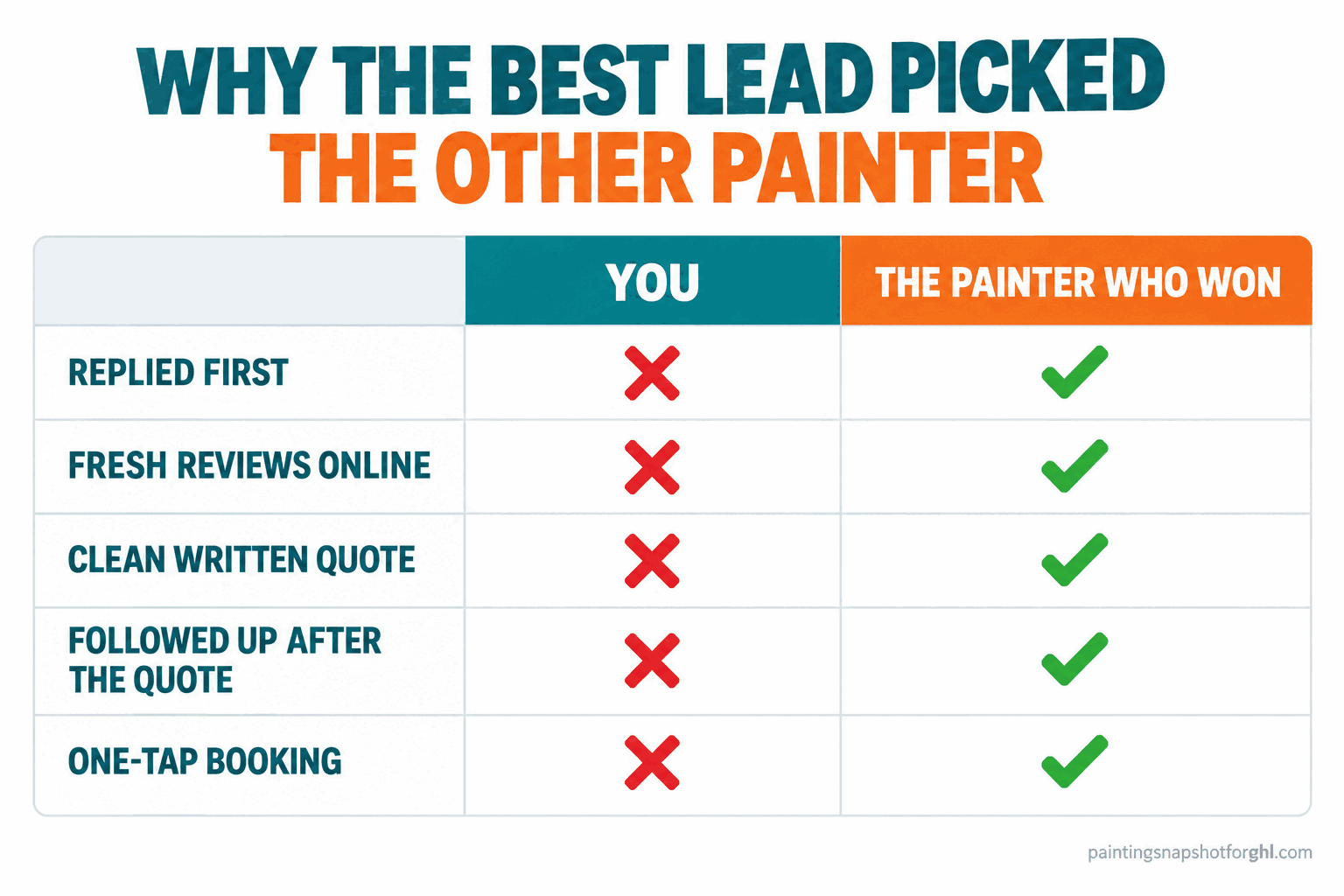
Usually because another painter won one of six small moments: he replied first, looked more trustworthy online, sent a cleaner and clearer quote, actually followed up after the quote, made booking easy, or simply had the fresh reviews that made him feel like the safe choice. A homeowner with a real budget is buying confidence, not the lowest bid, so the painter who makes the whole process feel easy and low-risk tends to win even at a fair price.
How fast do I really need to respond to win the good leads?
As close to instant as possible, and within five minutes at the outside. A serious buyer contacts two or three painters at once, and the classic lead-response study found replying within five minutes made a company about 21 times more likely to qualify a lead than waiting thirty minutes. Since you cannot personally reply that fast while painting, an automated text that fires the moment a lead lands is the practical way to be first.
Do online reviews actually matter for a painting business, or is that overblown?
They matter a lot, especially for high-value jobs. BrightLocal's 2025 survey found only about 4 percent of consumers never read online reviews, and 74 percent check at least two review sites before deciding. A careful buyer who is about to spend five figures will absolutely look you up, and a thin or stale review profile reads as risky even when your work is excellent. Fresh, deep reviews are what make you look like the safe choice.
What makes a painting quote look professional enough to win?
Clarity. The winning quote is rarely the lowest, it is the one that spells out the scope, the prep, the paint, what is and is not included, a clear price with a validity window, and an obvious next step to book. A vague verbal number texted late at night reads as a guess and makes a careful buyer nervous. A clean written quote, sent the same way every time, reads as someone who has done this a hundred times.
How many times should I follow up on a quote before giving up?
Two or three touches over about ten days, spaced out and automated so they fire whether or not you remember. A friendly check-in on day two, a gentle nudge about filling dates around day five, and a graceful I-will-close-this-out message around day ten. That last message pulls the most replies because it gives a busy buyer a reason to answer now instead of someday. More than that in a short window starts to feel like a telemarketer.
Is it legal to send automated texts to homeowners who requested a quote?
Yes, when done correctly. A homeowner who asked you for an estimate gives you a reasonable basis to text about that project under the TCPA. Keep messages relevant, honor STOP replies promptly, and register your number and campaigns under A2P 10DLC so carriers do not filter your texts. Also check your state's advertising rules, California, for example, requires your contractor license number on your advertising, which includes the website feeding the system.