
If your painting website takes more than three seconds to load, more than half your Dallas visitors are already gone — back to Google, tapping the next painter’s ad. That isn’t an opinion; it’s Google’s own data: 53% of mobile visits are abandoned when a page takes longer than 3 seconds to load (Think with Google, 2018). In a market as crowded as Dallas–Fort Worth — where a homeowner searching “house painter near me” has a dozen results one thumb-tap apart — the fastest site doesn’t just rank better, it books the estimate. This post breaks down exactly how much a slow site costs a painting contractor, what the 2026 speed and Core Web Vitals data actually say, and how to fix it without hiring a developer by the hour.
In this post
- The three-second cliff, in Dallas terms
- How much a slow site actually costs a painter
- Speed is now a Google ranking factor (Core Web Vitals)
- Why painting websites get slow in the first place
- Speed-to-page meets speed-to-lead
- How to fix it: a lighter, faster site
- What a fast Dallas painting site looks like
- Frequently asked questions
The three-second cliff, in Dallas terms
Picture a homeowner in Plano whose living room is peeling. It’s 8 p.m., they’re on the couch with their phone, and they search “interior painters near me.” They tap the first three results. Two load instantly. Yours — built on a page builder, stuffed with plugins, hosted on a slow shared server — spins for four seconds on a screen showing nothing but a blank white box.
They’re gone before your logo even appears.
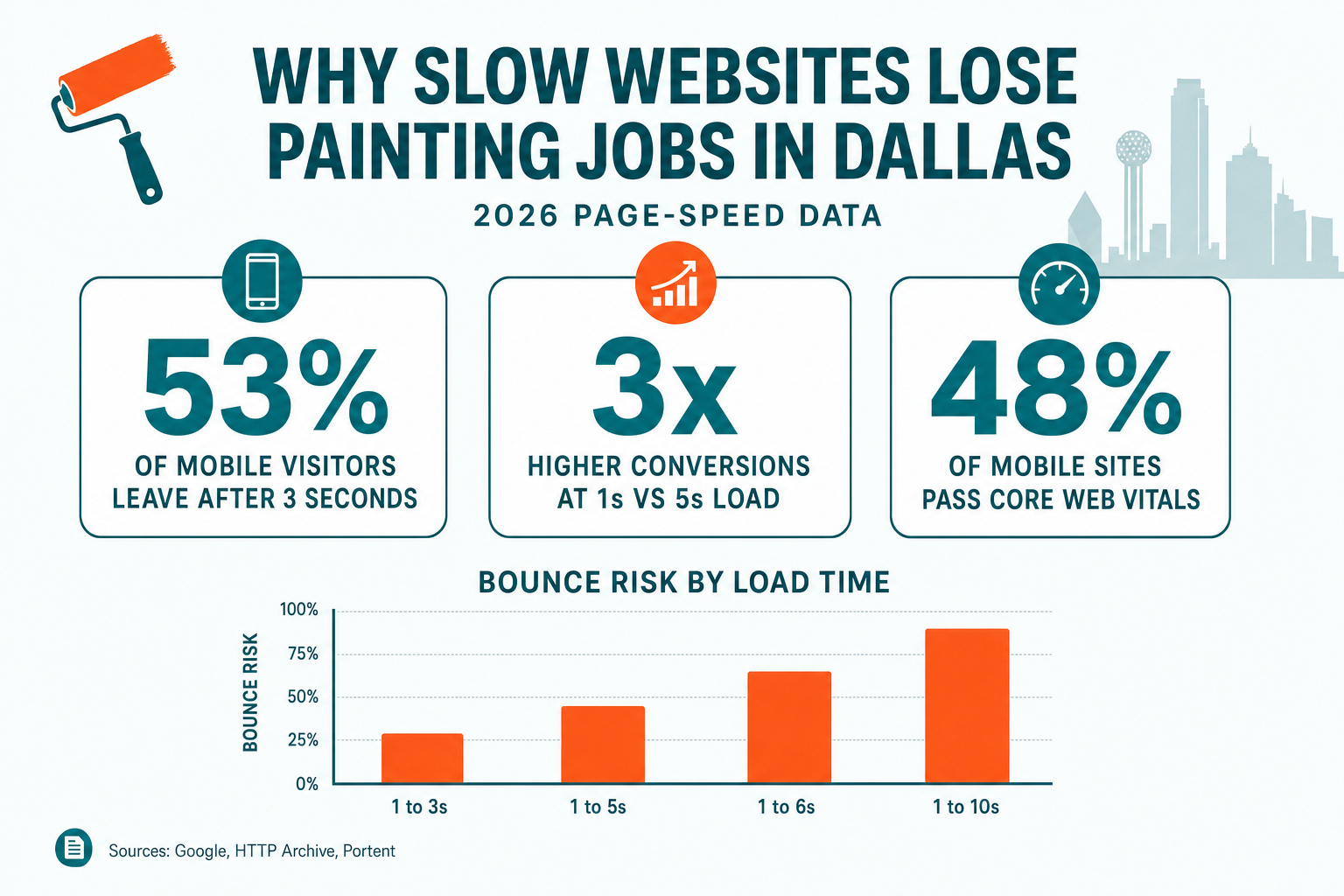
That’s not a hypothetical, it’s the single most-cited number in web performance: 53% of mobile site visits are abandoned if the page takes longer than three seconds to load (Think with Google, 2018). And it gets worse the slower you go. Google’s research with SOASTA mapped the exact curve: as page load time climbs from one second to five, the probability that a visitor bounces increases by 90% — and by 123% by the time you hit ten seconds (Think with Google).
Increase in the probability that a mobile visitor bounces as page load time slows. Going from a 1-second to a 5-second load raises bounce probability by 90%. Source: Google / SOASTA via Think with Google.
Here’s why this matters more in Dallas than almost anywhere: the traffic is overwhelmingly mobile and overwhelmingly local. 76% of people who run a “near me” search on a smartphone visit a related business within 24 hours, and 28% of those searches end in a purchase (Think with Google). These aren’t tire-kickers researching for a rainy day — they have peeling siding, a move-out deadline, or an HOA letter, and they’re picking a painter today. If your site makes them wait, the next contractor gets the call.
How much a slow site actually costs a painter
It’s tempting to treat page speed as a technical detail — something for “the website guy” to worry about. But for a painting business, slow load time is a direct, measurable leak in your job pipeline. Two numbers make it concrete.
First, conversions. Portent studied more than 100 million page views across 20 sites and found that a site loading in 1 second has a conversion rate roughly three times higher than a site loading in 5 seconds (Portent, 2022). Same visitors, same offer — the only variable is how fast the page appeared. For a painting shop, “conversion” is a submitted estimate form or a tapped call button. Triple that rate and you’ve tripled your booked estimates without spending another dollar on ads.
Second, the margins are razor-thin. Google and Deloitte’s Milliseconds Make Millions study analyzed 30 million user sessions across 37 brands and found that improving mobile site speed by just 0.1 seconds lifted retail conversion rates by 8.4% and increased average order value by 9.2% (Deloitte + Google, 2020). One tenth of a second. If a fraction of a second moves the needle that much, a four-second painting site is bleeding jobs you never even see.
Put it against the size of the prize. The US house-painting industry is a $28.2 billion market with roughly 223,209 contractor businesses (IBISWorld, 2025). In a metro like Dallas–Fort Worth, dozens of those shops are bidding for the same homeowner’s attention in the same three-second window. Speed is one of the few advantages you can actually buy outright.
Speed is now a Google ranking factor (Core Web Vitals)
Losing impatient visitors is only half the damage. The other half is that Google uses page speed to decide who ranks in the first place.
Since 2021, Core Web Vitals have been part of Google’s page-experience ranking systems. They measure three things about the real experience of loading your site (Google Search Central):
- Largest Contentful Paint (LCP) — how fast the main content appears. “Good” is under 2.5 seconds (web.dev).
- Interaction to Next Paint (INP) — how responsive the page feels when tapped. “Good” is under 200 milliseconds.
- Cumulative Layout Shift (CLS) — how much the page jumps around while loading. “Good” is under 0.1.
These are measured on real visitors — the 75th percentile of actual Chrome users hitting your site, not a lab test. And here’s the uncomfortable reality for most painting contractors: only about 48% of mobile sites pass all three Core Web Vitals, with LCP the most common failure — just 62% of mobile pages clear that 2.5-second bar (HTTP Archive, 2025).
Share of real-world sites passing Core Web Vitals in 2025. Fewer than half of mobile sites pass all three — a ranking liability most contractors don’t know they have. Source: HTTP Archive Web Almanac 2025 (Chrome UX Report data).
If half the web is failing, then simply passing is a ranking edge over your slower competitors. It also feeds everything else that matters locally: Google is the channel 83% of consumers use to find local businesses (BrightLocal, 2025), so where you land in Google’s results is close to the whole ballgame. A fast site is the foundation your local SEO for painters is built on — reviews, location pages, and schema all work harder when the site underneath them loads instantly.
Why painting websites get slow in the first place
Most contractor sites aren’t slow because the owner did anything wrong. They’re slow because of how they were built. The typical painting website is a WordPress, Wix, or GoHighLevel page-builder site, and those platforms pay for their drag-and-drop convenience in weight.
The 2025 HTTP Archive data tells the story: the median web page now ships about 697 KB of JavaScript and weighs 2.56 MB on mobile (HTTP Archive, 2025). Every plugin, every page-builder widget, every tracking script, and every carousel adds more code the visitor’s phone has to download and run before it can show anything. On a mid-range Android over a Dallas suburb’s LTE connection, that adds up fast — which is why the average mobile page takes 27.3 seconds to fully load (Backlinko).
A static-first site flips that model. Instead of assembling every page on the fly from a database and a stack of plugins, it serves pre-built HTML from a global edge network — with almost no JavaScript to download. That’s the entire reason our painting websites are built on the Astro framework: less code shipped means faster paint, which means the homeowner sees your estimate button before they lose patience.
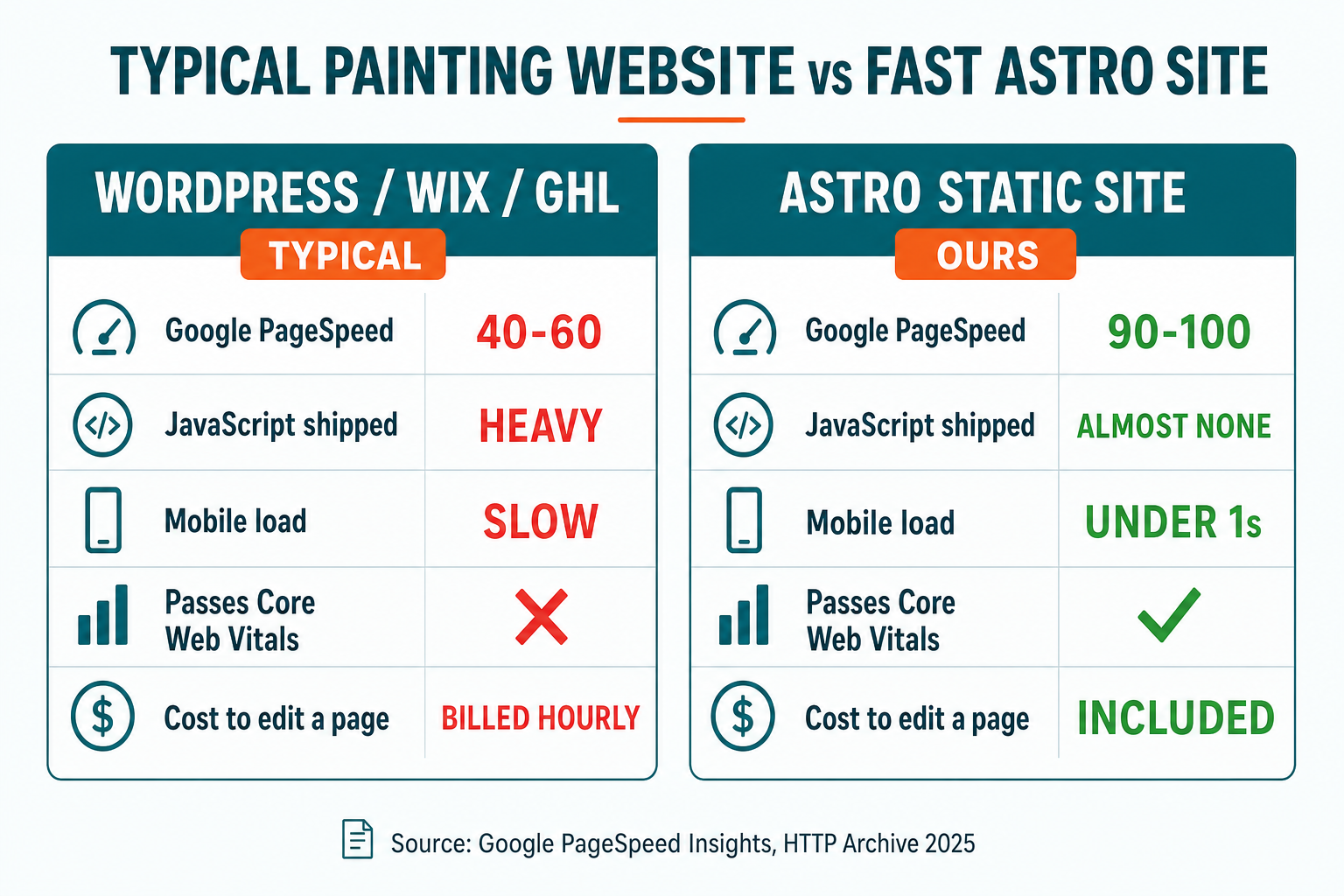
Typical page-builder painting sites carry plugin and page-builder overhead that a static-first Astro build sheds — the difference between a homeowner waiting and a homeowner booking.
| What the homeowner’s phone deals with | Typical WordPress / Wix / GHL site | Static Astro site (ours) |
|---|---|---|
| Google PageSpeed score | Often 40–60 | 90+ guaranteed (often 100) |
| JavaScript shipped | Heavy — plugins + page builder (~697 KB median) | Almost none — static-first |
| Where pages are served | Shared origin server | Global edge (Cloudflare) |
| Mobile LCP (main content) | Frequently > 2.5s (fails CWV) | Well under 2.5s |
| Editable meta, schema & llms.txt | Limited / plugin-dependent | Built in for SEO/AEO/GEO |
| Cost to change a page | Often billed by the hour | Included in $97/month |
PageSpeed and JavaScript figures reflect typical page-builder builds vs. our static Astro build; median JS payload from HTTP Archive, 2025. Our 90+ PageSpeed figure is the guarantee on our painting websites.
Speed-to-page meets speed-to-lead
Here’s the part most painters miss: a fast website and fast lead response are the same problem, one after the other. Getting the homeowner onto the page fast is worthless if the inquiry they submit then sits unanswered for an hour.
The speed-to-lead data is just as brutal as the page-speed data. The landmark MIT/InsideSales study of 1.25 million leads found that companies that respond within five minutes are 21× more likely to qualify the lead than those who wait 30 minutes (reported by Harvard Business Review). And 78% of customers buy from the company that responds first (Vendasta). A blazing-fast site that captures the lead, followed by a form that emails you and gets answered “sometime tomorrow,” still loses the job.
How to fix it: a lighter, faster site
You don’t need to become a performance engineer. You need a site that was built light from the start. If you’re auditing your current painting website, this is the short list that actually moves Core Web Vitals:
- Test it honestly. Run your homepage and a service page through Google PageSpeed Insights on the mobile tab. That’s the score Google actually uses. Under 90 on mobile means you’re leaving jobs on the table.
- Cut the JavaScript. Every unused plugin, chat script, and page-builder widget is download-and-run weight. On a page-builder platform, there’s a hard ceiling to how much you can cut — the framework itself is the weight.
- Serve from the edge. Static HTML delivered from a global CDN loads in a blink versus a page assembled on a shared server on every visit.
- Right-size images. Images are the single biggest contributor to page weight (HTTP Archive, 2025). Modern formats and proper sizing matter.
- Stop the layout jump. Reserve space for images and headers so the page doesn’t shift as it loads — that’s your CLS score, and it’s what makes a fast page still feel janky.
The honest truth: on a plugin-heavy WordPress or a page-builder platform, you can chase these one by one and still get stuck at a 55. The framework is the bottleneck. That’s why a growing number of Dallas contractors are moving to a static-first build instead of endlessly tuning a slow one — it’s the difference between patching a slow system and starting with a fast one.
What a fast Dallas painting site looks like
Speed isn’t the goal by itself — booked estimates are. But every downstream number depends on the page loading fast enough that the homeowner sticks around. Here’s the chain, start to finish, for a Dallas painting shop:
- A homeowner in Frisco searches “cabinet refinishing near me” at night on their phone.
- Your static Astro site loads in under a second from the edge — no white screen, no spinner.
- Because it passes Core Web Vitals, Google was already more willing to rank it in that “near me” list (Google).
- The page shows a clear estimate form and a tap-to-call button above the fold. The AI chat widget offers to answer a question instantly.
- The lead is captured and an automatic text goes back within seconds — hitting the 5-minute window that makes a lead 21× more likely to qualify (HBR).
Every link in that chain is a place a slow, heavy site breaks — and every one is a place a fast one wins. In a metro as competitive as Dallas–Fort Worth, the painter with the faster site simply gets more at-bats, and converts more of them. It’s not the flashiest advantage in your marketing, but it might be the cheapest one you can buy.
If you’d rather not manage any of this yourself, that’s the whole point of our done-for-you painting websites — we build it fast, host it, and keep it fast, so you can stay on the ladder instead of in the WordPress dashboard. Prefer to talk it through first? Book a quick call or see all our pricing.
Frequently asked questions
How fast should a painting website load?
Aim for your main content to appear in under 2.5 seconds on mobile — that's Google's 'good' threshold for Largest Contentful Paint, one of the Core Web Vitals ranking signals. Ideally you want a full load closer to 1 second, because Google's data shows 53% of mobile visitors abandon a page that takes longer than 3 seconds, and sites loading in 1 second convert about 3× better than those loading in 5.
Does website speed really affect my Google ranking in Dallas?
Yes. Core Web Vitals — which measure load speed, responsiveness, and visual stability — have been part of Google's page-experience ranking systems since 2021. In a competitive local market like Dallas, where only about 48% of mobile sites pass all three Core Web Vitals, simply having a fast site that passes is a ranking edge over slower local competitors. Speed also amplifies your local SEO, reviews, and location pages.
Why is my WordPress or Wix painting site so slow?
Page-builder and plugin-heavy platforms ship a lot of JavaScript — the 2025 median page carries roughly 697 KB of JS and weighs 2.56 MB on mobile. Every plugin, widget, and tracking script is more code the visitor's phone must download and run before anything appears. There's a hard ceiling to how fast a plugin-heavy site can get; the framework itself is the bottleneck, which is why static-first sites are dramatically faster.
What is a good Google PageSpeed score for a contractor website?
On the mobile tab of Google PageSpeed Insights, aim for 90 or above — that's the range associated with passing Core Web Vitals. Many contractor sites score in the 40–60 range without realizing it. Our Astro-built painting websites guarantee a 90+ PageSpeed score, and often hit a perfect 100, on both mobile and desktop.
How much does a fast painting website cost?
Our done-for-you painting websites are $497 one-time plus $97/month. The monthly covers managed edge hosting, your domain, SSL, an AI chat widget, and ongoing updates — no per-edit agency fees. You pay only the monthly invoice up front; the one-time build fee isn't charged until the site is live and you're satisfied. Add automatic blogging for $197/month total, or rebrand up to 5 sites for $1,200 one-time + $297/month.
Will a faster site help if I run Google Ads or Local Services Ads?
Significantly. You pay for every click regardless of how fast your landing page is, but a slow page means fewer of those paid clicks turn into submitted estimates — so your true cost per booked job rises. Improving page speed is one of the cheapest conversion-rate improvements available, and it lifts the return on every ad dollar you already spend.
Rachel has spent the better part of a decade helping home-service companies turn scattered marketing into predictable pipeline. She started in agency life managing Google and Facebook lead-gen for painting and remodeling clients, then went all-in on automation when she realized the real leak was follow-up, not ad spend. She writes about review harvesting, reputation, local ranking, and the messaging — and the fast websites — that get a homeowner to pick up the phone.
Related posts
- Local SEO for Painters: How to Rank in the Map Pack
- How Much Does a Painting Lead Actually Cost?
- Missed-Call Text-Back for Painters: Never Lose a Lead to Voicemail
- Stop Losing Painting Leads After Hours
- 5 Painting Automations Every Contractor Should Be Running
Painting Snapshot builds done-for-you GoHighLevel automation systems and fast Astro websites for house painting contractors. We are not a painting company and do not perform painting work or quote project pricing. Page-speed, Core Web Vitals, and conversion figures above are drawn from the cited third-party sources (Google, Deloitte, HTTP Archive, Portent, HBR, IBISWorld, BrightLocal) and reflect general industry benchmarks, not a guarantee of results for any specific site. Website pricing reflects current published terms and may change — verify on our Get a Website page.