Here’s the honest answer most agencies won’t give you: for a working Phoenix painting contractor, doing your own social media is only “cheaper” if your time is worth nothing — and it usually isn’t the posting that fails, it’s the consistency. A homeowner in Ahwatukee comparing painters will scroll your Instagram, your Facebook, and your Google profile before they ever call. If your last post is from March, they assume you’re slow, out of business, or not worth the risk. This post lays out the real 2026 numbers — the hours DIY actually eats, what an in-house hire costs, why short-form video is the format that reaches new homeowners, and where DIY quietly leaks booked jobs — so you can decide honestly whether to run it yourself or hand it off.
In this post
- DIY or done-for-you? The real question is whether it gets done
- Why Phoenix homeowners check social before they call a painter
- What “doing it yourself” actually costs
- The Reels problem: the best content is the hardest to make
- DIY vs done-for-you: an honest side-by-side
- Where DIY quietly leaks jobs: comments and DMs
- What a done-for-you setup looks like for a Phoenix painter
- The honest math: when each option wins
- Frequently asked questions
DIY or done-for-you? The real question is whether it gets done
Painting is one of the most competitive local trades in the country. The US house-painting industry is a $28.2 billion market spread across roughly 223,000 contractor businesses (IBISWorld, 2025) — and metro Phoenix is one of its hottest arenas. The Phoenix–Mesa–Chandler metro added 59,065 residents in a single year to reach 5,228,938 people, the tenth-largest metro in the country and fourth in raw numeric growth (US Census data via ABC15, 2025). More new homeowners means more repaint demand — and more painters fighting for the same feed space.
So the DIY-vs-done-for-you decision isn’t really about who can post a photo. Anyone can post a photo. The decision is about who can keep posting, on every platform, every week, for months — and answer fast when a homeowner reaches out. That’s the part that breaks down when you’re on a ladder in Scottsdale by 7 a.m. The honest framing: DIY is free in dollars and expensive in the one thing a growing painting shop has least of — the owner’s attention.
Why Phoenix homeowners check social before they call a painter
Before a homeowner in Chandler or Tempe books an estimate, they vet you. Social media is now a core part of that vetting. BrightLocal’s 2025 survey found that consumers routinely use social platforms to research and review local businesses: 40% use Facebook, 34% use Instagram, 34% use YouTube, and 23% use TikTok for that purpose (BrightLocal, 2025). Google still leads for reviews at 83%, and 41% of consumers consult three or more sources before deciding — so your Instagram grid isn’t competing with nothing, it’s one of several tabs a homeowner has open while they choose.
Share of consumers who use each social platform to research or review local businesses in 2025. Your feed is part of the homeowner’s shortlist. Source: BrightLocal Local Consumer Review Survey 2025.
The attention is there to win. Americans now number 253 million social media user identities — about 73% of the population — spending an average of 2 hours 16 minutes a day on social platforms (DataReportal, Digital 2025: USA). And that attention converts: Sprout Social’s 2024 research found 49% of consumers make daily, weekly, or monthly purchases because of what they see in social posts (Sprout Social, 2024). For a painter, “the painter I keep seeing do beautiful cabinet jobs in my neighborhood” is a powerful nudge when it’s finally time to call.
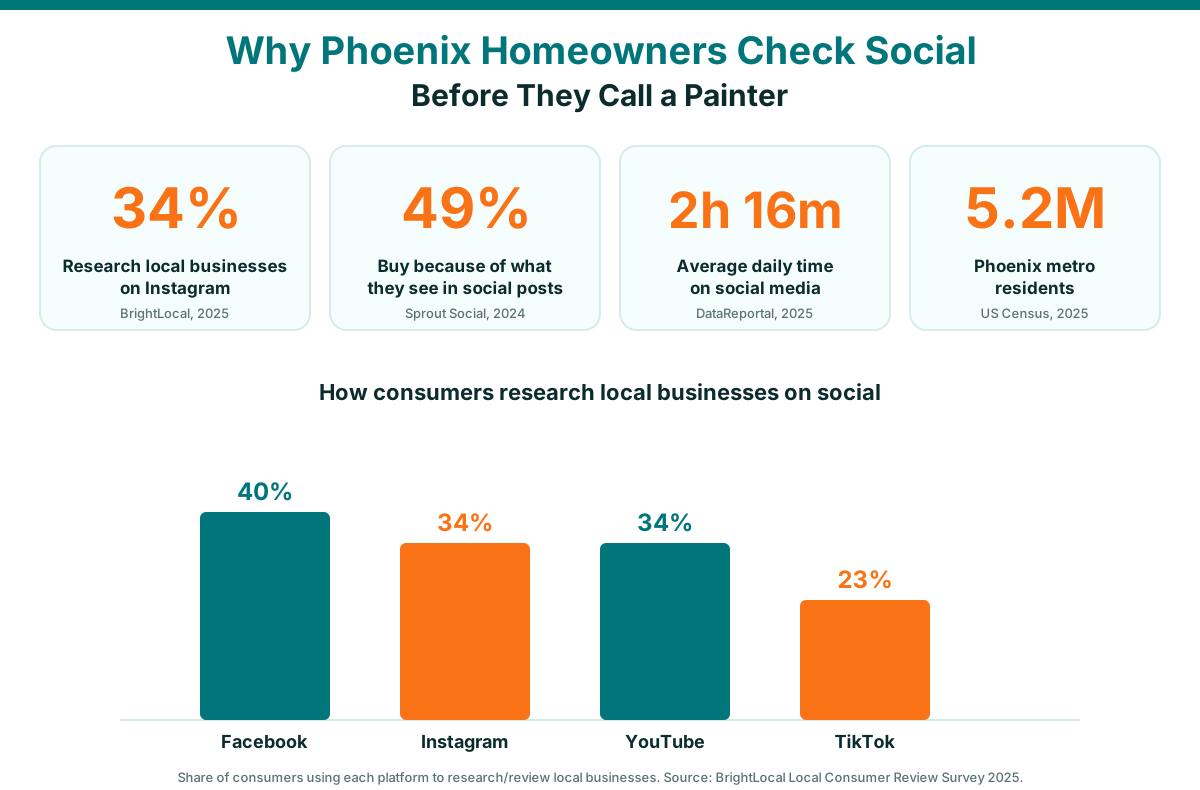
The homeowner attention is already on social — the question is whether your painting company is visible and active when they look. Figures: BrightLocal 2025, Sprout Social 2024, DataReportal 2025, US Census 2025.
The uncomfortable flip side: if a homeowner opens your profile and the newest post is four months old, that silence is itself a signal. It says “not busy” or “not around,” and they move to the painter whose feed looks alive. Consistency isn’t a vanity metric here — it’s a trust signal that either passes or fails in about three seconds.
What “doing it yourself” actually costs
DIY social media feels free because there’s no invoice. But the cost is real; it’s just paid in hours and in the jobs you didn’t quote because you were editing a Reel instead. One small-business survey found 43% of owners spend roughly 6 hours a week on social media marketing (VerticalResponse). Six hours is not a rounding error for an owner-operator — it’s the better part of a working day, every week, spent on captions and cropping instead of estimates, prep, and crew management.
Now weigh the alternatives on cost. Hiring the work in-house is the most expensive path: the average US social media manager salary is about $71,545 a year (Glassdoor, 2026) — and that’s one person who still can’t shoot, edit, design, and answer DMs at a professional level. Outsourcing to an agency or freelancer typically runs $500 to $5,000 a month depending on scope (Sprout Social; WebFX). The spread is the whole story: what you pay depends entirely on how much actually gets done, and by how many specialists.
Annual cost of one in-house social media manager vs. a done-for-you painting social package for a single brand. The in-house hire is one generalist; the package is a whole content team plus AI agents. Sources: Glassdoor, 2026; Painting Snapshot social pricing.
There’s a third cost that never shows up on a spreadsheet: the quality gap. A single owner posting between jobs can manage a phone photo and a caption. They generally cannot also produce a color-graded before/after Reel, a swipeable “how we prep before we paint” carousel, and a branded color-of-the-season graphic — cropped and captioned differently for nine platforms — every week without fail. That gap is exactly where jobs are won and lost, because the highest-performing content is also the hardest to make.
The Reels problem: the best content is the hardest to make
If there’s one thing the 2026 data agrees on, it’s that video is the format that reaches new people. Wyzowl’s State of Video Marketing 2025 reports that 89% of businesses use video as a marketing tool, 93% say it delivers a good ROI, and 87% say video has directly helped increase sales (Wyzowl, 2025). Short-form vertical video — Reels, TikToks, YouTube Shorts — is the tip of that spear, and marketing analyses consistently find Reels reach far more non-followers than static posts do; Later’s 2025 breakdown puts Reels at roughly 2.25× the reach of a static image post (Later, 2025).
How businesses rate video marketing in 2025 (share of respondents). Painting transformations are among the most watchable content online — but only if someone cuts the footage. Source: Wyzowl, State of Video Marketing 2025.
Here’s the painting-specific opportunity, and the painting-specific trap. Painting is made for video — a peeling exterior becoming crisp, a dated kitchen going from oak to bright white, a fence restored in thirty seconds. That’s some of the most naturally shareable content there is, and a single breakout transformation Reel can put your Phoenix shop in front of thousands of local homeowners who never followed you. But a great Reel isn’t a raw clip. It’s footage shot at the right moments, trimmed to the satisfying beats, captioned, scored, and branded. That is precisely the work a painter running a crew has zero time and, usually, zero tooling for. So the highest-ROI content is the first thing DIY drops — which is why so many painter feeds are a graveyard of blurry “finished job” photos and nothing that actually travels. (For the organic-tactics side of this, see our guide to Instagram marketing for painters.)
DIY vs done-for-you: an honest side-by-side
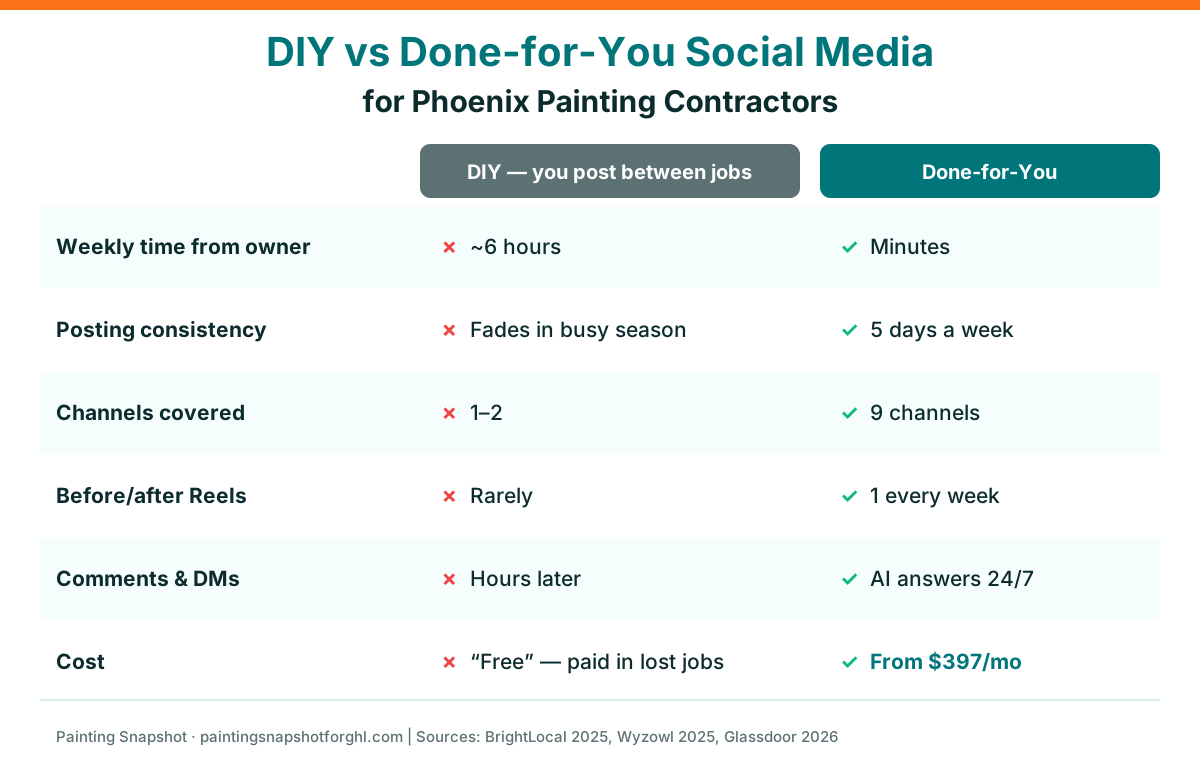
Neither option is automatically right. DIY keeps costs at zero and your voice unmistakably yours; done-for-you buys back your time and closes the consistency and video gaps. Here’s the honest comparison for a working painting contractor:
| What it takes to win | DIY (you post between jobs) | Done-for-you (our painting package) |
|---|---|---|
| Weekly time from you | ~6 hours you don’t have (survey) | Minutes — send us job photos and clips |
| Posting consistency | Fades the first busy season | 5 days a week, every week |
| Channels covered | Usually 1–2 you can keep up with | 9 (FB, IG, GBP, LinkedIn, TikTok, YouTube, Pinterest, Threads, Bluesky) |
| Short-form video / Reels | Rarely — no time to edit | 1 branded before/after reel weekly |
| Comments & DMs answered | Hours or days later, if at all | AI agents reply 24/7 and book estimates |
| Design & branding | Phone photo + caption | Designer, editor, copywriter, community manager |
| Typical cost | “Free” — paid in your hours & lost jobs | From $397/mo, one flat rate |
| White-label / resale | N/A | Yes — run multiple brands or resell |
Weekly-time and video figures reflect the sources cited above; package details reflect current published terms on our social media service page.
Where DIY quietly leaks jobs: comments and DMs
Posting gets you seen. Answering gets you booked — and this is the single biggest hole in DIY. Every “how much to paint a 2,000 sq ft exterior?” comment and every “are you taking jobs in Gilbert?” DM is a live lead with a clock on it. The classic Harvard Business Review analysis of lead response found that companies contacting a web lead within an hour were about 7× more likely to qualify it than those who waited even an hour longer — and 60× more likely than firms that waited 24 hours or more (HBR, 2011). The widely-cited MIT/InsideSales “5-minute rule” pushes it further, putting a five-minute response at roughly 21× more likely to qualify than a 30-minute one.
For a DIY painter, that clock is brutal. You see the comment at 8 p.m., you’re exhausted, you tell yourself you’ll answer tomorrow — and by tomorrow the homeowner has messaged three painters and booked with whoever replied first. The lead didn’t cost you money. It cost you the job.
What a done-for-you setup looks like for a Phoenix painter
Done-for-you doesn’t mean “we post a stock photo twice a month.” For a painting contractor it means an entire content team and an answering layer, running on your behalf while you stay on the job. Here’s the engine our painting social media package runs, per brand:
- A full weekly content set: 1 Q&A text post, 1 branded image, 2 swipeable carousels, and 1 short before/after Reel — published 5 days a week across all 9 channels, cropped and captioned for each.
- Your job photos become the content. You send before/after shots and clips from the site; we cut, caption, brand, and schedule them into scroll-stopping posts and Reels.
- Three AI agents catch every lead: a Comment agent that replies under your TikTok, Instagram, and Facebook posts; a DM agent that answers Facebook and Instagram messages, qualifies the homeowner, and books the estimate; and a Web Chat agent on your site that turns anonymous traffic into booked jobs — all in your brand voice, 24/7.
- Everything lands in one CRM with your own login, so every lead’s name, number, address, and the appointment the AI booked is visible to you, and syncs to your Google Calendar.
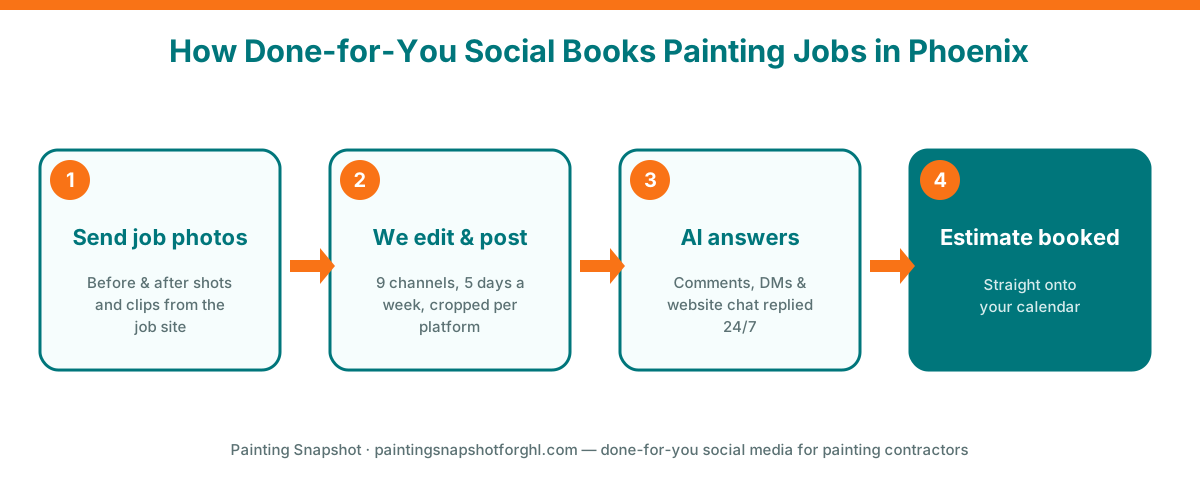
The done-for-you loop for a Phoenix painting company: your job photos in, consistent multi-channel content out, every comment and DM answered, estimates booked automatically.
Because the content ships every weekday across nine platforms, you get dozens of at-bats a month at a breakout post — and painting transformations are some of the most shareable content online. Organic reach compounds: the honest timeline is meaningful inbound in roughly three to five months as the algorithms start surfacing your work to new local homeowners, with a single viral Reel able to move faster.
The honest math: when each option wins
We build this system for a living, so take the recommendation with that in mind — but here’s the genuinely honest breakdown.
DIY makes sense when: you’re a brand-new solo painter with more time than jobs, you genuinely enjoy making content, and you can commit to a real posting rhythm for at least six months. If you’ll actually shoot the video, edit it, post to a couple of channels consistently, and answer DMs the same day, DIY can absolutely work — and it keeps your voice unmistakably authentic.
Done-for-you wins when: you’re booked enough that six hours a week is real money, you keep meaning to post and don’t, your feed goes quiet the second summer hits, or you know Reels would help but you’ll never cut them yourself. At $397/month, the package costs less than a fifteenth of an in-house salary and a fraction of what those six weekly hours are worth once you’re busy — and it fixes the two things DIY reliably breaks: consistency and response speed. For most established Phoenix painting contractors, that’s the math.
Whichever way you go, the principle is the same: homeowners hire the painter who is visibly active and answers fast. If you can be that painter yourself, do it. If your job site can’t spare you, hand the feed to a team built for painters — and keep quoting jobs. Want to talk it through first? Book a quick call or see all our pricing.
Frequently asked questions
Is it cheaper for a painting contractor to do social media themselves?
Only if your time is worth nothing. DIY has no invoice, but one small-business survey found 43% of owners spend around 6 hours a week on social media marketing — the better part of a workday you could spend quoting jobs. An in-house social manager averages about $71,545 a year, and agency or freelance management runs $500–$5,000 a month. A done-for-you painting package starts at $397/month, which is less than a fifteenth of an in-house salary and usually less than those weekly hours are worth once you're booked.
How many social platforms should a Phoenix painting company be on?
Homeowners research on several — 40% use Facebook, 34% Instagram, 34% YouTube, and 23% TikTok to check local businesses, per BrightLocal's 2025 survey — so being on only one leaves reach on the table. Realistically, a busy owner can keep one or two channels alive. A done-for-you setup publishes to all 9 (Facebook, Instagram, Google Business Profile, LinkedIn, TikTok, YouTube, Pinterest, Threads, and Bluesky) from one brand voice, cropped and captioned per platform.
Do Reels really matter for painters, or is it hype?
They matter. Video is the highest-reach social format — 93% of marketers say video delivers good ROI and 87% say it increased sales (Wyzowl, 2025), and Reels reach far more non-followers than static posts. Painting before/after transformations are naturally some of the most shareable content online, so a single strong Reel can put your shop in front of thousands of local homeowners. The catch is that a good Reel has to be shot and edited well — which is exactly the content DIY painters skip for lack of time.
What's the biggest risk of running social media myself?
Two things: inconsistency and slow replies. Feeds that go quiet during busy season read as 'not busy' to homeowners, and unanswered comments and DMs are lost jobs — a lead contacted within an hour is about 7× likelier to qualify than one answered later (HBR). Done-for-you services fix both by posting on a fixed schedule and using AI agents to answer comments, DMs, and web chats instantly, 24/7.
How fast will done-for-you social media get me painting jobs?
Organic growth compounds rather than switching on overnight. Expect meaningful reach and inbound estimate requests in roughly 3–5 months as the algorithms start surfacing your work to new local homeowners. Because content ships 5 days a week across 9 channels, a single before/after Reel can go viral much sooner. Anyone promising overnight results isn't being straight with you.
Do I have to hand over my social media passwords?
No. A reputable done-for-you service never needs your account passwords. During onboarding you connect your existing or newly created accounts to the social planning platform — that connection is all that's needed to publish for you, and you can disconnect anytime. You stay in full control, and every lead and appointment lives in a CRM you have your own login to.
Rachel has spent the better part of a decade helping home-service companies turn scattered marketing into predictable pipeline. She started in agency life managing Google and Facebook lead-gen for painting and remodeling clients, then went all-in on automation and content systems when she realized the real leak was consistency and follow-up, not ad spend. She writes about social media, review harvesting, local ranking, and the messaging that gets a homeowner to pick up the phone.
Related posts
- Instagram Marketing for Painters: Turn Before-and-After Photos Into Booked Jobs
- How to Get More 5-Star Painting Reviews on Autopilot
- Missed-Call Text-Back for Painters: Never Lose a Lead to Voicemail
- Local SEO for Painters: How to Rank in the Map Pack
- How Much Does a Painting Lead Actually Cost?
Painting Snapshot builds done-for-you GoHighLevel automation systems, fast Astro websites, and social media content for house painting contractors. We are not a painting company and do not perform painting work or quote project pricing. The social media, video, lead-response, cost, and market figures above are drawn from the cited third-party sources (BrightLocal, Sprout Social, Wyzowl, Later, VerticalResponse, HBR, Glassdoor, WebFX, IBISWorld, US Census, DataReportal) and reflect general industry benchmarks, not a guarantee of results for any specific painting business. Service pricing reflects current published terms and may change — verify on our social media and pricing pages.