

It is a Tuesday and you are scraping a 1962 front porch when the homeowner mentions the last painter got fined by the EPA. You laugh it off and finish the job. Six weeks later a competitor you underbid files a complaint: your truck wrap shows no license number, your quotes went out by text with no opt-in on file, and you never handed over a lead-paint pamphlet on that pre-1978 house. None of that was the painting. All of it can cost more than the job paid.
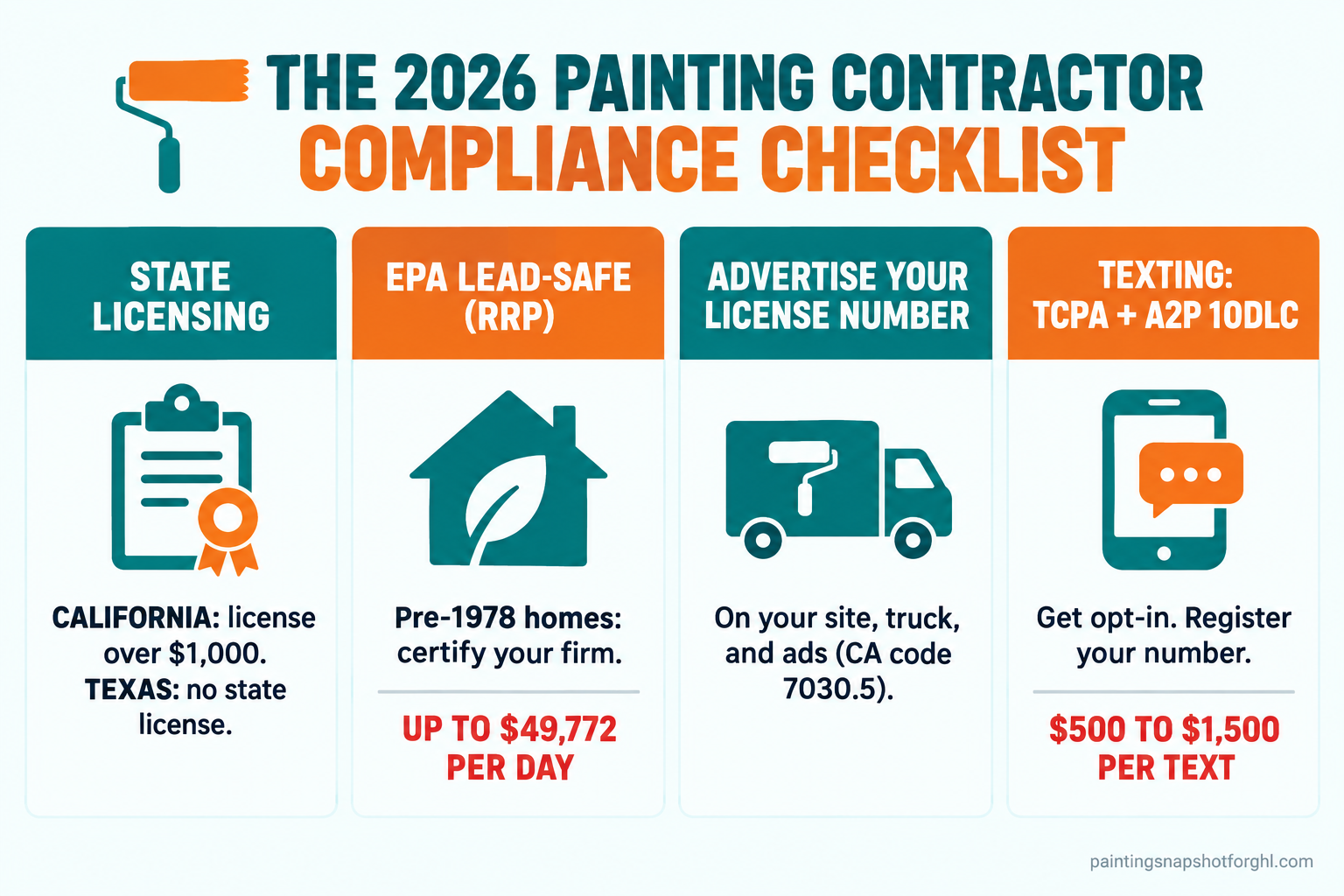
Here is the short version, because you are busy. Painting contractors have four compliance areas that actually get people fined in 2026: state licensing, the EPA lead-paint rule, how you advertise (license number placement), and how you text and call leads (TCPA and A2P 10DLC). None are hard once you know the rule. All are expensive to ignore. This guide walks each one, shows how it breaks, and hands you the real copy to stay legal.
What this guide covers
- What getting compliance wrong actually costs
- Do you even need a painting license?
- The EPA lead-paint rule that catches painters off guard
- Putting your license number where the law requires it
- Can you legally text and call your leads?
- Steal this: the consent, disclosure, and opt-out copy
- Three shops, three compliance realities
- Straight answers to the objections
- Frequently asked questions
What getting compliance wrong actually costs
Compliance feels like paperwork until it turns into a number. Here is the math on the two that hurt.
The EPA penalizes lead-paint violations under the Toxic Substances Control Act at nearly $50,000 per violation, per day, and each day counts as a separate violation (40 CFR 19.4 penalty table; 2025 inflation adjustment). That is not only for big firms. A one-man shop scraping an old porch without certification is exactly the case that gets flagged.
EPA RRP exposure stacks: nearly $50,000 per violation, per day. Figure from the TSCA Section 16(a) maximum in 40 CFR 19.4. Actual penalties depend on the case; this shows how the per-day structure adds up.
Texting is the sleeper. The Telephone Consumer Protection Act gives a consumer $500 for each unlawful message, and a court can treble that to $1,500 per message for a willful violation, with no cap (47 U.S.C. 227). It is a private right of action, so you are not fined by an agency. You are sued by the recipient, and every text in a blast is its own violation.
Statutory exposure for one non-compliant blast to 1,000 recipients, at the TCPA minimum ($500) and willful maximum ($1,500) per message. Source: 47 U.S.C. 227(b)(3). Settlements vary, but the per-message math is why one bad blast is business-ending.
You will never actually pay the theoretical maximum, and that is not the point. The point is that these are the only areas in a painting business where one careless afternoon can cost more than a year of profit, all avoidable with setup you do once.
Do you even need a painting license?
This is the question I get most, and the honest answer is: it depends on your state, and sometimes your city. There is no national painting license. Some states license painters tightly, some barely at all. Two examples show the spread.
California requires a Contractors State License Board license for most jobs. As of January 1, 2025, the threshold below which you can work unlicensed rose from $500 to $1,000 in total contract price, and only for casual or minor work needing no building permit (Business and Professions Code 7048, amended by AB 2622). Note the date: many sites still quote the old $500 figure or credit the wrong bill. If a repaint costs more than $1,000, which is nearly all of them, you need a license in California.
Texas sits at the other end. There is no state license to be a general contractor or a painter. As Austin’s Development Services puts it, “A State of Texas license is not required to be a General Contractor for a Building Permit” (City of Austin). Trades like electrical and plumbing are state-licensed through the Texas Department of Licensing and Regulation; painting is not. Individual cities may still make you register to pull permits.
The failure mode is assuming the next state works like yours. It does not. Unlicensed contracting where a license is required is no slap on the wrist: in strict states it can void your contract, block you from filing a lien, and in some places it is a misdemeanor. Check your own state board, find your threshold and permit rules, and write them down. Thirty minutes, once.
The EPA lead-paint rule that catches painters off guard
If you touch older homes, this is the rule most likely to bite you, because it is aimed at what you do for a living: disturbing paint.
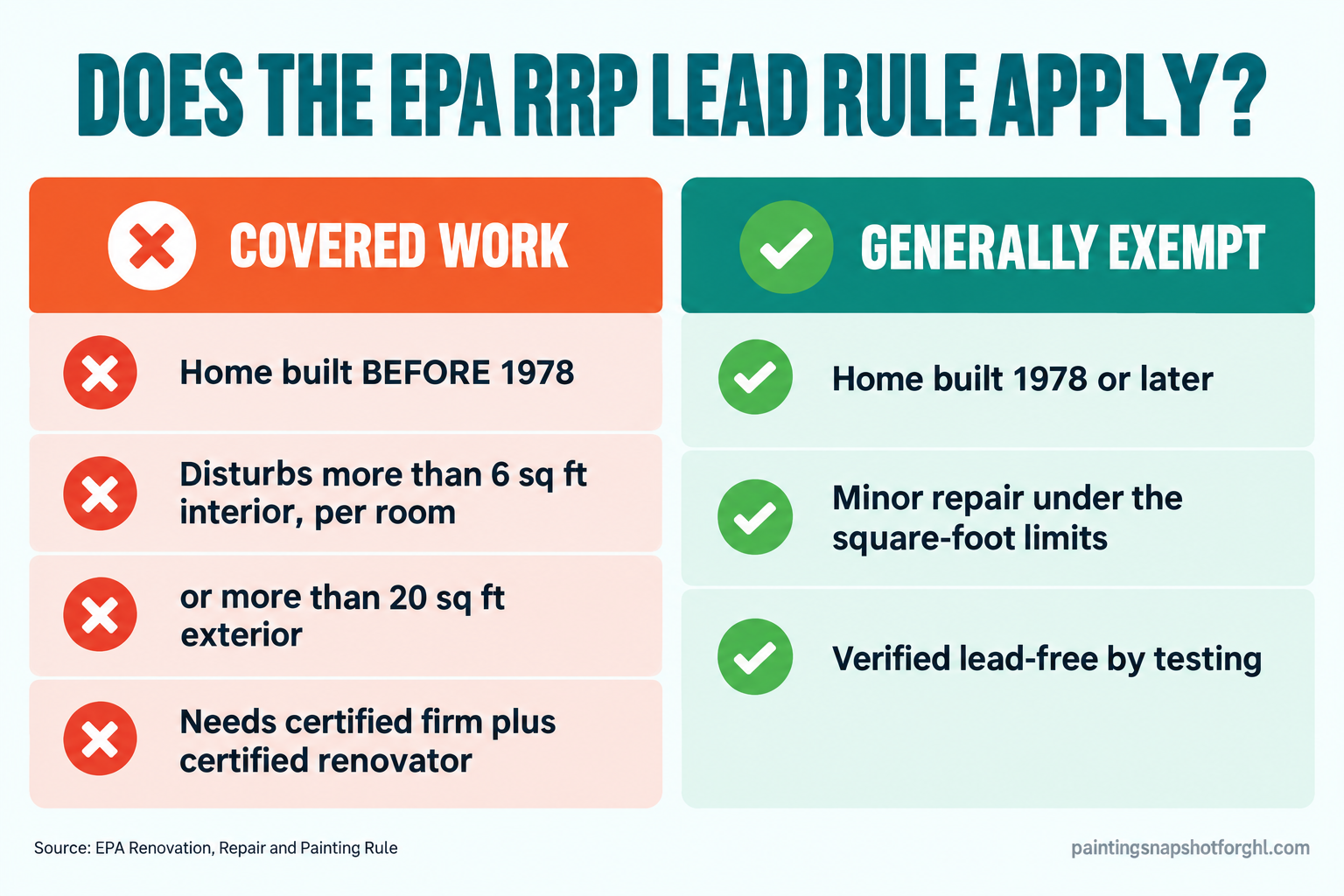
The EPA’s Renovation, Repair and Painting Rule (RRP) applies to paid work that disturbs paint in housing and child-occupied facilities built before 1978 (EPA RRP program). The trigger is how much paint you disturb. Work that disturbs more than 6 square feet of interior painted surface per room, or more than 20 square feet of exterior, is covered. Below that, minor repair is generally exempt. Sanding a whole exterior, scraping window trim, prepping walls for a repaint: almost always over the line on a pre-1978 house.
Why it matters this much: roughly three-quarters of US homes built before 1978 still contain some lead-based paint (EPA). You cannot tell by looking, and if the house predates 1978 and you have not confirmed it lead-free, the rule assumes lead is present.
What compliance requires, in plain terms:
- Your firm is EPA-certified (or certified by an EPA-authorized state program).
- The people running the job are certified renovators trained in lead-safe practices.
- You use lead-safe practices: contain the area, avoid prohibited methods like open-flame burning and uncontained power sanding, and clean up properly.
- You give the owner the EPA’s lead-hazard information before work starts, and keep records.
The failure mode is the friendly one. A homeowner with a 1950s house wants a quick refresh, you want the work, and nobody mentions lead. If that job goes sideways, the missing certification and pamphlet are what turn a normal repaint into an enforcement case. Getting your firm and renovator certified is a one-time cost, cheap next to the per-day penalties above. Start at the EPA’s contractor page.
Putting your license number where the law requires it
This one is too easy to fix to justify the fine it causes. Several licensing states require your license number to appear in your advertising. Holding the license is not enough. You have to show it.
California is the clearest example. Business and Professions Code 7030.5 requires the license number in “all construction contracts, subcontracts and calls for bid, and all forms of advertising” (Section 7030.5). Advertising means your website, Google Business Profile, truck wrap, yard signs, flyers, and paid ads. Miss it on any and you have a violation on every impression.
The fix is one-time. Put the number in your site footer so it shows on every page, in the header of your quotes, and on the truck. If you are having a new site built, bake it into the template so it is impossible to forget. This is one reason a purpose-built painting website beats a generic template: the compliance line is part of the layout, not an afterthought someone forgets. If your state requires it, audit every public place your business name appears and add the number. An afternoon, and a whole category of risk closed.
Can you legally text and call your leads?
Speed wins paint jobs, so you want to text a lead back the second the form comes in. Two rules apply, and painters trip on both.
Rule one: TCPA consent. The Telephone Consumer Protection Act governs marketing calls and texts. For promotional messages, the operative standard is prior express written consent before you send: a real opt-in tied to a clear disclosure, not a box you checked for them.
You may have heard about the FCC’s “one-to-one consent” rule that was supposed to tighten this in early 2025. So you do not act on bad information: that rule was vacated by the Eleventh Circuit on January 24, 2025, one business day before it would have taken effect, and the FCC then reinstated the prior standard (Insurance Marketing Coalition v. FCC). So the older, well-understood consent standard applies. Get a genuine opt-in, honor every STOP, and you are on solid ground.
Rule two: A2P 10DLC registration. This is the carrier-level rule that surprises people. In the US, business texting from a normal 10-digit number (Application-to-Person messaging) must be registered through The Campaign Registry: your brand and campaign both get vetted. Unregistered business texts get filtered or blocked, and carriers charge fees on the traffic (Twilio A2P 10DLC docs; The Campaign Registry). Painters who skip registration often think their system is broken when messages quietly never arrive. It is not broken. It is unregistered.
The failure mode across both rules is the “I imported my old leads and blasted them” move. Contacts you never got written consent from, sent through an unregistered number, is the recipe for both a delivery problem and legal exposure. Do it right on the front end instead. Our SMS automation and the approach in SMS marketing for painters both assume a registered number and a real opt-in, because anything else is a liability dressed up as a shortcut. Same with a fast missed-call text-back: an asset only when the number is registered and consent is on file.
Steal this: the consent, disclosure, and opt-out copy
Here is the actual language. Adapt it, run it past your attorney, and use it.
Form opt-in (next to the phone-number field, unchecked by default):
By providing your phone number and checking this box, you agree to receive automated and manual calls and text messages from [Your Painting Co] about your estimate, appointment, and related offers. Consent is not a condition of purchase. Message and data rates may apply. Reply STOP to opt out, HELP for help.
Your first automated text (to opted-in contacts, from a registered number):
Hi [First Name], this is [Your Name] with [Your Painting Co]. Thanks for requesting an estimate. What day this week works for a quick look at the project? Reply STOP to opt out.
The STOP reply (must send automatically):
You are unsubscribed from [Your Painting Co] and will receive no further messages. Reply HELP for help. No more messages will be sent.
The HELP reply:
[Your Painting Co]: For help call [phone] or email [email]. Msg&data rates may apply. Reply STOP to unsubscribe.
Advertising and contract line (footer, quotes, truck, in license states):
[Your Painting Co] | Licensed, Bonded & Insured | [State] License No. [#######]
Lead-paint acknowledgment (pre-1978 jobs, before work starts):
I received the EPA-approved lead-hazard information pamphlet for renovation work on this pre-1978 property before work began. Signed: ______ Date: ______
Wire the STOP and HELP replies into your CRM so they fire automatically, store each opt-in with a timestamp, and keep the lead-paint acknowledgment with the job file. That is most of your texting and lead-paint paperwork handled by a system instead of your memory.
Three shops, three compliance realities
The same rules land differently depending on your size. Here is how I would prioritize at three stages.
The solo operator. You are the crew, the salesperson, and the office. Your fastest wins: confirm your state license threshold and get licensed if you clear it, get yourself and your one-person firm EPA lead-certified if you touch older homes, and put your license number on your site and truck today. For texting, register one number and turn on the STOP and HELP autoreplies. Four one-time setups and a form that captures consent. No compliance department required.
The five-person crew. Now the risk is that someone other than you creates the violation. A crew lead prepping a 1955 exterior needs to be a certified renovator too. Your quotes go out from a template, so the license number and consent language live in the template, not in whoever typed the estimate. This is where a real CRM earns its keep: one registered number, opt-in captured on every lead form, STOP handled automatically, lead-paint acknowledgments stored per job. Written process beats memory the moment more than one person can bind the company.
The multi-crew or commercial shop. You are bidding jobs, running several trucks, maybe holding HOA and property-manager contracts. Exposure scales with volume: more ad surfaces carrying the number, more texts, more old homes. Treat compliance as a system you audit quarterly: every renovator’s certification current, every ad channel showing the number, your texting registered and consented, and records you could produce if asked. A shop this size absorbs the setup easily; what it cannot absorb is a stacked, per-day, per-message case built on sloppy records.
Straight answers to the objections
“I only do new construction, so the lead rule does not apply to me.” Correct, for genuinely post-1978 buildings. The moment you take a repaint on an older home, which most painters eventually do, you are back in scope. Know the 1978 line and ask the age of the house before you quote.
“Customers will hate an opt-in checkbox on my form.” They will not notice it. An unchecked consent line next to the phone field does not hurt conversion in any measurable way, and it is the difference between a lead you can legally text and one you cannot. The homeowner wants you to text them anyway. You are just documenting it.
“I’m in Texas, so none of this applies to me.” Licensing, maybe not at the state level. But the EPA lead rule is federal and applies in Texas like everywhere else, and the TCPA and A2P 10DLC texting rules are federal and carrier-level, so they apply no matter what state you paint in. Texas removes one item from the list, not four.
“My CRM handles compliance for me.” A good system handles the mechanical parts: store consent with a timestamp, fire the STOP and HELP replies, text from a registered number. It cannot get you EPA-certified, decide your license threshold, or put the number on your truck. Software closes the repetitive gaps. You still own the licenses and certifications.
“This is lawyer stuff and I can’t afford it.” Most of this list costs time, not legal fees: reading your state board’s page, getting certified, editing a footer, registering a number, adding a checkbox. Do the one-time setups first. Then, if your contracts make you nervous, a paid hour with a contractor attorney is far cheaper than the first violation.
Frequently asked questions
Do I need a license to paint houses?
It depends on your state and sometimes your city. There is no national painting license. California requires a Contractors State License Board license for jobs over $1,000 in total price (raised from $500 by AB 2622, effective January 1, 2025). Texas requires no state general-contractor license at all. Check your own state board's threshold and local permit rules before you quote.
What is the EPA RRP rule and does it apply to my jobs?
The Renovation, Repair and Painting rule covers paid work that disturbs paint in housing or child-occupied facilities built before 1978, above about 6 square feet of interior surface per room or 20 square feet of exterior. If you scrape, sand, or prep older homes, you likely need to be an EPA-certified firm using certified renovators and to give the owner the EPA lead pamphlet before work starts.
How much can a compliance violation actually cost?
EPA lead-paint violations can run to nearly $50,000 per violation, per day under the Toxic Substances Control Act, and each day is a separate violation. TCPA texting violations are $500 per message, trebled to $1,500 for willful ones, with no cap on the count. You will rarely pay the maximum, but that structure is why one careless job or blast is so dangerous.
Do I have to put my license number in my advertising?
In many licensing states, yes. California's Business and Professions Code 7030.5 requires the license number in all contracts, bids, and every form of advertising, which includes your website, Google Business Profile, truck wrap, and yard signs. The fix is a one-time change to your website template and signage. Confirm your own state's rule.
Is it legal to text my painting leads?
Yes, if you do two things. Get prior express written consent through a real opt-in before marketing texts (the TCPA standard, after the FCC's stricter one-to-one rule was vacated in January 2025), and register your business number through A2P 10DLC so carriers deliver your messages. Skip either and you get blocked messages or legal exposure.
Keep reading
Compare the tools painters actually shop in the best painting software guide for 2026, and turn finished jobs into 5-star reviews the compliant way with review harvesting.
Compliance is not the fun part of the business, but it is the cheapest insurance you will ever buy. Do the four setups once, wire the repeatable parts into a system so they happen without you thinking about them, and get back to the ladder. That Tuesday porch scrape never has to become a call from an inspector.