

It is 8:10 on a Tuesday morning and you are up a ladder cutting in a ceiling line. Your phone buzzes in your pocket. A homeowner two neighborhoods over just filled out the quote form on your website: kitchen, hallway, and two bedrooms, wants it done before the holidays. Good lead. Real job. You will call her back at lunch.
By lunch, she has booked someone else. Not because they were cheaper. Because they called her back at 8:14 while you were still holding a brush, and by 8:40 she had a ballpark number and a Thursday estimate booked. You called at 12:30 and got voicemail.
A painting lead is worth the most in the first few minutes and loses value by the hour. The homeowner who waits four hours for your quote has usually already talked to two or three other painters, and the one who answered first is winning the job. The fix is not answering your phone faster. It is a system that starts the conversation the second a lead lands, whether you are on a ladder, on a roof, or asleep. This post breaks down what slow response actually costs you, then walks the five stages that get your first reply under a minute, with the exact messages you can copy tonight.
In this post
- What a slow quote response actually costs you
- Why the first painter to reply wins the job
- The 5-stage fast-response system
- Stage 1: Measure your real response time
- Stage 2: Instant auto-reply in under a minute
- Stage 3: Get a real number in front of them fast
- Stage 4: Automated follow-up on the unsold estimate
- Stage 5: Book the estimate without phone tag
- How this changes for a solo painter, a 5-person shop, and a multi-crew company
- The compliance part nobody warns you about
- Objections I hear every week
- Frequently asked questions
What a slow quote response actually costs you
Most owners feel the slow weeks but never put a number on the leads that slipped away because nobody answered fast enough. The number is what makes you fix it.
Start with the math on a single lead. Say you get 12 estimate requests a week and close about 30% of the ones you actually reach. That is a healthy shop. Now say slow response costs you just one extra job a month, a job a faster painter grabbed while you were working. At an average residential job with $1,500 in gross profit, that is $18,000 a year gone. Not to a better painter. To a faster phone.
That number is not a rounding error. The median annual wage for a U.S. painter is $48,660, and there were about 342,200 painter jobs in the country in 2024 (U.S. Bureau of Labor Statistics). An owner leaking $18,000 a year in booked work is losing a painter’s worth of profit to response time alone. Here is what that looks like across shop sizes:
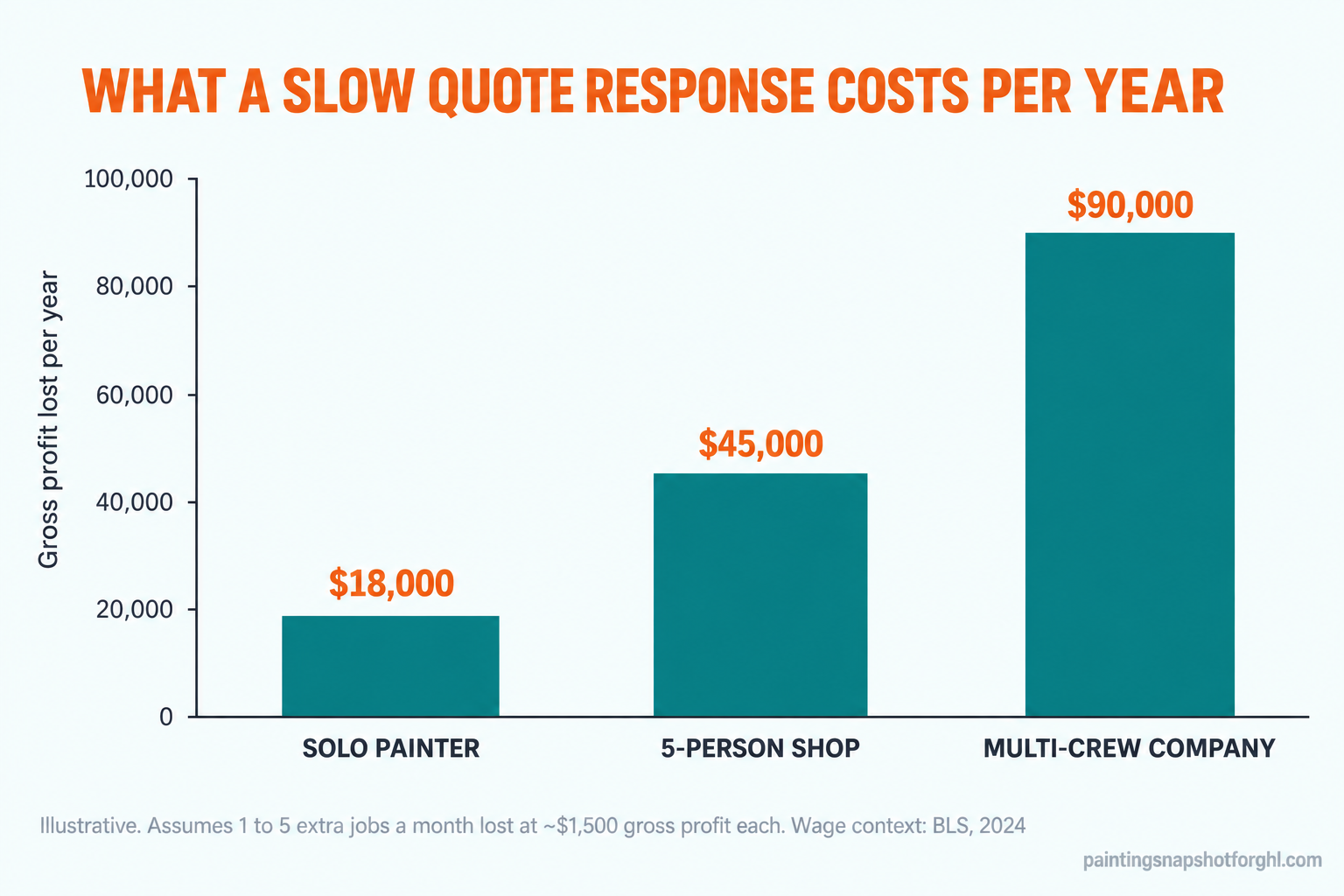
Illustrative annual gross profit lost to slow first response, assuming one extra job a month lost for a solo painter up to about five a month for a multi-crew shop, at roughly $1,500 gross profit per residential job. Your figures depend on your job mix and close rate. Wage context: BLS.
The frustrating part is you did nothing wrong. You were painting. That is the job. But the lead does not care why you were slow, and neither does the homeowner. She knows one painter called back in minutes and the others did not.
Why the first painter to reply wins the job
This is not a hunch. It is one of the most studied numbers in sales, and it holds for a home-service trade like painting.
The classic lead-response study, run by Dr. James Oldroyd with InsideSales, tracked six companies, more than 15,000 leads, and over 100,000 call attempts. Reaching a new lead within 5 minutes instead of 30 made a company about 100 times more likely to make contact and 21 times more likely to qualify the lead (InsideSales/MIT, 2007). Not 21% more. Twenty-one times.
Relative odds of qualifying a new lead by first-response speed. A 5-minute reply was about 21x more likely to qualify the lead than a 30-minute reply. Source: InsideSales/MIT lead response study, 2007. Vendor-platform data, directional.
A few years later, Harvard Business Review analyzed 1.25 million sales leads and found firms that tried to reach a lead within an hour were about 7 times more likely to have a meaningful conversation with a decision-maker than firms that waited just one hour longer (Harvard Business Review, 2011). The pattern is the same at every scale: a lead’s value falls off a cliff, fast.
Now picture your homeowner. She did not fill out one form. She filled out three in ten minutes, because that is how people shop for a painter now. Whoever replies first gets to frame the conversation and become the painter she compares the others against. Reply fourth, and you are the afterthought she cancels on. Speed does not just help you win. It decides who is even in the running.
The 5-stage fast-response system
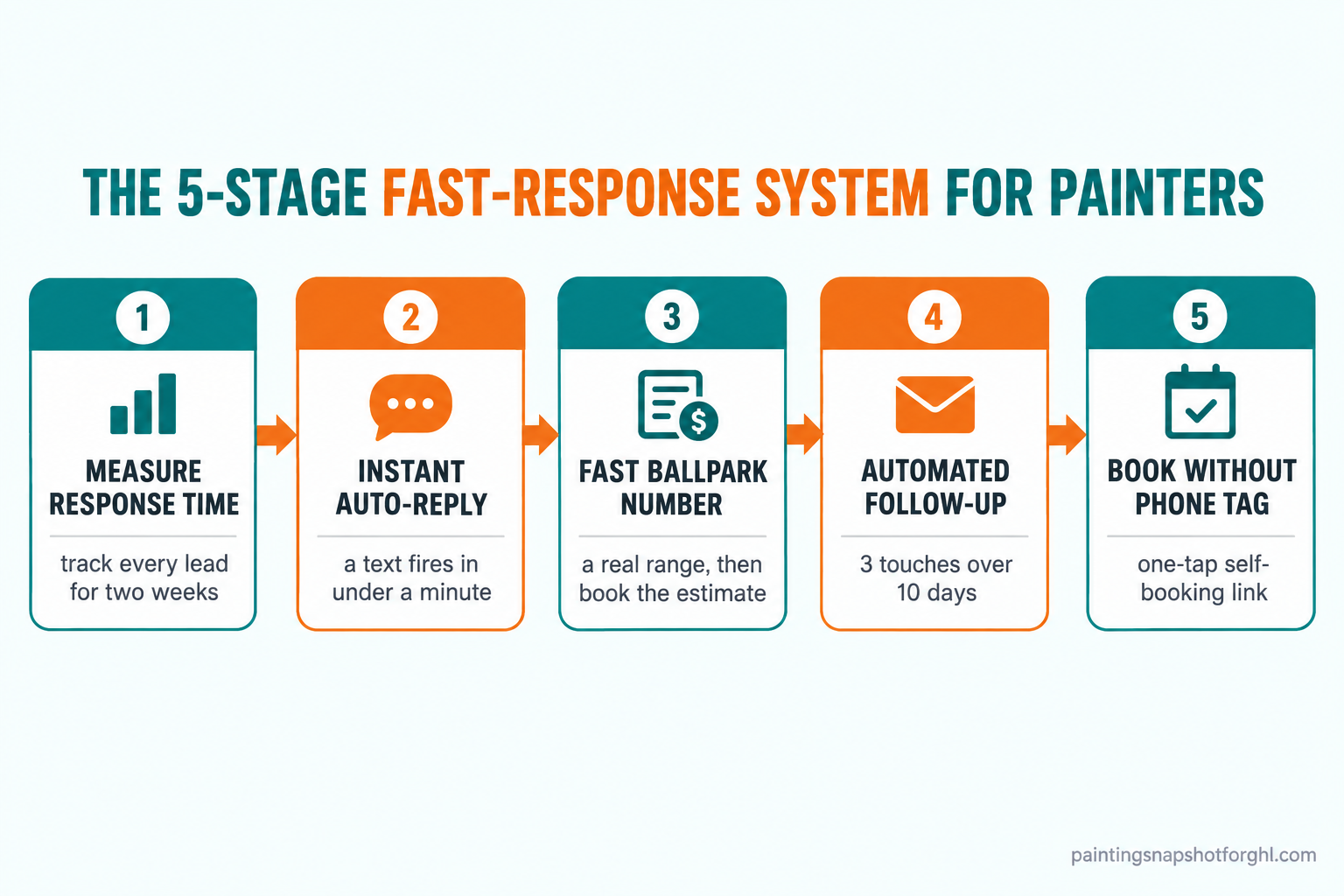
Getting fast is not about hustle. Hustle fails the week you get slammed, which is exactly the week the good leads come in. It is about a system that does the first response for you, every time, so your speed does not depend on whether you happen to be free. Five stages get you there:
- Measure your real response time so you know how big the leak is.
- Instant auto-reply in under a minute on every form, call, and message.
- Get a real number in front of them fast so the conversation moves toward a decision.
- Automated follow-up so no quote goes cold in your inbox.
- Book without phone tag so a ready homeowner can grab a slot the moment she is ready.
The first two stages alone will change your win rate. Let us walk each one, what it costs when it breaks, and the exact copy to steal.
Stage 1: Measure your real response time
You cannot fix a number you refuse to look at. For two weeks, log one thing for every new lead: the time it came in, and the time you (or anything) first responded. Not the time you meant to. The time you actually did. Then find your median. Most owners guess “maybe an hour.” The honest number is usually three to six hours, and worse on the days you are busiest.
That gap is the money in the chart above. A lead that comes in at 8am and gets a reply at 1pm spent five hours going cold while the homeowner talked to other painters. Once you can see the number, the fix becomes obvious and the excuses stop.
How it breaks: Owners measure from memory, and memory only keeps the wins. You remember the lead you called back in ten minutes and forget the six that sat until evening. Write down every one for two weeks, no exceptions. The number will be worse than you think, and that is the point. For the cost side of the same picture, we broke down what a painting lead really costs so you can see what each slow response throws away.
Stage 2: Instant auto-reply in under a minute
Here is the stage that does most of the work. The moment a lead comes in, from a web form, a missed call, a Facebook message, whatever, an automatic text fires within seconds. The homeowner submits at 8:10 and by 8:11 has a message that reads like a real person from your shop. You are still on the ladder. The conversation already started.
A good instant reply does three things: it acknowledges fast so she knows she was heard, it sets expectations so she is not left wondering, and it asks one easy question so the thread keeps moving until you can jump in. That single automated text is the difference between being first and being fourth. It is also the whole idea behind missed-call text-back for painters, which turns every rung-out call into a live text thread instead of a lost lead.
How it breaks: You write a robot. “Your request has been received. A representative will contact you.” That kills the momentum you were trying to save. It has to sound like you. Use your name, your shop’s name, plain words. The other way it breaks is having no after-hours version, so the evening and weekend leads, which are most of them, still sit until Monday. Automate it once and it runs at 8pm on a Sunday exactly as well as it runs at 10am on a Tuesday. We went deep on that in how to stop losing painting leads after hours.
Stage 3: Get a real number in front of them fast
Speed on the first reply only matters if you follow it with a real number soon after. A homeowner comparing painters is not just timing who replies first. She is timing who gives her something to decide on first. That does not mean a firm bid off a photo. It means a credible ballpark and a booked estimate, fast, so you become the painter she measures the rest against.
The move is to separate the ballpark from the final bid. Give a range early (“most kitchens like yours run X to Y, and I can lock the exact number when I see it Thursday”), then book the walk-through to nail it down. That gives her a number to sit with now and a reason to hold the appointment. An instant estimate tool on your site can produce that ballpark automatically the second she asks, so the range lands with your first reply instead of two days later.
How it breaks: You go silent until you can produce a perfect number. Perfect and slow loses to good and fast every time in this trade. The homeowner does not need your final bid in the first hour. She needs to feel like you are moving and the others are not. A range now, a firm number at the estimate. That wins.
Stage 4: Automated follow-up on the unsold estimate
Most lost jobs are not lost at the quote. They are lost in the silence after it. You send a number, the homeowner says “let me talk to my spouse,” and then life happens on both sides. You get busy on a job and forget to circle back. Eleven days later she hires the painter who followed up on day two. The estimate was fine. The follow-up never happened.
This is the least glamorous automation in the business and it books more work than any ad. A short, friendly sequence fires after you send a quote, whether or not you remember: two or three touches over ten days, each with a clear reason to reply. It is the same principle we cover in the full painting estimate follow-up playbook, boiled down to the messages that pull the most answers.
How it breaks: You either never follow up, or you follow up like a telemarketer, five texts in three days. Both lose. The sweet spot is polite persistence: a helpful check-in, a gentle nudge about filling slots, and a graceful “I’ll close this out” that gives her a reason to answer now.
Stage 5: Book the estimate without phone tag
You replied in seconds, gave a ballpark, and followed up. Do not let the last step die in phone tag. The moment a homeowner is ready to book the walk-through or a color consult, she should be able to grab a time from her phone without a back-and-forth of “does Thursday work, no how about Friday.” Every round of tag is a chance for her to cool off or book someone easier.
A simple booking link inside the text thread closes the loop. She picks a slot, gets a confirmation, gets a reminder the day before, and if she no-shows, an automatic nudge tries to rebook her instead of you chasing. That is what appointment automation is for, and it is the quiet difference between a full week and a calendar full of maybes.
How it breaks: You keep booking by hand, so a ready homeowner at 9pm waits for you to see her text and offer times tomorrow, by which point she has self-booked with an easier painter. Make booking one tap. The whole system exists to get her to a confirmed time, so do not add friction at the finish line.
How this changes for a solo painter, a 5-person shop, and a multi-crew company
The five stages are the same. What you automate first depends on your size.
The solo painter or owner-plus-one. You are the sales team, the crew, and the office, which is exactly why leads go cold, you physically cannot reply while painting. The instant auto-reply (Stage 2) is not a nice-to-have for you, it is the whole game, and it buys you the hours you spend on a ladder without losing the lead. Automate the instant reply and estimate follow-up first. At your size, one saved job a month is real money.
The 5-person shop with one or two crews. You have enough volume that leads pile up faster than anyone can answer them by hand, and the ones that slip are invisible because you never see what you didn’t catch. Measure your response time (Stage 1) and you will find the leak. Priority: instant reply plus a booking link (Stages 2 and 5), so leads convert without tying up whoever is running the office.
The multi-crew company. Your problem is consistency. On a good day someone replies in ten minutes, on a slammed day a lead waits four hours, and you have no way to know which. The full system with tracked response times matters most here, because you are managing other people’s speed, not just your own. Priority: the whole loop, measured, so no lead depends on who happened to check the phone.
The compliance part nobody warns you about
Every steal-this text here is a business text message, and business texting is regulated. Get it wrong and the system that wins you jobs becomes a fast way to get fined or filtered.
First, the TCPA and A2P 10DLC. You need a reasonable basis to text a customer, you must honor a STOP reply promptly, and to send business texts reliably in the U.S. you have to register your number and campaigns under A2P 10DLC, or carriers quietly filter your messages into nowhere (FCC). The good news: a homeowner who just asked you for an estimate has given you a reasonable basis to text about that project. Keep it relevant, give an easy opt-out, and you are on solid ground. We laid out the whole picture in the painting contractor compliance checklist.
Second, lead paint and your license. If you work on homes built before 1978, the EPA’s Renovation, Repair and Painting Rule requires you to be certified, because about three-quarters of pre-1978 U.S. homes still contain some lead-based paint (EPA). And some states, California among them, require your contractor license number in all of your advertising, which includes the website and forms feeding this whole system. Rules genuinely differ by state, so check yours rather than copying a competitor’s site.
Objections I hear every week
“Won’t an automated text feel fake and annoy people?” Only if it reads like a robot. A message with your name that asks one relevant question feels like a fast, on-the-ball painter, which is exactly the impression you want. The annoying painter is the one who goes silent for two days and then calls at dinner.
“I already pay for Jobber or Housecall Pro.” Good, and you may not need to replace them. The real question is whether your setup actually fires an instant reply in seconds and runs the estimate follow-up on its own, or whether those still live in your head. If the automations are not running, the software is a filing cabinet, not a response system. Still weighing tools? We compared the main options in the best painting business software breakdown.
“I don’t have a speed problem, I have a not-enough-leads problem.” Maybe. But measure your response time for two weeks before you spend another dollar on ads. Most shops that feel starved for leads are losing the ones they already get to slow follow-up, and buying more leads that also go cold is the expensive way to stay stuck.
“Do I need to be technical to set this up?” No. If you can send a text and use a calendar app, you can run it day to day. The one-time setup is the only technical part, and you can do it yourself, hand it off, or buy it done-for-you. Daily life is reading replies and showing up to booked estimates.
Slow response is not bad luck, and it is not a lead problem you have to outspend. It is a systems problem you fix with one automated text, a fast ballpark, a short follow-up, and a booking link. Build that loop and the next time your phone buzzes while you are up a ladder, the homeowner already has a reply, a number, and a reason to wait for you. The painter who used to beat you to the punch is the one calling back at lunch to voicemail now.
Frequently asked questions
How fast do I really need to respond to a painting lead?
As close to instant as you can get, and definitely within five minutes. The classic lead-response study found replying within five minutes made a company about 21 times more likely to qualify a lead than waiting thirty minutes. Since you cannot personally reply that fast while painting, an automated text that fires the moment a lead lands is the practical way to hit it.
What should the first automated text actually say?
Use your real name and your shop name, thank them for reaching out about their specific project, say you want to get them a quick number, and ask one easy question like whether it is interior, exterior, or both and when they want it done. The name makes it feel human and the question keeps the conversation moving until you can jump in.
Isn't it better to wait and send a perfect, accurate quote?
No. Perfect and slow loses to good and fast in this trade. Give a credible ballpark range fast so the homeowner has a number to sit with, then book a walk-through to lock in the exact figure. You become the painter she measures the others against, which is worth far more than being the most precise painter she never hears back from in time.
How many follow-ups should I send on an unsold estimate?
Two or three, spaced over about ten days, and automated so they fire whether or not you remember. A check-in on day two, a gentle nudge about filling slots around day five, and a graceful I-will-close-this-out message around day ten. That last one pulls the most replies because it gives the homeowner a reason to answer now.
I already use a CRM. Do I need something else?
Not necessarily. The question is whether your current setup actively fires an instant reply, runs the estimate follow-up, and lets homeowners self-book, or whether those tasks still depend on you remembering. If the automations are not actually running, you need to add that layer, not necessarily a new tool.
Is automated texting to homeowners legal?
Yes, when done right. A homeowner who requested an estimate gives you a reasonable basis to text about that project under the TCPA. Keep messages relevant, honor STOP replies promptly, and register your number and campaigns under A2P 10DLC so carriers do not filter your texts. Check your state's rules on including a license number in advertising too.
Do I need to be technical to run a fast-response system?
No. If you can send a text and use a calendar, you can run it day to day. Building it is the one-time technical part, and you can do that yourself, delegate it, or buy it done-for-you. Everyday use is just reading replies and showing up to the estimates the system books for you.