

It is 8:50 on a Wednesday night. You sent the Hendersons their estimate four days ago. They loved it. They said “let’s get on the calendar.” And here you are, thumb hovering over their name, trying to word a text that asks for the deposit without sounding like you don’t trust them. You skip it again. Tomorrow you buy their paint out of your own pocket, put a crew on their house Monday, and hope the check shows up before payroll does.
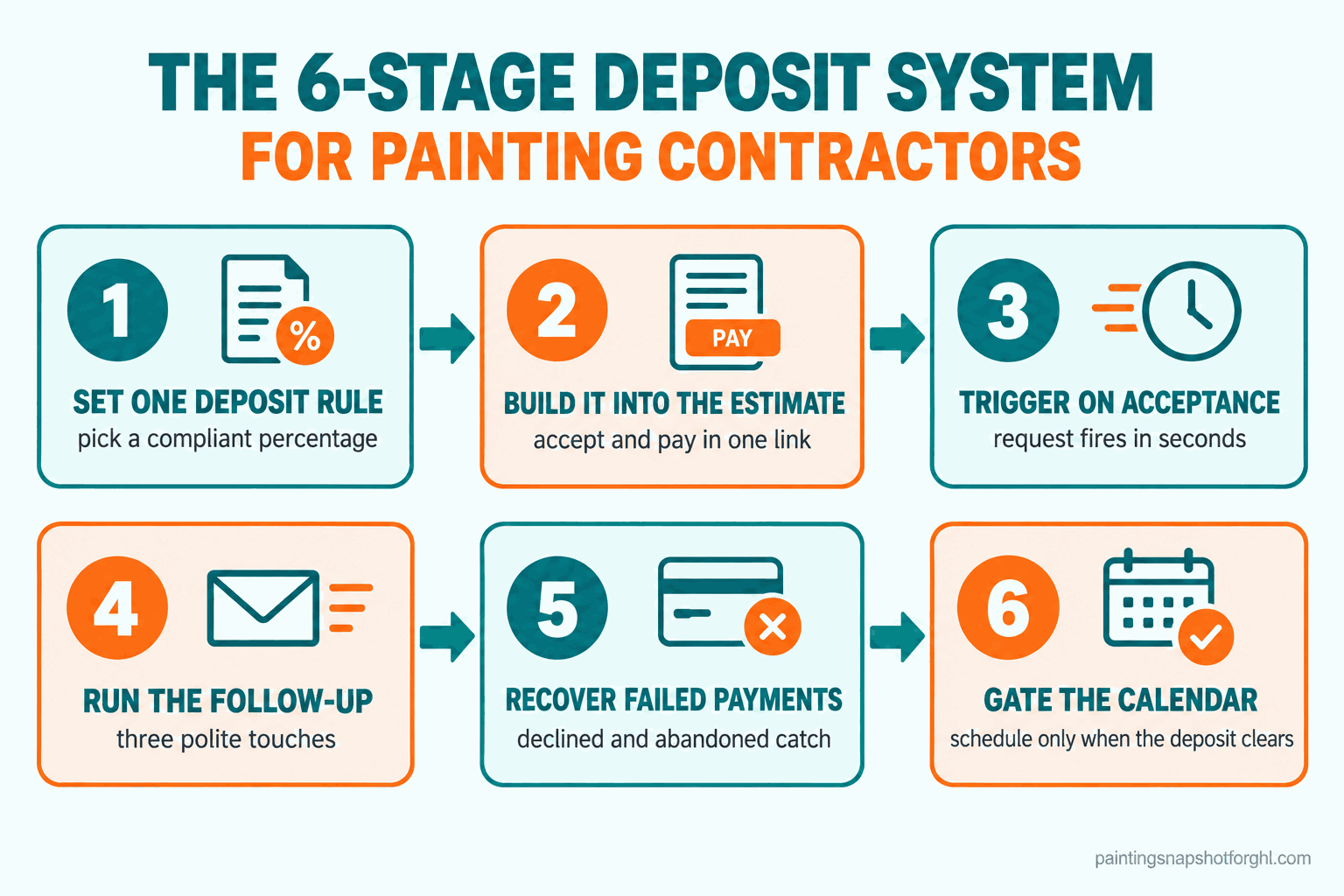
The fix is not a better-worded text. It is a system that asks for the deposit the second a homeowner accepts the estimate, sends the payment link automatically, follows up on its own if the money does not land, and refuses to put a job on the calendar until the deposit clears. This post walks through the six stages that make that happen, the exact messages you can copy tonight, and the state rules you cannot ignore when you set your deposit amount.
In this post
- Why chasing deposits quietly drains your business
- A signed estimate is not a booked job
- Stage 1: Set one deposit rule (and check your state’s cap)
- Stage 2: Build the deposit into the estimate itself
- Stage 3: Trigger the request the second they accept
- Stage 4: Run the deposit follow-up sequence for you
- Stage 5: Recover failed and abandoned payments
- Stage 6: Gate the calendar on a cleared deposit
- How this changes for a solo painter, a 5-person crew, and a 3-crew shop
- The compliance part you cannot skip
- Objections I hear every week
- Frequently asked questions
Why chasing deposits quietly drains your business
A missing deposit feels like a small annoyance. It is why a busy painting shop can still be broke: you float your own money.
Start with the paint. Materials, primer, tape, and sundries run roughly 20% to 30% of a residential painting bill, with labor eating the rest (Housecall Pro painting price guide). On a $6,000 interior, that is $1,200 to $1,800 in product you buy before a single wall gets cut in, out of your own account. Run three at once and you have $4,000 to $5,000 of your cash sitting on other people’s walls, plus the wages you owe your crew Friday whether the customer has paid or not.
Now the part nobody puts on a spreadsheet. Late and missing payments are the number-one silent killer of small trades. In the 2026 QuickBooks Small Business Late Payments Report, 59% of small businesses said at least some invoices were 30-plus days overdue, up from 47% the year before, and those waiting were owed an average of $17,700. Nearly half of owners, 49%, said payment timing created moderate or critical cash-flow gaps (Intuit QuickBooks). That is the hole you dig every time a deposit slips. The same report found businesses that required payment upfront were far more likely to have zero overdue invoices than those on net-30 terms. Taking money before the work is the cleanest way to stay out of the overdue column.
Share of U.S. small businesses carrying invoices 30 or more days overdue, year over year. Source: Intuit QuickBooks 2026 Small Business Late Payments Report.
A signed estimate is not a booked job
This mindset has to shift before any software helps. A homeowner who says “yes, let’s do it” has given you a wish, not a commitment. Until money changes hands, they are still shopping and still able to ghost you the morning your crew loads the van.
A deposit does three jobs at once. It commits the customer, so they stop taking calls from the guy underbidding you. It funds the paint, so you stop being the bank. And it filters tire-kickers, because the person who will not put $500 down was never going to be an easy customer. A verbal yes with no money down is the most expensive kind of “win” in this business: you plan around it, staff for it, and it can vanish for free.
So the whole system below runs on one rule: the deposit request goes out the instant the estimate is accepted, not the next evening when you get to your phone. The longer the gap between “yes” and “pay,” the more room the homeowner has to cool off or take another bid, the same speed argument we made in the real cost of a slow quote response.
Stage 1: Set one deposit rule (and check your state’s cap)
Before you automate anything, you need one deposit rule you use every time. Not “it depends,” not a number you make up at the kitchen table. One rule.
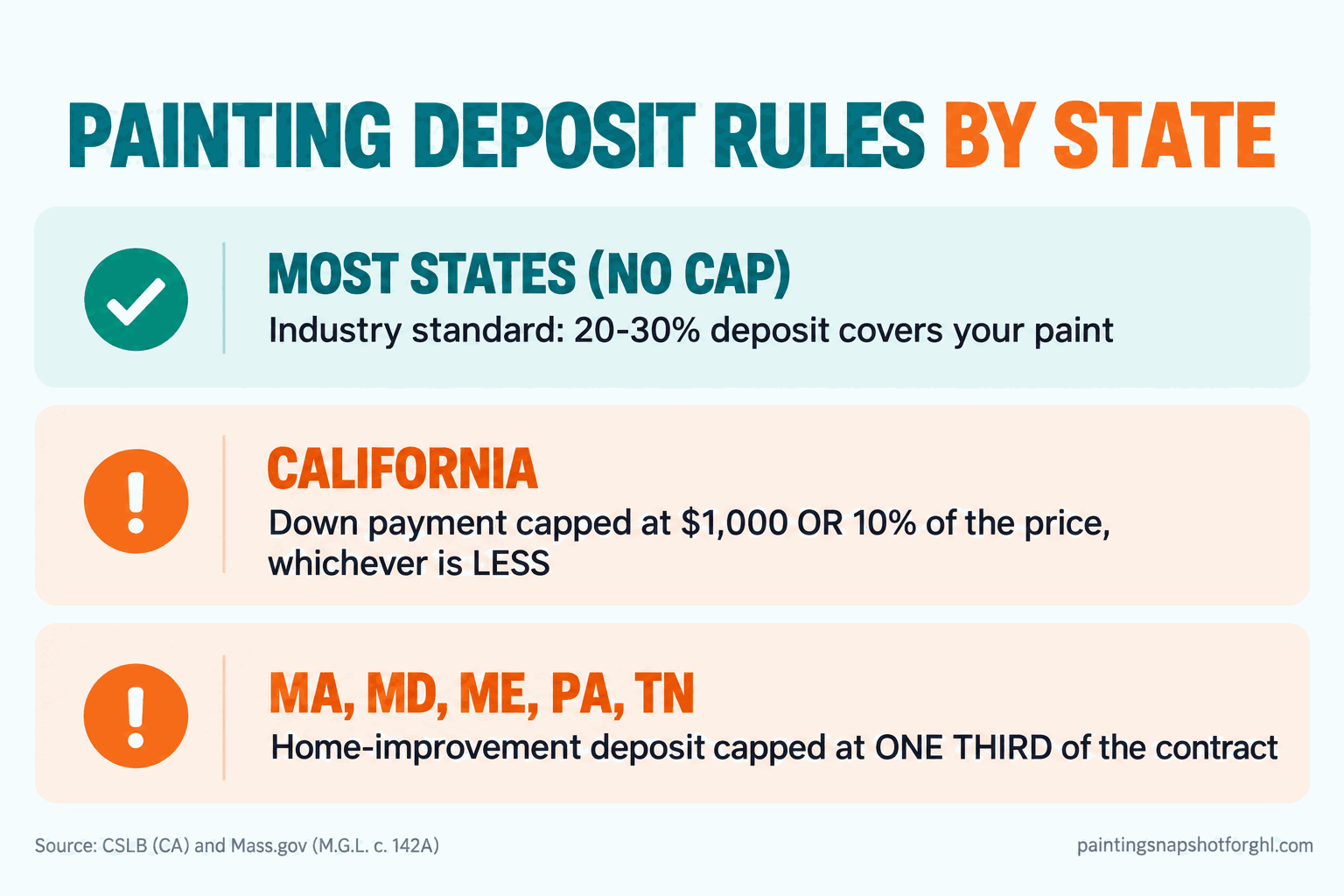
For most repaint work in states without a cap, a deposit of 20% to 30% covers your materials and commits the customer without scaring them. Pick the rule once and make it the default in your paperwork, so you never have to decide it under pressure.
Then check your state, because a handful make this a legal question, not a preference. California caps the down payment on a home-improvement contract at $1,000 or 10% of the price, whichever is less, and requires that exact language in the contract (California Contractors State License Board). On a $6,000 California job, your legal maximum deposit is $600. Massachusetts, Maryland, Maine, Pennsylvania, and Tennessee cap it at one third of the price (Mass.gov, M.G.L. c. 142A). If you paint in a capped state and have been taking 30%, you are out of compliance and do not know it.
How it breaks: You set no rule, so every job gets a different number based on your mood and your bank balance, and you look like you are making it up. Or worse, you take a bigger deposit than your state allows and a customer reports it. Pick one compliant rule and let the system apply it every time.
Stage 2: Build the deposit into the estimate itself
The biggest reason deposits get chased is that the estimate and the payment are two separate events. You send a PDF, then later you have to remember to ask for money. That gap is the leak.
Close it by making the deposit part of the estimate itself. A modern estimate lets the homeowner do three things in one link: read the scope, accept and e-sign, and pay the deposit, all in the same flow, on their phone, at 9pm. The moment they tap accept, the deposit amount is right there with a Pay Now button. No second step for them, no second reminder for you.
This is table stakes on the tools painters already use. What most shops get wrong is that they own the tool but never turn on the pay-on-accept setting, so the estimate still goes out as a plain document. Turn it on. Make the accept and the pay the same action.
How it breaks: You send the estimate as a flat PDF, so accepting it is just a text back that says “looks good,” and the money becomes a separate ask that puts you right back to chasing. If your estimate cannot take a payment, you are using the wrong estimate. We compared the tools that do this well in the best painting business software breakdown.
Stage 3: Trigger the request the second they accept
Here is where automation earns its keep. When a homeowner accepts an estimate, that action should fire a workflow on its own: a friendly deposit request by text and email, with the payment link and exact amount, within seconds. You do nothing, because you are on a ladder. The system does the asking.
Why seconds and not “later today”? Acceptance is the peak of intent, and that feeling fades by the hour. If the ask lands while they are still holding the phone, most people just pay it, like anything else they just decided to buy. If it lands two days later, you are interrupting a busy person about money, the worst possible framing.
How it breaks: The trigger depends on you. You tell yourself you will send the link “after this job,” and then it is 9pm and you are cooked. If a human has to remember to press send, the deposit slips. Stage 3 works by removing you from the loop.
Stage 4: Run the deposit follow-up sequence for you
Some pay the first request in a minute. Plenty do not. They mean to, they get distracted, and the link scrolls up their phone. This is not a trust problem, it is a life problem, and the answer is polite, automatic follow-up you never have to think about. Build a short sequence that runs on its own after the first request goes unpaid. Three touches over about four days is the sweet spot: any less and you leave money on the table, any more and you are nagging.
It is the same muscle as chasing an unsold estimate. If your estimate follow-up is also manual and leaky, fix both with the playbook in painting estimate follow-up.
How it breaks: You send one request and give up, or you follow up so hard it feels like collections. The sequence has to be short, kind, and tied to their start date. And it must stop the instant they pay, or you will text a paying customer a reminder to pay.
Stage 5: Recover failed and abandoned payments
Two things happen even with a great sequence. Some cards get declined, and some people start to pay and bail before finishing. Both are recoverable money most shops never chase, because they never know it happened.
Set up two small automations. First, a declined-payment catch: if a deposit charge fails, the customer gets an immediate, gentle note with the link to try again. Cards fail for boring reasons all the time (expired dates, a fraud hold, a wrong digit), and a quick heads-up fixes it. Second, an abandoned-checkout catch: if someone opens the payment page and does not finish within an hour, they get one soft nudge: “Looks like the deposit didn’t quite go through, here’s the link again if you got interrupted.” That recovers deposits you would otherwise write off as “they changed their mind,” when really the dog jumped on the couch mid-payment.
How it breaks: You treat a failed charge as a no, so a customer who fully intended to pay just falls off your radar. Or you have no visibility into abandoned payments, so you cannot chase what you cannot see. This stage is pure found money, but only if the system is watching for it.
Stage 6: Gate the calendar on a cleared deposit
This is the rule that ends the stress: no job goes on the schedule until the deposit clears. Not the acceptance, the cleared deposit. Make it the one hard gate in your operation.
In practice, the scheduling workflow only moves a job into “scheduled,” and only lets you order paint, once the deposit is marked paid. Before that, it sits in a “waiting on deposit” stage where the follow-up sequence works. That protects your calendar from soft yeses that evaporate, and protects your cash, because you never buy materials or block a crew day on an unfunded job.
It also fixes the downstream mess. Schedule unfunded jobs and you get last-minute holes when the deposit never lands, and a hole in the schedule is a crew standing around on your dime. A deposit-gated calendar is the front door to keeping your painting crew booked and reducing estimate no-shows.
Most painting shops run all of this on one platform, so the pieces actually talk to each other instead of living in five apps. A lot of them use GoHighLevel for exactly that. (Disclosure: that is our affiliate link, and we may earn a commission at no extra cost to you.)
How it breaks: You cave. A homeowner you like says “I’ll pay you when you start,” and you schedule it anyway because you want the work. Then that job is the one that falls through, and it takes a crew day with it. The gate only works if it is a gate for everyone, including the nice ones.
How this changes for a solo painter, a 5-person crew, and a 3-crew shop
The system is the same at every size. What you automate versus do by hand is what shifts.
Solo painter or single crew. You are the estimator, the buyer, and the guy on the brush. The deposit slips because you are too tired to ask at night. Automate the two pieces that matter most first: the pay-on-accept estimate (Stage 2) and the instant deposit request (Stage 3). Those two alone move most of your deposits from “chased” to “collected while I was working.” You do not need the full stack on day one, you need the ask to happen without you.
Five-person crew (one to two crews out daily). Now the leak is coordination. Jobs sit at different stages and it is easy to lose track of who paid. This is where Stages 4 and 6 matter most: turn on the full follow-up sequence so nothing depends on your memory, and enforce the deposit gate so only funded work gets scheduled. At this size, one unfunded job that falls through does not just cost a deposit, it strands a whole crew for a day.
Three crews or more. The deposit system is now part of cash-flow forecasting, not just admin. Every stage runs automatically, and the “waiting on deposit” pipeline becomes a leading indicator: if it swells, your close-to-cash timing is slipping and you can act before it hits payroll. At your volume, the failed-payment and abandoned-checkout recovery (Stage 5) is real monthly money, and the deposit gate is team policy, not a per-job decision.
Illustrative materials you float per active job when you skip the deposit, by shop size, assuming roughly $1,500 of product per job in flight per crew. Your numbers depend on job mix and how many jobs run at once. Materials basis: Housecall Pro.
The compliance part you cannot skip
Automating deposits touches three rules. None are hard to follow, all are expensive to ignore.
Deposit caps. As covered in Stage 1, some states limit your down payment: California is $1,000 or 10% of the contract, whichever is less, with required contract language (CSLB); Massachusetts, Maryland, Maine, Pennsylvania, and Tennessee cap it at one third (Mass.gov). Set your automated rule to your state’s cap, not a national default.
Texting rules. Every deposit request and reminder you send by SMS falls under the TCPA, and business texting now runs through carrier registration called A2P 10DLC. In plain terms: get clear consent (the customer gave you their number for this job), keep messages about their specific project, and give an easy opt-out (FCC on telemarketing and robocalls). Deposit and appointment texts a customer expects are fine. Blasting old contacts is not.
Lead paint. If you touch any home built before 1978, EPA’s Renovation, Repair, and Painting rule requires you to be lead-safe certified, because roughly three-quarters of pre-1978 homes still contain some lead-based paint (EPA RRP for contractors). That makes it a booking rule: your intake should flag home age so you never schedule a pre-1978 job you are not certified to do. For the full rundown, see our painting contractor compliance checklist.
Objections I hear every week
“Won’t asking for a deposit scare customers off?” The opposite, usually. Professional contractors take deposits. The guy who does not is often the guy who disappears, and homeowners know it. Tie the deposit to their paint and their start date, not to your cash needs, and most people expect it. The ones who balk at a reasonable deposit are often the same ones who would have fought the final invoice.
“I already pay for Jobber or Housecall Pro. Do I need something new?” Maybe not. Both can take deposits. The real question is whether the pay-on-accept estimate, the instant request, and the follow-up are actually turned on, or whether you still ask for money by hand. If the automations are live, you are set. If not, turn them on or add a layer that does. Owning the tool is not the same as running it.
“What about customers who want to pay by check?” Take it, just keep your gate. The rule is “deposit cleared before scheduling,” not “paid online.” A check-payer stays in “waiting on deposit” until it clears, same as everyone. Most people, given a one-tap link, just pay the link.
“I’m not technical. This sounds like software homework.” The day-to-day is not technical. If you can send a text and read a calendar, you can run this. The one-time setup is the only technical part, which you can do yourself, delegate, or buy done for you. After that, the system asks for money so you do not have to.
Frequently asked questions
How much deposit should a painting contractor take?
In states without a legal cap, 20% to 30% of the job is standard for repaint work, which usually covers your materials and commits the customer. Always check your state first: California limits it to $1,000 or 10% of the contract, whichever is less, and Massachusetts, Maryland, Maine, Pennsylvania, and Tennessee cap it at one third.
When should I ask for the deposit?
The moment the homeowner accepts the estimate. Acceptance is the peak of intent, and the longer you wait, the more likely they cool off or take another bid. The best setup fires the deposit request automatically within seconds of acceptance, with the payment link and exact amount.
How do I collect a deposit without chasing people?
Make the estimate itself take payment (accept and pay in one link), trigger the request automatically on acceptance, run a short three-touch follow-up sequence for anyone who hasn't paid, recover failed and abandoned payments, and refuse to schedule any job until the deposit clears. Automating those steps removes you from the chase.
Is it legal to require a deposit before painting work?
Yes, in every state, but several states cap how much you can take on a home-improvement contract. California caps the down payment at $1,000 or 10% of the price, whichever is less, with required contract language. Set your automated deposit rule to your own state's limit.
Are deposit request texts allowed under the TCPA?
Generally yes, when the customer gave you their number for this job and the message is about their specific project. Business texting runs through A2P 10DLC carrier registration, so get clear consent, keep messages relevant, and include an easy opt-out. Transactional deposit and appointment texts a customer expects are the safe zone.
What if a customer wants to pay the deposit by check?
Take it. Just keep your scheduling rule intact: the job stays in the waiting-on-deposit stage until the check clears, then it moves to scheduled. The gate is about cleared money, not the method. In practice, most people pay a one-tap link faster than they mail a check.
Do I need to be technical to set this up?
No. Running it day to day means sending texts and reading a calendar. The one-time setup is the only technical part, and you can do it yourself, delegate it, or have it installed done-for-you. After setup, the deposit ask, the reminders, and the recovery run on their own.
The Hendersons? In the system version of that Wednesday night, you never sent a nervous 8:50pm text. They accepted the estimate on their couch at 9:10, the deposit request pinged their phone at 9:11, and they paid it before their show came back from commercial. By the time you woke up, the money was in, the job was scheduled, and the paint was on the order list. You chased no one, and that is the whole point.