
It is 8:10 on a Sunday night. You are looking at a full exterior week: a two-story repaint Monday, a deck stain Wednesday, a day of trim Friday. Then the forecast updates. Rain Monday, rain Tuesday, overnight lows in the high 30s all week. Now you are stuck with two bad options. Send the crew out and hope, and you risk a callback when the paint fails. Sit them at home, and you eat a week of wages and lose a week of work you cannot sell twice.
You cannot control the weather, but a rained-out week only strands your crew if you run a one-track schedule. The fix is a two-track calendar with an interior backlog ready to swap in, a clear temperature and dew point rule that tells you go or no-go before anyone loads a ladder, and delay messages that go out before the customer calls you. This post covers the conditions the paint needs, the six-stage system that keeps crews working, and the texts you can copy tonight.
In this post
- What a rained-out week actually costs you
- The four conditions that decide if you can paint
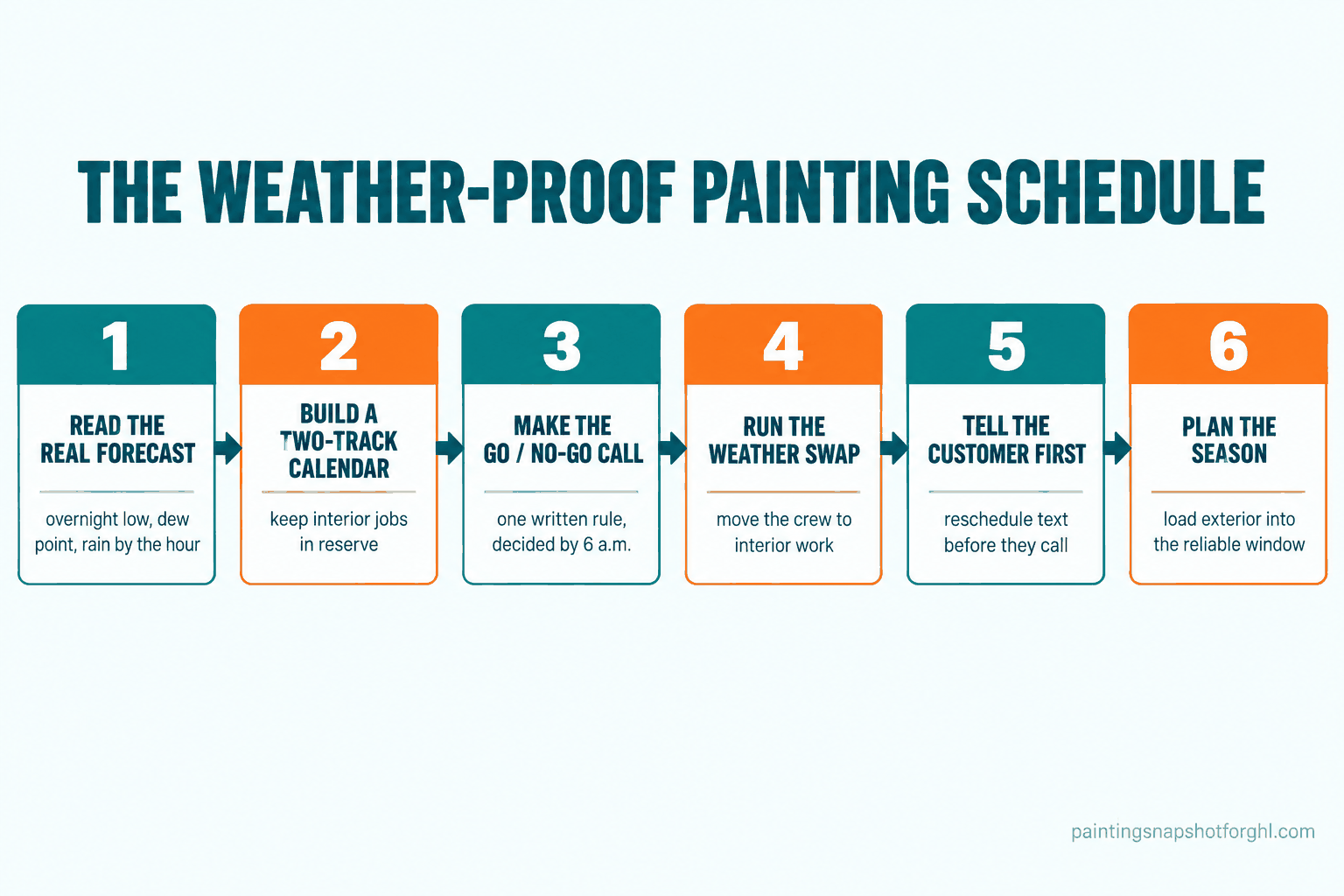
- Stage 1: Read the forecast that matters
- Stage 2: Build a two-track calendar
- Stage 3: Make the go or no-go call early
- Stage 4: Run the weather swap
- Stage 5: Tell the customer first
- Stage 6: Plan the season, not the week
- Solo, one crew, or three crews
- The texting rule that can fine you
- Objections I hear every week
- Frequently asked questions
What a rained-out week actually costs you
Most owners feel a rained-out week in their gut but never put a number on it, and the number is what pushes you to build the system.
Start with wages. The median annual wage for U.S. painters is $48,660, or roughly $24 an hour (U.S. Bureau of Labor Statistics). An eight-hour day runs about $195 per painter, so a three-person crew you keep on the clock with nothing to bill is close to $585 a day gone, near $3,000 across a week.
Wages are the small half. The bigger loss is the work that week was supposed to produce. A small exterior crew bills roughly $2,500 to $4,000 for a solid day, leaving gross profit of maybe $1,200 to $1,800 per crew-day. When the week rains out with nothing to slot in, that profit is gone, because you cannot sell it twice. And when Monday slides, everything behind it slides too. Here is what one fully rained-out exterior week costs by shop size:
Illustrative gross profit lost from one fully rained-out exterior week, by shop size (USD). Labor basis: BLS median painter wage of $48,660 (May 2024). Source: U.S. Bureau of Labor Statistics.
The four conditions that decide if you can paint
Homeowners think rain is the only problem. It is not. Four conditions decide whether today is a paint day, and three are invisible if you only glance at the sky.
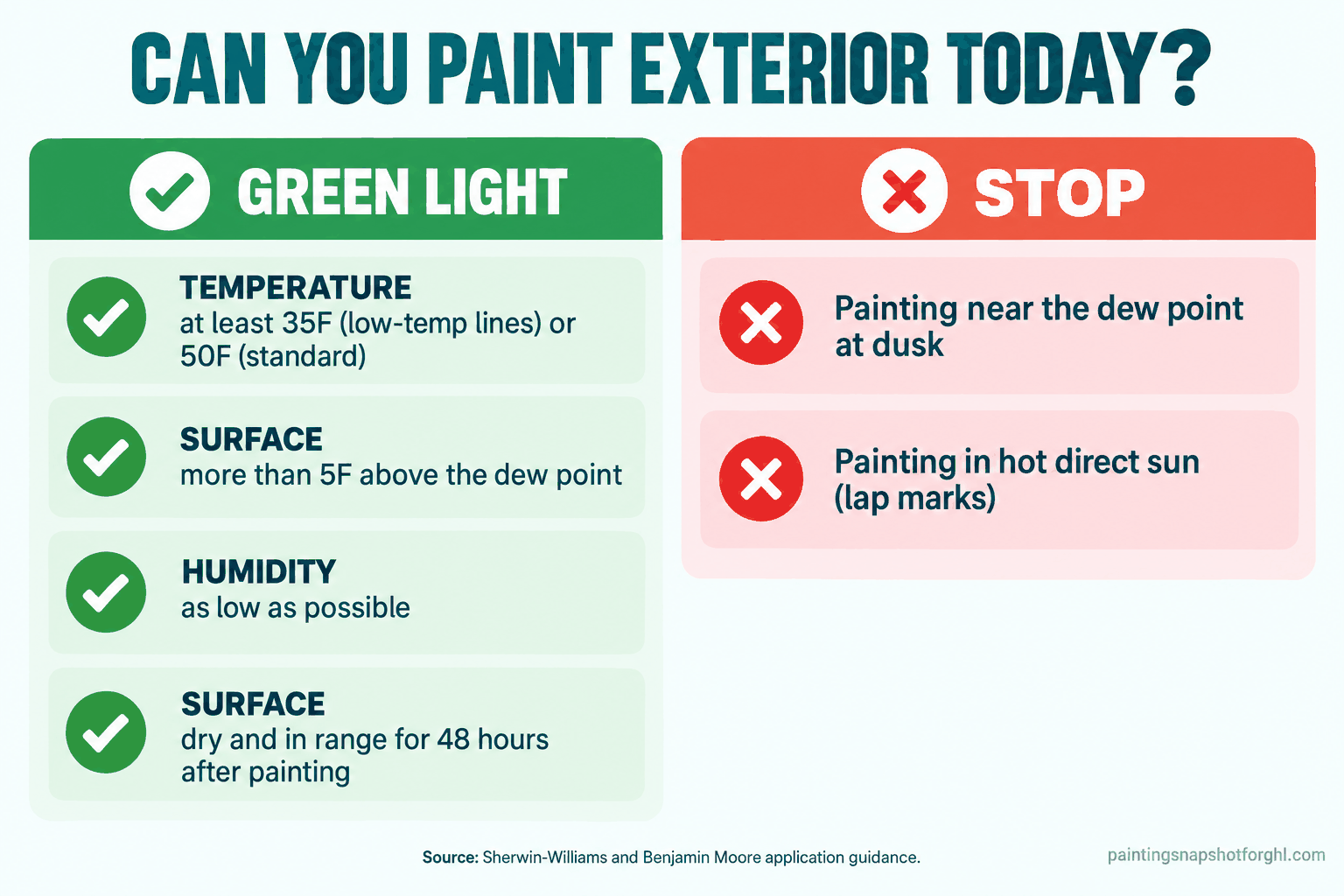
1. Air and surface temperature. This is the one that quietly kills spring and fall weeks. Most standard exterior sheens want around 50°F or warmer, but here is the part that saves weeks: all of the Sherwin-Williams exterior products except a high-gloss sheen can be applied as low as 35°F, including Duration, Resilience, SuperPaint, and A-100 (Sherwin-Williams). Benjamin Moore says the same, recommending 35°F to 100°F, with 77°F ideal (Benjamin Moore). Knowing which bucket your product is in is the difference between a cool morning painted and everyone sent home.
Lowest safe exterior application temperature by paint line (°F). Lower is better for cool-weather scheduling. Source: Sherwin-Williams exterior FAQ and Benjamin Moore temperature guide.
2. The dew point. The industry standard is to paint only when the surface temperature is more than 5°F above the dew point, the temperature at which water starts to condense (Benjamin Moore). The classic fall mistake, in Sherwin-Williams’ words, is painting when days rise above 50°F but nights drop below 35°F: the paint stops coalescing as it cools, and dew seeps into the uncured film (Sherwin-Williams).
3. Humidity and the 48-hour window. Paint when humidity is as low as possible, because high humidity slows drying. And the surface needs to stay in range and above the dew point for about 48 hours after application, which is why the overnight low matters as much as the daytime high.
4. A dry surface, and not too hot. Paint over damp siding and it will not bond. Heat bites too: direct sun makes paint dry too fast, which Sherwin-Williams links to brush marks, lap marks, and poor adhesion, so you chase shade instead of the sunny wall at 2 p.m.
Stage 1: Read the forecast that actually matters
The weather app on your phone is built for someone deciding whether to bring an umbrella. It buries the three numbers a painter needs: the overnight low, the dew point, and the hourly chance of rain, not just the daily headline. Pull a real hourly forecast the night before and again at 6 a.m. Check the overnight low first, because a 62°F afternoon means nothing if it dropped to 34°F at dawn and the siding is still cold and damp at 8 a.m. Then read the dew point against the expected surface temperature, and read rain by the hour, because “40% chance” often means a wet morning that clears by noon, which is a half-day job, not a lost one.
How it breaks: You trust the daily summary, see “sunny, high 64,” and roll out. The crew waits until 10:30 for cold, wet siding to warm, then the dew point catches you at 4 p.m. and the last wall flashes. The hourly numbers would have told you to start at noon.
Stage 2: Build a two-track calendar
This is the whole game. A shop that only sells exterior work has one track, and when it rains that track is closed. A shop that keeps a running interior backlog has a second track to move onto. For every exterior week on the calendar, have interior or cabinet work in reserve that can move up on a day’s notice.
Interior work does not care about the forecast. Cabinet refinishing, interior repaints, a garage, trim and doors inside a climate-controlled house: none of it gets rained out. So you deliberately hold a few interior jobs as your rainy-day bench. When you book one that is not time-sensitive, tell the homeowner, “You are on my calendar for the week of the 14th, and if a slot opens sooner I will call first.” Now that job is both booked and a shock absorber.
How it breaks: You run pure exterior in summer because it pays and books easily, so you have nothing to swap to when a system parks over town for four days. Build the bench in the good weeks, not in a panic during the bad one. If keeping the whole calendar full is the bigger battle, we covered that in the guide on keeping your painting crew booked.
Stage 3: Make the go or no-go call early
Indecision costs more than a clear no. A crew that drives 40 minutes, unloads, waits two hours, then packs up has burned half a day and a tank of gas. A crew that got a clear “we are on interior today, meet at the Johnson job” at 6 a.m. lost nothing. So you need a rule, not a gut feel, and you make the call early.
Write the rule down so it is not an argument every morning. Something like: exterior is a go if the surface will be above 40°F and more than 5°F above the dew point by 9 a.m., the low held above freezing, and rain chance is under 30% through the window we need. Otherwise we swap to interior. A written rule lets your lead make the call without texting you five times, and keeps you from talking yourself into a bad day when the schedule is tight.
Stage 4: Run the weather swap
The swap is where the two-track calendar earns its keep. When the forecast turns, you do not cancel the day. You move the exterior crew onto the interior bench job and slide the exterior job to the next clear window, so it goes out two days later when the siding is dry and warm. Three things make it smooth: the bench job has to be truly ready (materials on hand, colors chosen, access confirmed), the gear gets staged the night before once the forecast looks shaky, and one person owns the swap decision so it happens fast instead of becoming a parking-lot debate.
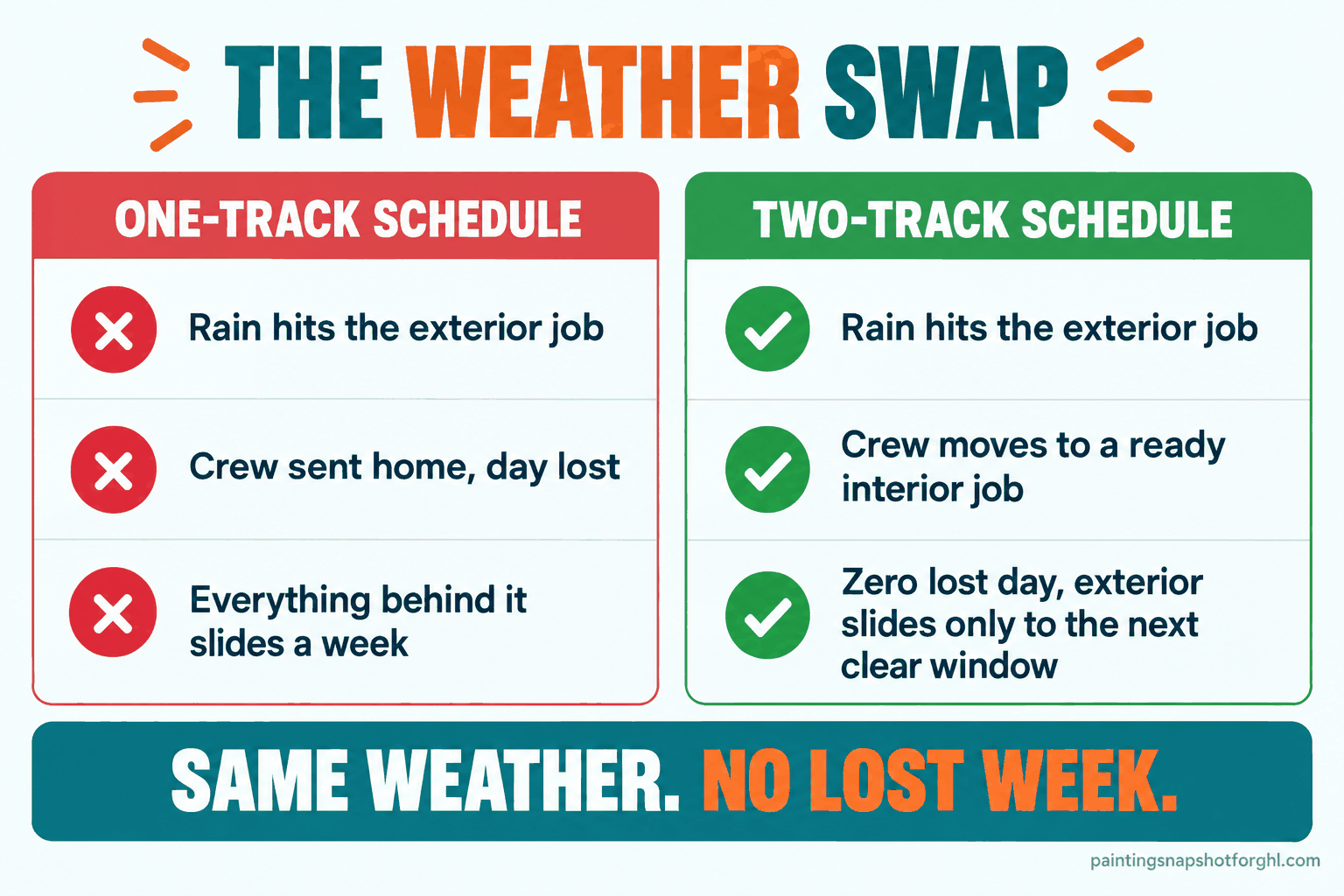
How it breaks: You have interior work on the books but it is not ready to start today, or you keep the swap decision in your own head while you are on a roof with no signal. Either way the crew sits. The swap only works if the bench is start-ready and the decision is delegated.
Stage 5: Tell the customer before they call you
Here is the part that protects your reputation. When you push a job for weather, the homeowner notices. The only question is whether they hear it from you first as a confident heads-up, or call you annoyed after your crew never showed. The first earns trust. The second costs a review.
So get ahead of it: the moment you make the no-go call, the affected customers get a text, and the same when the weather clears and you can move someone up. Doing this by hand falls apart, because you are busy running the swap. This is the kind of thing painting shops automate inside GoHighLevel, which ties your calendar, texting, and reminders into one system so a reschedule fires the message without you touching your phone. (Disclosure: that is our affiliate link, and we may earn a commission if you sign up through it, at no extra cost to you.) The same engine cuts your no-shows, covered in reducing painting estimate no-shows.
Stage 6: Plan the season, not just the week
Weather is a daily problem and a yearly one. The daily swap keeps a bad week from stranding the crew. Season planning keeps you from booking exterior work into a window the paint will not allow.
Your exterior window depends on where you paint, and it is real. In a market like Denver, the practical exterior season runs roughly spring to fall, because the manufacturer minimums around 50°F and the overnight dew point rule shut you down in the cold months. In Phoenix you can paint exterior nearly year-round, but you lose the peak summer midday to flash-drying, so you start at dawn and chase shade. Neither is a surprise if you plan for it: load exterior-heavy jobs into the reliable window, push interior and cabinet work toward the shoulder seasons, and stop promising an October exterior start you may not keep. Want the booking side handled so the calendar fills the right work into the right months? That is the core of appointment automation for painting contractors.
How it breaks: You book exterior straight through the calendar because the phone was ringing, then a cold, wet stretch arrives and you have three exterior jobs due and no interior bench. Plan the season and the bench is deepest exactly when you need it.
Solo, one crew, or three crews: what changes
The system is the same. The knobs turn differently by size.
The solo painter or owner-plus-one. A rained-out week costs less in raw dollars but hurts more, because you are the crew, the scheduler, and the office. You cannot afford to sit, or to spend the wet morning texting twelve customers by hand. Priority: keep two or three interior jobs on a rolling bench, and automate the reschedule text.
The one-crew shop with three to five painters. This is where a rained-out week gets expensive fast, roughly $7,500 in gross profit down. You have the volume to keep a real interior bench, so build it deliberately and write down the go or no-go rule so your lead can run the morning call without you. Priority: the two-track calendar and a delegated swap.
The three-crew company. One wet system is three crews idle, more than $22,000 in a week, and you cannot hold three schedules and a weather call in your head. Priority: a written rule every lead follows, a bench deep enough to absorb all three crews for several days, and automated customer messaging, because a manual reschedule of thirty jobs will not happen in time.
The texting rule that can fine you
Every one of those weather texts is a business message to a customer’s cell phone, which puts it under the same rules as the rest of your SMS. Under the federal Telephone Consumer Protection Act, you need the customer’s consent before you text them, and carriers now enforce this through A2P 10DLC registration, which vets business texting before it can send at volume (Twilio A2P 10DLC).
In practice this is not hard, and you almost certainly already have consent: when a homeowner requests an estimate and gives you their number, capture a clear opt-in on the form, identify your business by name in every message, and honor STOP the instant someone sends it. The reschedule and move-up texts above are exactly the transactional messages this framework is built for. Get it wrong and TCPA penalties run per message. We laid out the full painting-specific version, plus licensing and EPA lead rules, in the painting contractor compliance checklist.
Objections I hear every week
“I already run interior in winter and exterior in summer. Isn’t that enough?” Seasonal splitting handles the year. The two-track calendar handles the day. Even in peak exterior season you get wet mornings and cold snaps, and that is when a ready interior bench job saves you.
“My customers will be annoyed if I keep moving them.” They are far more annoyed by a crew that no-shows with no word, or a paint job that fails because you pushed it. A confident, early “I’m moving you so the finish holds up” reads as professional. Silence reads as unreliable.
“I can just look outside. Why do I need a dew point number?” Because the dew point is invisible and it is what ruins jobs that looked fine. A sunny 60°F afternoon that drops near the dew point at dusk lets moisture into a fresh coat, and you will not see the problem until the callback. Looking outside tells you about rain, not about the conditions that cause most weather-related failures.
“Do I need to be technical to automate the texts?” No. The reschedule messages run on a template you set once: pick the trigger, write the message in plain English, and it fires when you move a job. If that still sounds like homework, that is the whole point of a done-for-you system, and it is worth comparing your options first in the best painting business software breakdown.
Frequently asked questions
How long after rain can you paint an exterior?
Wait until the surface is fully dry, not just until the rain stops, or the paint will not bond. Sherwin-Williams also advises keeping the surface above the dew point for about 48 hours after you paint, so a wet stretch followed by a cold, damp night is still a no-go. Give bare wood and masonry extra time.
What is the lowest temperature you can paint outside?
Standard sheens want around 50°F, but Sherwin-Williams says all of its exterior products except a high-gloss sheen can go as low as 35°F, and Benjamin Moore recommends 35°F to 100°F. The catch is the overnight low: the temperature must stay in range for about 48 hours after application.
What is the dew point rule for painting?
Paint only when the surface temperature is more than 5°F above the dew point, the point at which moisture condenses. Paint too close to it and water forms in the fresh film and it fails, which is why a sunny day that cools toward dusk can still be a bad paint day.
How do I keep my crew working when it rains?
Run a two-track calendar: keep a rolling bench of interior and cabinet jobs ready to start on a day's notice, so when the exterior forecast turns you swap the crew onto interior work instead of sending them home. It works when the bench job is start-ready and one person makes the go or no-go call by 6 a.m.
Is it bad to paint in direct sun or extreme heat?
Yes. Heat from direct sun dries paint too fast, which Sherwin-Williams links to brush marks, lap marks, and poor adhesion. In hot weather, start early and follow the shade rather than painting the wall the sun is hitting hardest.
Weather is the one variable you will never control. The crew is the one you can. Go back to that Sunday night forecast. With a two-track calendar, Monday’s rain does not send anyone home, it sends them to the interior job that was ready to go. The exterior repaint slides to Thursday when the siding is dry and warm, the homeowner already got your text, and Friday’s trim still happens on time. Same weather, no lost week.