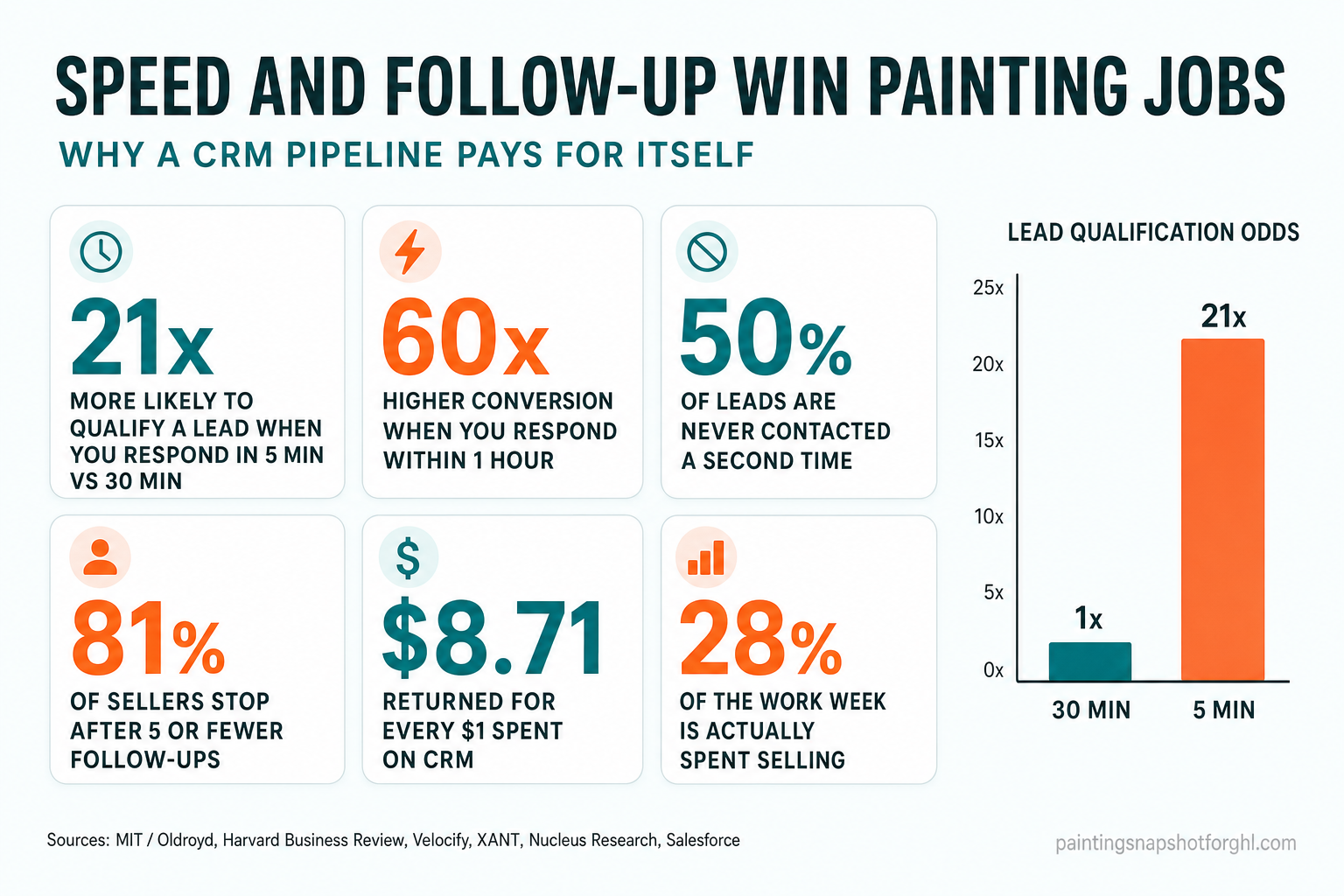
Most Sacramento painting contractors don’t lose jobs on price — they lose them in the gap between “lead comes in” and “someone actually follows up.” A homeowner in East Sac fills out your form at 9 a.m., you’re on a ladder in Elk Grove until 4, and by the time you call back the job is already booked with the painter who answered in five minutes. That gap has a number attached to it: a lead contacted within five minutes is 21× more likely to be qualified than one contacted 30 minutes later (MIT / Oldroyd Lead Response Study). This post breaks down what a messy, sticky-note pipeline actually costs a Sacramento painting business — and the specific CRM and workflow automations that close the leaks.
In this post
- What a “messy pipeline” actually means for a painting shop
- The cost of a slow response, in Sacramento terms
- The follow-up gap: where most paint jobs quietly die
- The admin drain nobody prices in
- What a fixed pipeline looks like (the actual workflows)
- How to fix it without hiring a full-time office manager
- Frequently asked questions
What a “messy pipeline” actually means for a painting shop
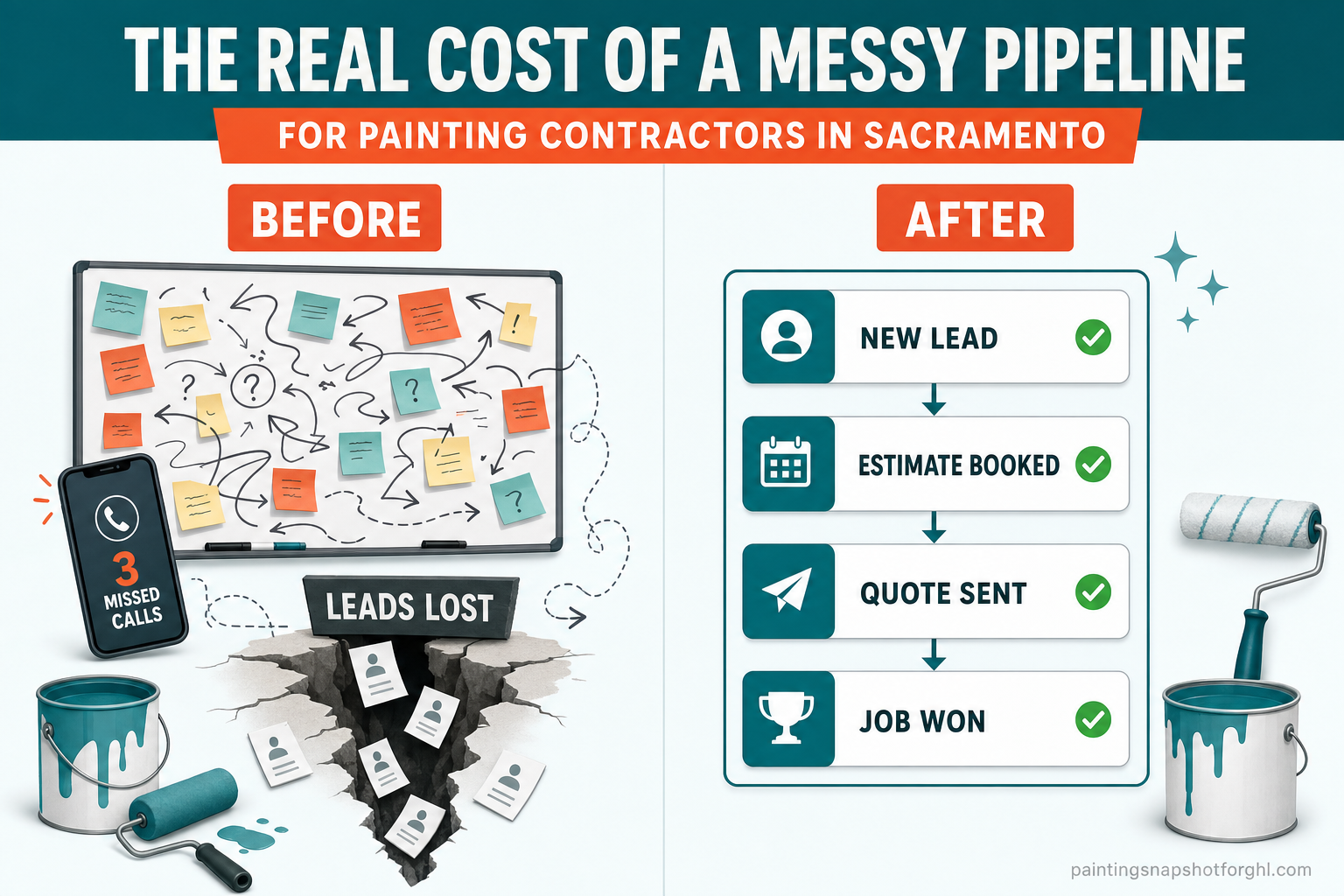
A “pipeline” is just the path a lead takes from first contact to a signed job. For a lot of Sacramento painting contractors, that path lives in five different places at once: missed calls on a cell phone, a few texts, a Facebook message, sticky notes on the truck dashboard, and a memory that’s already half-full with the current job.
That’s not a character flaw — it’s what happens when the owner is also the estimator, the crew lead, and the dispatcher. But a scattered pipeline leaks in predictable places:
- New leads sit unanswered while you’re on a ladder or driving between estimates.
- Estimates get quoted and then forgotten — no second touch, no “just following up.”
- Booked estimates turn into no-shows because nobody sent a reminder.
- Finished jobs never turn into reviews, so the next lead has less reason to trust you.
Sacramento is a real market for this to matter in. The city has roughly 528,000 residents and a homeownership rate near 52% (U.S. Census QuickFacts) — hundreds of thousands of homes, many of them older stock that needs interior and exterior repaints. Nationally, painting is a $49.3 billion industry spread across roughly 231,500 businesses (IBISWorld, 2025). In a metro that competitive, the painter who runs a tight pipeline isn’t necessarily the best with a brush — they’re the one who answers first and follows up every time.
The cost of a slow response, in Sacramento terms
Here’s the uncomfortable math. When a homeowner requests an estimate, they almost never request just one. They fill out two or three forms, or tap the top three Google results, and go back to their evening. Whoever calls back first is talking to a warm buyer with their guard down. Everyone who calls back later is interrupting someone who’s already half-committed.
The research on this is old, large, and remarkably consistent:
- Contact a lead within five minutes and you’re 21× more likely to qualify it than if you wait just 30 minutes. The odds of even reaching the person drop by roughly 100× over that same half hour (MIT / Oldroyd Lead Response Management Study).
- Firms that respond within an hour are 60× more likely to convert a lead than firms that wait 24 hours or more — from an audit of 2,241 U.S. companies (Harvard Business Review).
- And it compounds: an estimated 35–50% of sales go to the company that responds first (Think with Google / CEB).
Relative odds of qualifying a lead by response speed. A five-minute reply is 21× more effective than a 30-minute one. Source: MIT / Oldroyd Lead Response Management Study.
For a painting shop, the villain here isn’t laziness — it’s physics. You can’t answer a phone with a roller in your hand, and you can’t stop mid-cut-line to text a lead back. That’s precisely the job a pipeline is supposed to do for you. An AI caller and instant text-back can greet a new lead in under 30 seconds, ask the two or three questions that qualify a paint job (interior vs exterior, square footage, timeline), and drop them straight onto your calendar — all while your hands are busy. We wrote a full breakdown of that specific leak in missed-call text-back for painters and how to stop losing painting leads after hours.
The follow-up gap: where most paint jobs quietly die
Speed gets the first conversation. Follow-up gets the job. And follow-up is where the leaks turn into a flood — because it’s the least urgent, most forgettable task in a busy week.
Two numbers tell the whole story:
- About 50% of leads are never contacted a second time (Velocify contact-strategy analysis). One call, one voicemail, done.
- 81% of sellers make five or fewer contact attempts (XANT, ~30 million contact attempts analyzed) — even though most deals that eventually close needed more persistence than that.
Translate that to a Sacramento painting shop. A homeowner requests an exterior repaint in March, when the weather’s still iffy. You quote it. They say “let me talk to my spouse.” You get busy. By the time the first dry May weekend arrives — prime exterior season — they’ve forgotten your name and re-Googled. That job didn’t go to a better painter. It went to the one whose CRM sent an automatic “still thinking about that repaint? here’s our May availability” text.
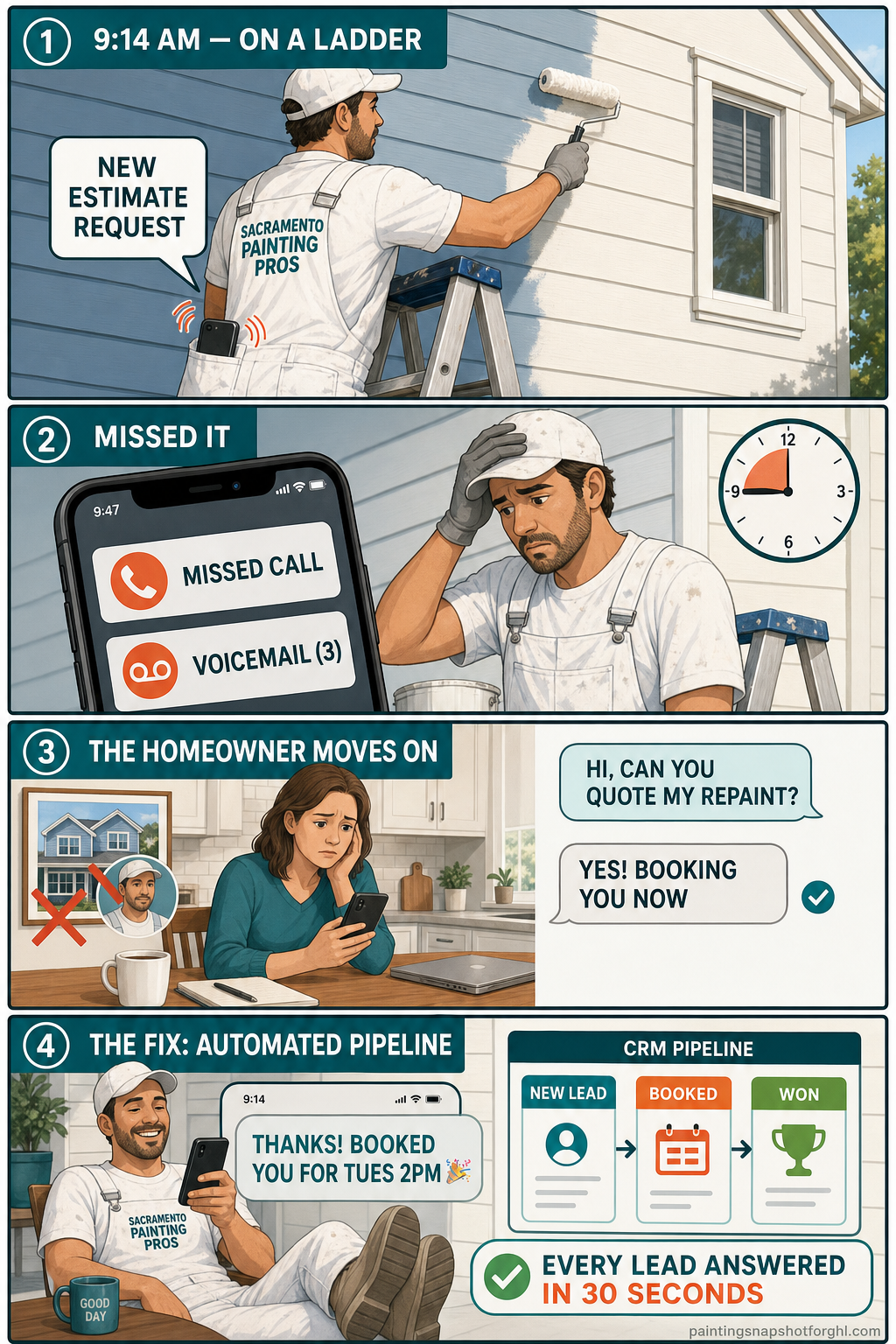
The fix is not “try harder to remember.” It’s a set of workflows that follow up whether or not you remember: a quoted-but-not-booked lead gets a text on day 2, an email on day 4, and a check-in on day 10; a cold lead from last season gets a seasonal re-activation message when the weather turns. This is exactly the kind of unglamorous, revenue-saving automation covered in painting estimate follow-up that actually books jobs and the 5 painting automations every contractor should run.
The admin drain nobody prices in
There’s a quieter cost, too: the hours the owner spends being the CRM. Copying phone numbers into a spreadsheet. Texting reminders by hand. Chasing down which quote went to which house. It feels like work, but it’s the opposite of billable.
The data backs up the feeling. Salespeople spend only about 28% of their week actually selling — down from 34% a few years earlier — with the rest lost to admin, data entry, and manual follow-up (Salesforce State of Sales, 7,700+ professionals). For a painting owner, that “admin” is time you could spend on a ladder, on an estimate, or with your family.
This is why a CRM is one of the best-returning tools a small contractor can buy. Nucleus Research measured CRM software returning $8.71 for every $1 spent at its peak, and even as the category matured, a more recent analysis still put the return near $3.10 per $1 (Nucleus Research). Either number is a return most marketing channels can’t touch — because a CRM doesn’t just find new leads, it stops you from wasting the ones you already paid for.
Return per $1 spent on CRM software. Source: Nucleus Research.
What a fixed pipeline looks like (the actual workflows)
A “CRM” on its own is just a database — it doesn’t fix anything until it’s wired into workflows that run without you. Here’s the specific chain that plugs each leak we’ve walked through, mapped to what a done-for-you CRM and workflow automation build actually installs:
- Instant response. A new lead — form, call, text, or Facebook message — gets an automatic reply within 30 seconds and a tag that starts the clock. No lead ever sits.
- Qualify and route. The lead answers a couple of questions (service type, timeline, ZIP) and is sorted into the right pipeline stage — interior, exterior, cabinet, commercial — so your morning starts with a prioritized list, not a mystery.
- Self-serve booking. Qualified leads see your real availability and book an estimate themselves, with the details pushed to your calendar. This is the appointment automation piece, and it’s why San Jose painters cut no-shows with the same system.
- Reminders and no-show recovery. Confirmation, a 24-hour reminder, and a 1-hour reminder go out automatically; if someone no-shows, a recovery sequence reschedules them instead of losing them. (More on that in reducing painting estimate no-shows.)
- Quote follow-up. A quoted-but-unbooked lead gets a scheduled nudge sequence — day 2, day 4, day 10 — until they book or explicitly say no.
- Review harvesting. When a job is marked complete, the system requests a review, routing happy customers to Google and unhappy ones to you privately first.
Every one of those steps is a place a sticky-note pipeline drops the ball, and a place an automated one quietly wins.
How to fix it without hiring a full-time office manager
The instinct, when the pipeline is a mess, is to hire someone to manage it — a part-time office admin to answer calls and chase quotes. That works, but it’s expensive, it’s another person to manage, and a human still can’t answer a call in 30 seconds at 8 p.m. on a Saturday.
The alternative is to let a system handle the repeatable 90% and keep a human for the judgment calls. Practically, you have three paths:
- Build it yourself in GoHighLevel. Doable if you’re technical and have time — but expect weeks of setup, and the workflows are only as good as your CRM knowledge. Most owners start this and stall halfway.
- Get a done-for-you snapshot. A pre-built painting snapshot drops the entire CRM, pipeline, and 50+ workflows into your account in about 24 hours, branded to your shop — no rebuild, no half-finished automations. See how it compares in Painting Snapshot vs. building it yourself.
- Add a GHL virtual assistant. If you want a human on the judgment calls — reviewing quotes, handling odd requests — a dedicated GHL VA runs the system day to day so you don’t have to touch the dashboard.
Whichever path you pick, the goal is the same: no lead waits, every quote gets followed up, every booking gets a reminder, and every finished job asks for a review — automatically. That’s not a bigger phone or a better memory. It’s a pipeline that runs itself, so a Sacramento painting owner can spend the day on the ladder instead of in the inbox.
If you’re weighing the full picture of what leads cost and where they leak, how much a painting lead actually costs and local SEO for painters are good companion reads. Prefer to just see it live? Book a quick demo or compare pricing.
Frequently asked questions
What is a sales pipeline for a painting business?
A pipeline is the path a lead takes from first contact to a signed job — typically stages like New Lead, Estimate Booked, Quote Sent, and Job Won. In a CRM, each lead sits in a stage so you can see at a glance who needs a call, who needs a reminder, and who's ready to close. A 'messy pipeline' is when that path lives across missed calls, texts, and sticky notes instead of one system, which is where leads leak.
How fast do I really need to respond to a painting lead?
As fast as physically possible — ideally within five minutes. A lead contacted within 5 minutes is about 21× more likely to qualify than one contacted after 30 minutes (MIT/Oldroyd study), and responding within the first hour makes conversion roughly 60× more likely than waiting a day (Harvard Business Review). Since you can't answer a phone with a roller in your hand, an automated instant text-back or AI caller is the practical way to hit that window every time.
Do I need a CRM if I'm a small Sacramento painting crew?
If you're getting more than a handful of leads a week, yes. A CRM is what stops leads from falling through the cracks — about half of all leads are never contacted a second time without a system nudging you. CRM software has been measured returning $8.71 for every $1 spent (Nucleus Research), largely because it recovers leads you already paid to generate rather than needing you to find new ones.
Will automation make my painting business feel impersonal?
Done right, it's the opposite. Automation handles the timing — the instant reply, the reminder, the follow-up nudge — so a real conversation actually happens instead of a lead going cold in a voicemail box. The homeowner gets a fast, professional response every time, and you get to have the human conversation when it matters, at the estimate. The system removes the delays, not the relationship.
How long does it take to set up a painting CRM pipeline?
Building it yourself in GoHighLevel typically takes weeks, and the workflows are only as strong as your CRM skills. A done-for-you painting snapshot installs the full CRM, pipeline, and 50+ workflows — instant response, booking, reminders, no-show recovery, quote follow-up, and review harvesting — into your account in about 24 hours, branded to your shop. You can also add a dedicated GHL virtual assistant to run it day to day.
What does a done-for-you painting snapshot include?
It's a complete GoHighLevel system built for painting contractors: instant lead response and AI caller, an AI website chatbot, SMS and social follow-up automations, self-serve estimate and color-consult booking, appointment reminders and no-show recovery, a 50+ workflow CRM, review harvesting, and a conversion-ready website — all installed and branded to your business. You can watch every piece run in a free 30-minute live demo before you decide.
Travis is a recovering project manager who ran scheduling for a commercial and HOA painting outfit before moving into systems consulting. He is the person crews call when the pipeline is a mess of sticky notes and missed reminders. He maps the messy real-world back office of a painting business into clean GoHighLevel workflows, and he writes about appointments, no-show recovery, and the unglamorous automations that quietly save the most money.
Related posts
- Missed-Call Text-Back for Painters: Never Lose a Lead to Voicemail
- Painting Estimate Follow-Up That Actually Books Jobs
- Reduce Painting Estimate No-Shows
- Appointment Automation for Painting Contractors in San Jose
- 5 Painting Automations Every Contractor Should Be Running
Painting Snapshot builds done-for-you GoHighLevel automation systems and fast websites for house painting contractors. We are not a painting company and do not perform painting work or quote project pricing. The speed-to-lead, follow-up, CRM ROI, and industry figures above are drawn from the cited third-party sources (MIT/Oldroyd, Harvard Business Review, Think with Google/CEB, Velocify, XANT, Nucleus Research, Salesforce, IBISWorld, and U.S. Census) and reflect general industry benchmarks, not a guarantee of results for any specific business. Snapshot features and pricing reflect current published terms and may change — verify on our pricing page.