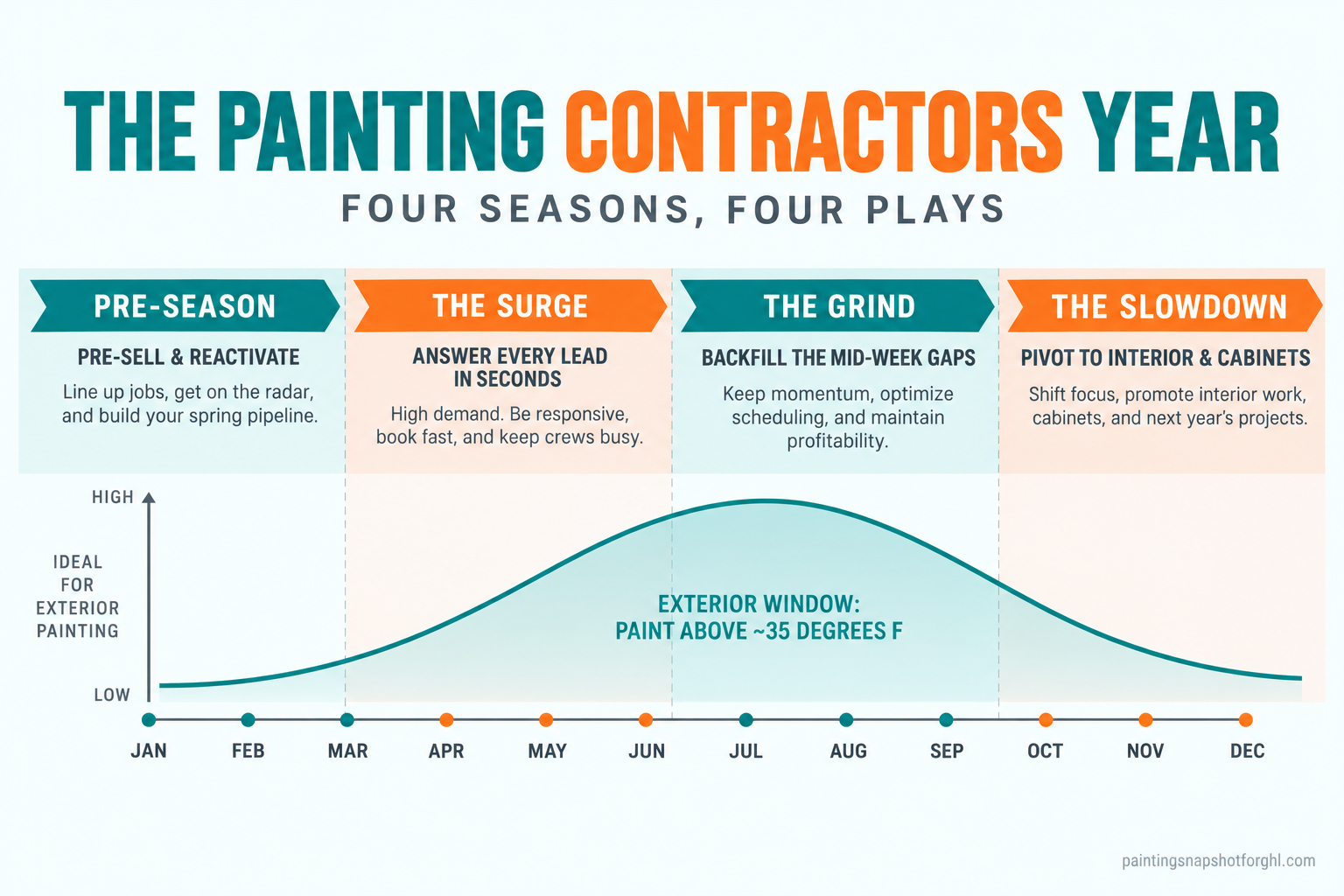
It is the second week of November and you already know how January is going to feel. The exterior phone has gone quiet, two of your guys are asking about hours, and the deposits that felt endless in July are now a spreadsheet you refresh too often. Every painter who went out on his own learns the same thing in year one: the work is seasonal, but the truck payment, the insurance, and the mortgage are not. So how do you stay booked all year? You stop treating the calendar as weather and start treating it as four distinct jobs: prep and pre-sell in the quiet months, protect your response speed during the surge, fill the mid-week gaps before crews go idle, and pivot hard to interior, cabinets, and your unsold backlog when the exterior window closes. The shops that run this calendar on purpose book through the slow months. The ones that only react to the weather ride the swing down every winter.
In this post
- What the seasonal swing actually costs you
- The painting year has four phases
- Phase 1: Pre-season
- Phase 2: The surge
- Phase 3: The grind
- Phase 4: The slowdown
- Steal these messages
- The same year for a solo, a crew, and a big shop
- Compliance you can’t skip in any season
- Straight answers to the objections
- Frequently asked questions
What the seasonal swing actually costs you
The Bureau of Labor Statistics counted about 342,200 painter jobs in 2024, with a median wage of $48,660 a year and roughly 28,100 openings projected each year through 2034. None of that tells you how to make payroll in February.
The swing is real. Contractors report that peak summer months run several times busier than deep winter, and most shops quietly cut rates in the cold months to keep a crew moving. That is the trap: you do your cheapest work when you have the least room to negotiate.
But the money you lose in the slow season is not mostly lost in the slow season. The jobs that would have filled January were sold, or not sold, back in September while you were too busy to pre-book them. And every estimate you gave during the surge and never chased is a January job you already paid to generate and let go cold. The research on speed is blunt: firms that reached a lead within an hour were nearly seven times as likely to reach a decision maker as those that waited one hour longer, and the average first response was 42 hours.
The painting year has four phases
Forget “busy season” and “dead season.” There are four phases, and the one that decides whether you work in winter is the surge, not the winter.
What sets the exterior window is overnight low temperature, not the calendar. Sherwin-Williams notes that older exterior products needed 50°F, while newer low-temperature lines like Duration, Resilience, SuperPaint, and A-100 are rated down to about 35°F. The common mistake is painting when the afternoon is warm but the night drops below that floor, so the paint stops coalescing and dew settles into an uncured coat. Here are Denver’s average overnight lows by month, from the NOAA 1991 to 2020 normals.
Denver average overnight low temperature (°F) by month. The reliable exterior window sits where the line clears about 35°F, roughly May through September. Source: NOAA U.S. Climate Normals, 1991 to 2020.
A Denver shop has a solid exterior window of roughly May through September, with April and October forecast-dependent. A Phoenix shop is different: its January average low is about 46°F, above the paint floor, so it paints most of the year but loses the summer midday to flash-drying heat. Your own window lands somewhere between. Map it once, and the four phases fall out of it.
Phase 1: Pre-season
Pre-season is the stretch just before your exterior window opens, late winter into early spring. The shops that win the year treat these weeks as a sales season.
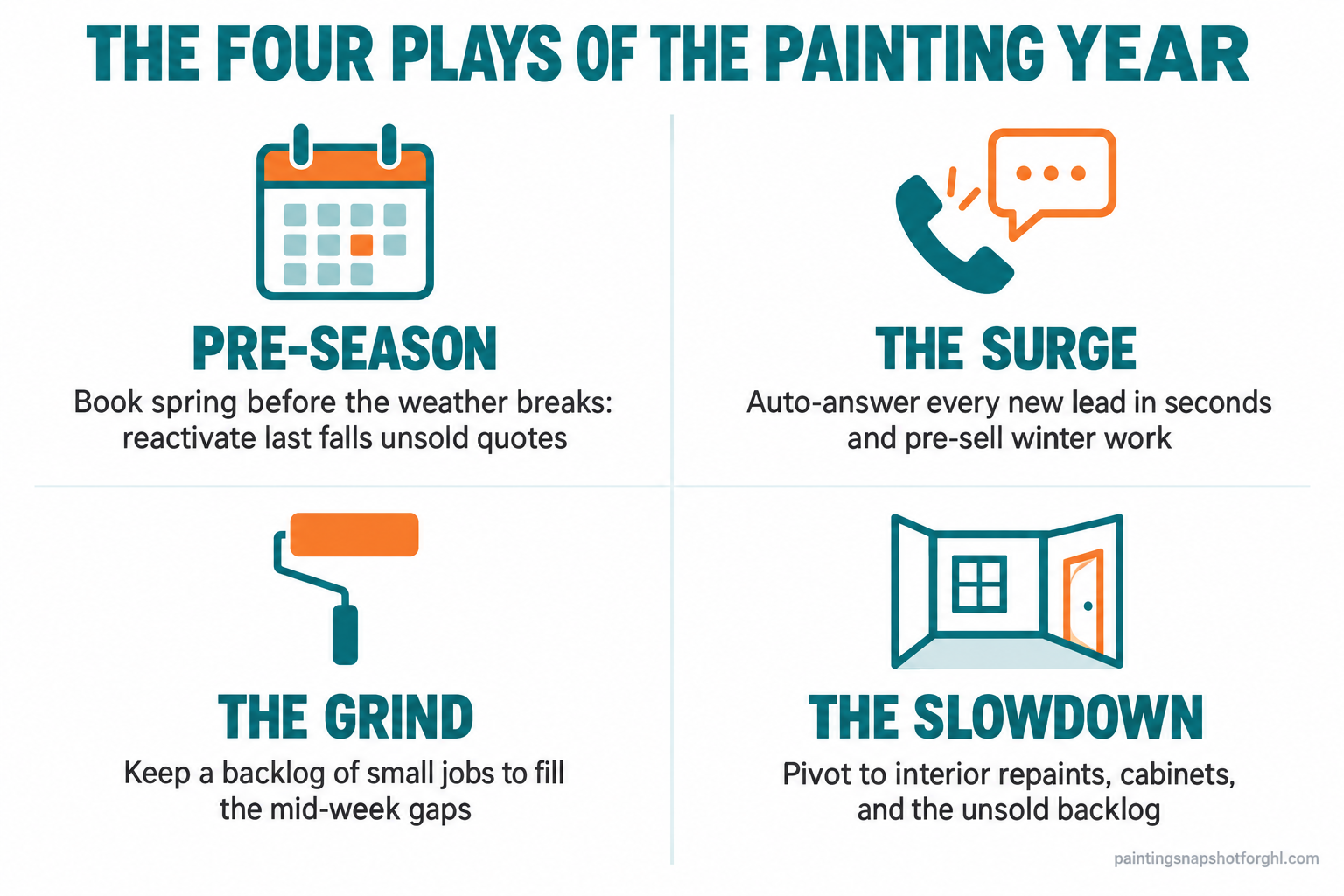
The play: get your spring calendar half-booked before the weather breaks. Reach back to every estimate you gave last fall that never closed, every past customer due for a repaint, and every homeowner you told to “call me in spring.” Spring is now. Beat the rush and you book at full price while competitors wait for the phone to ring. This is also the window for the unglamorous prep: renew your license and insurance, confirm your EPA lead certification is current, and service the sprayers.
How it breaks: you wait for inbound. You do nothing in February and spend April scrambling to fill May instead of starting May already booked. The counter is a short reactivation campaign to your old list: not a blast, a real message that sounds like you. The copy is below.
Phase 2: The surge
The surge is your money season, and it is where you lose the most money without noticing. When you are slammed, leads pile up behind the work you already have, and your response time falls apart exactly when demand is highest.
A homeowner who fills out your form in July does not wait. If you cannot call back for six hours, two other painters already have. The seven-times-within-an-hour finding hits hardest in the surge, when the most leads are in play and your bandwidth is most stretched.
So the first surge play is to make the first response stop depending on you being free. The touch that says “got your request, when works for a quick look” should fire in seconds whether you are on a roof or asleep, which is the case for an automated front end on your lead flow. Our missed-call text-back guide covers the simplest version, and why your best leads book someone else goes deeper on the speed gap.
The second surge play is to pre-sell winter while homeowners are in buying mode. Every exterior customer in July is a potential interior customer in January. Mention it on the job: “we do interiors and cabinets in the off-season, want me to pencil you in for a winter quote?” That fills your slow calendar months before it goes quiet.
How it breaks: you let follow-up slide because you are “too busy to sell.” You never catch up in the fall, and every unchased quote is a job you paid to generate and then abandoned. Speed and follow-up are not things you do when you have time. They are what pays for the time.
Phase 3: The grind
The grind is mid-season, busy but with holes in the schedule. A crew finishes a repaint Thursday at noon and the next job does not start until Monday. That afternoon and Friday are paid time with no revenue against it, and a few of those a month is the difference between a good year and a flat one.
The problem is not a shortage of work. It is sequencing: the next job is not ready, the deposit has not cleared, the color is not confirmed, so the crew sits. The play is to always keep a short, flexible job in your back pocket, a one-day interior room or a fence stain, that can slot into a gap on a day’s notice. Our keep-your-crew-booked playbook breaks down the dispatch logic. The second play is to make sure the next job is truly ready before the current one ends. A booked job with an unpaid deposit is a maybe, not a job.
How it breaks: you schedule back to back with no buffer, and one rain day cascades into a crew standing around. The fix is a backlog of small work and a rule that a job is not on the schedule until the deposit is in.
Phase 4: The slowdown
The slowdown is when your exterior window closes, late October in Denver, earlier in Minneapolis, barely at all in Phoenix. It is a pivot, not a stop, and the shops that pivot early work through it.
The pivot has three parts. First, interior repaints: homeowners want their walls done before the holidays and again in the dead of winter, and modern low-VOC paints have removed most of the old objection to painting with the windows closed. Second, cabinet refinishing, a high-ticket, indoor, weather-proof job that fills January. Third, the quiet money: work the backlog. Every estimate you never closed is a warm lead in a spreadsheet, and a structured estimate follow-up sequence turns a real share of cold quotes back into booked work.
To see why the pivot is mandatory in cold climates, look at the winter floor. A crew in Denver or Minneapolis cannot apply most coatings when nights sit in the teens. A Phoenix crew can.
Average January overnight low (°F) vs the ~35°F floor for modern low-temperature exterior paint. Phoenix stays above it; Denver sits far below. Sources: NWS Phoenix, NOAA Normals (Denver), Sherwin-Williams.
How it breaks: you treat winter as time off and start the pivot in January, too late. The jobs that fill December and January are sold in October and November.
Steal these messages
Here is the copy for the four seasonal moments that cost shops the most. Keep the plain tone, and set up your texting with proper consent first (more below).
One more pays all year: the review request, fired the day the job wraps. “Really enjoyed working on your place, {first name}. If you were happy with the crew, a quick Google review helps a small shop like ours more than you’d guess. Here’s the direct link.” Our guide to getting more 5-star reviews covers the routing that keeps unhappy ones private first.
The same year for a solo, a crew, and a big shop
The four phases are universal. How you run them is not.
The solo painter or two-person shop. Your enemy is your own time. You are the estimator, the painter, and the office, so the surge is when follow-up dies: you cannot climb down to answer a lead. Your highest-payoff move is an automated first response, so a July lead gets a reply in seconds without you touching the phone. In the slow season you pivot almost entirely to interior and cabinet work you can do solo.
The five-person crew. Your enemy is the mid-week gap. With one crew, an idle Thursday is a big chunk of that week’s revenue gone, so you need a backlog of small, flexible jobs and a hard deposit rule. In the surge you need the estimate pipeline to flow without you touching every step, which is where a real pipeline and workflow setup earns its keep.
The ten-plus painter shop. Your enemy is leakage you cannot see. At your volume, a 10 percent drop in response speed during the surge is a large number of lost jobs that never shows up as one event. You need measurement: how fast a lead gets answered, how many estimates get a real chase, your close rate by season. Your slow season runs crews on interior and commercial work, which is steadier year-round.
Compliance you can’t skip in any season
Three rules follow you through every phase, and all three can cost real money.
First, lead paint. The EPA Renovation, Repair and Painting rule requires a certified firm and trained workers for paid work that disturbs painted surfaces in pre-1978 homes, once you pass about 6 square feet of interior or 20 square feet of exterior surface. It matters most in the slow season, when your winter pivot pushes you into older interior repaints where lead is most likely, and the EPA estimates that roughly three-quarters of pre-1978 homes still contain some lead-based paint. Certification lasts five years, so renew it in pre-season.
Second, texting law. Every message in this playbook runs on text, so the TCPA and A2P 10DLC registration apply: real consent, a clear way to opt out, and a registered number, with per-message fines for getting it wrong. Our full compliance checklist lays out the consent language and the registration steps.
Third, advertising. In California, the CSLB requires a license for most work over $1,000, and Business and Professions Code 7030.5 requires your license number in all advertising, including your website and truck wraps. Texas requires no state general contractor license. Know your own state’s rule; the fix is often a free website change.
Straight answers to the objections
“I’ve painted for 15 years. I know my season.” You know your weather. The calendar here is about when you sell, follow up, and pivot. Most owners who know their season cold still lose winter revenue to estimates they never chased.
“Won’t the automated texts annoy my customers?” Not when they are short, sound like you, and respect a no. These are the follow-up you would do by hand anyway. What annoys a homeowner is the painter who never calls back.
“I already pay for Jobber or Housecall Pro.” Good, keep it. Those tools run the job you already booked: scheduling, invoicing, payments. None of them answers a brand-new lead in seconds during the surge or runs a multi-week chase on an unsold estimate. That is a different layer in front of your CRM, and it is where the seasonal revenue leaks.
“The slow season is my only time off.” Take it. The point is that the system keeps working while you do, so January stays booked without you living on the phone.
Frequently asked questions
When does the painting slow season actually start?
It starts when your overnight lows drop below the floor for your paint, not on a fixed date. Modern low-temperature exterior paints are rated to about 35°F and older ones to 50°F, so a cold climate like Denver closes its exterior window around October while Phoenix can paint most of the year. The slow season for sales, though, starts in late fall, which is why pre-selling winter work during the summer surge matters.
How do I keep my painting crew busy in winter?
Pivot to indoor work before the exterior window shuts. Interior repaints and cabinet refinishing are high-ticket, weather-proof jobs that fill December and January, and modern low-VOC paints have removed most of the old objection to painting indoors. The second lever is your backlog: chase every unsold estimate with a structured follow-up sequence. The jobs that fill a slow month are usually sold in October and November, not January.
What is the best time of year to market a painting business?
Market ahead of each phase, not during it. Promote exterior services in late winter before the window opens, pre-sell interior and cabinet work during the summer surge while customers are in buying mode, and run reactivation campaigns to your old list in the quiet weeks. Marketing during the surge is often wasted because you cannot keep up with the leads you already have.
Can you paint exteriors in cold weather?
Only within the paint's rated temperature, and the binding number is the overnight low and the surface temperature, not the warm afternoon. Sherwin-Williams notes that low-temperature lines like Duration and Resilience are rated to about 35°F, but if the night drops below that the paint can stop coalescing and dew can settle into the uncured coat. Check the data sheet and the forecast lows.
Do I need EPA lead certification for winter interior jobs?
If the home was built before 1978 and you are paid to disturb more than about 6 square feet of interior painted surface, yes, you need a certified firm and trained workers under the EPA RRP rule. Winter interior repaints push you into exactly the older homes where lead is most common, so your slow-season pivot raises your exposure. Certification lasts five years, so renew it during pre-season.
The truck payment does not take the winter off, so neither can your pipeline. Back to that second week of November. The shop that pre-sold interior work all summer, holds a backlog of small jobs, and runs an automated chase on last year’s unsold estimates does not dread January. It is already half-booked. The calendar does not control your year. How you run its four seasons does.