
It is 7:40 on a Thursday and your phone buzzes on the ladder tray. A new lead. You cannot answer because you are cutting in a ceiling line and both hands are full. By the time you climb down it has stopped ringing. You tell yourself you will call back at lunch, forget, and finally call at 6pm to get voicemail. She booked the painter who texted her at 7:41.
That is not a price problem. It is a follow-up problem, and the cheapest one you will ever fix. The painter who won did not have a bigger crew or a lower number. He had a text that fired the second her call went unanswered. The words were already written, sitting in his phone, so he never had to think about what to say.
This post is that script, and every other one you need: the missed-call text, the instant web-lead reply, the follow-up sequence for a quiet estimate, the no-show save, the review request, and the live phone script. All of it is copy-paste. Swap in your company name, and you will stop losing jobs you already won.
In this post
- What silence actually costs you
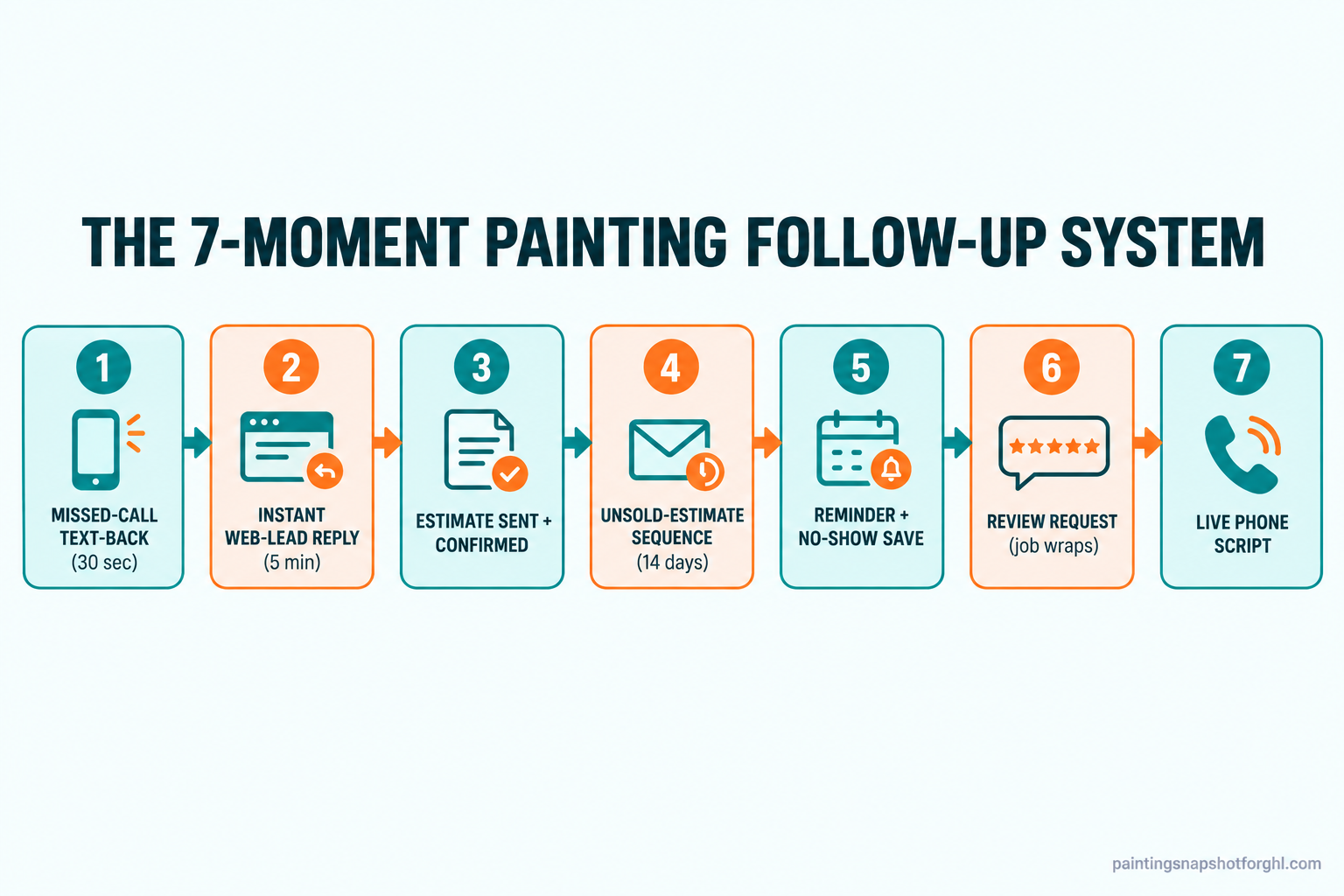
- The seven moments that need a script
- Script 1: the missed-call text-back
- Script 2: the instant web-lead reply
- Script 3: the estimate sent and confirmed
- Script 4: the unsold-estimate sequence
- Script 5: the reminder and no-show save
- Script 6: the review request and routing
- Script 7: the live phone script
- Running the scripts by shop size
- The consent and compliance fine print
- Objections I hear every week
- Frequently asked questions
What silence after the estimate actually costs you
Most owners never put a number on the jobs that die in silence, so the leak stays invisible. Start with speed. Research by Dr. James Oldroyd with InsideSales and MIT found that contacting a web lead within five minutes instead of thirty makes a company about 21 times more likely to qualify it (Harvard Business Review, 2011). A homeowner who waits three evenings has already read someone else’s estimate. Yet in a secret-shopper study of 466 home-services companies, only about 60 percent even responded within five business days (Pro Remodeler, 2018). The bar to beat is comically low: just answer, and answer fast.
Here is the money math. Say you walk 12 estimates a week and close about a third. Of the ones you lose, a large share go quiet, not “no.” If a written sequence recovers one extra job a month at roughly $1,500 gross profit per repaint, that is $18,000 a year, against a median U.S. painter wage of about $49,400 (BLS, with roughly 326,900 painter jobs in 2025, Bureau of Labor Statistics). That is a third of a painter’s pay left on the table because nobody sent three texts.
Reviews compound all of it. About 75 percent of consumers regularly read online reviews before choosing a local business, and only 3 percent say they never do (BrightLocal, 2024). The review request is not an afterthought. It is what makes the next lead cheaper to win.
The seven moments that need a script
Follow-up feels like a hundred little decisions, but it is really seven moments. In each one the homeowner is deciding whether you are the organized pro or the guy who disappears. Write a script for all seven, load them into your phone or CRM, and you never have to think about what to say again.
Below is every script, verbatim. The bracketed parts are the only things you change. Keep each message short and give one clear next step.
Script 1: the missed-call text-back
This is the highest-return script in the set. When a call goes unanswered, an automatic text fires back within 30 seconds so the caller never hits a dead voicemail. It is the difference between the 7:41 painter and you.
Hi, this is [Your Name] with [Company Name]. Sorry I missed
your call, I'm on a job site. What's the address and what are
you looking to get painted? I'll set up a quick estimate.
Timing: instant, inside 30 seconds. Manual callbacks lose the race every time.
How it breaks: sending it from a number the homeowner cannot reply to. The whole point is a two-way thread, so send it from the same number they called. The setup is in our guide to missed call text back for painters.
Script 2: the instant web-lead reply
A form fill or a Facebook lead is a hand in the air, and right now that homeowner is on your competitor’s site too. Reply inside five minutes.
Hi [First Name], it's [Your Name] at [Company Name]. Got your
request about painting the [interior / exterior / cabinets] at
[address]. We do a lot of work in that area. Are you free [day]
at [time] or [day] at [time] for a quick 20-minute walk-through?
I'll bring colors.
Pair it with a quick voicemail if you can.
Timing: under 5 minutes. After 30 minutes your odds fall off a cliff.
How it breaks: a generic “Thanks, we’ll be in touch.” It reads like a robot and never asks for the appointment. Always offer two specific times. A yes/no closes faster than an open “when works for you.”
Script 3: the estimate sent and confirmed
You walked the job and sent the written estimate. Most painters go silent here and pray. Confirm it landed and set the expectation that you will follow up. This one text prevents half your ghosting.
Hi [First Name], just emailed over your estimate for the
[project] at [address]. You'll see a standard and a premium
option in there. Take a look when you get a sec, and I'll
check back in a couple days in case any questions come up. No
rush, and thanks for having me out.
Timing: within 10 minutes of sending the estimate, while you are still fresh in their mind.
How it breaks: sending the estimate with no message, so it sits unopened in a spam folder while you assume they said no. The text also earns you permission to follow up, so the next messages feel expected.
Script 4: the unsold-estimate sequence
This is where the real money hides. A quiet estimate is not a no. It is a busy homeowner who got distracted. The painter who sends a calm, friendly sequence over two weeks books a chunk of these back. The painter who sends one text and quits books almost none. Space it out and stop the moment they reply.
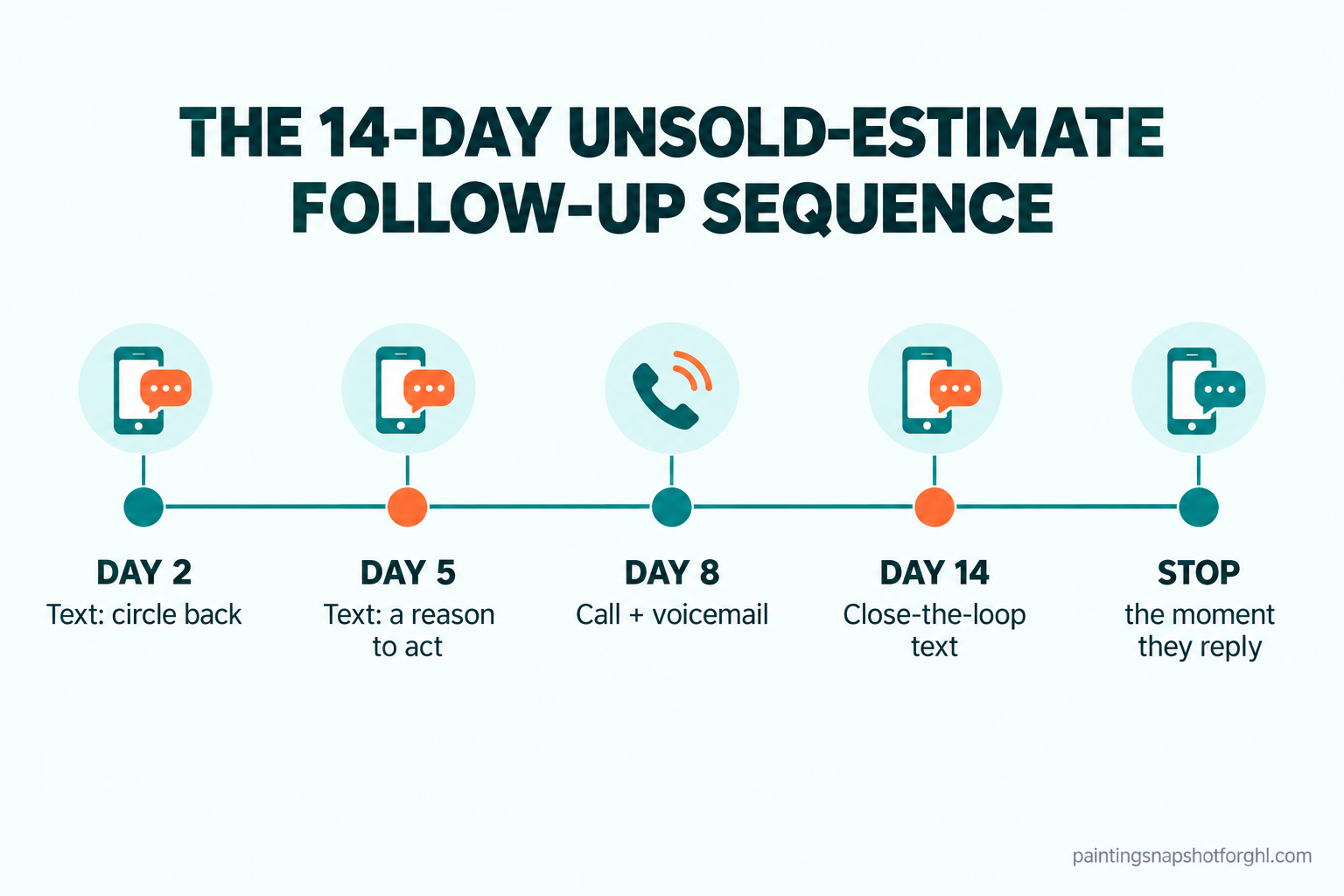
Day 2, text:
Hi [First Name], circling back on the [project] estimate. Any
questions on the scope or the options? Happy to walk through
anything over the phone.
Day 5, text (add value, do not just nag):
Hey [First Name], no pressure on the paint project. One thing
worth knowing: [reason to act, e.g. "we're booking about 2
weeks out, so to get it done before the holidays we'd want to
lock a date soon"]. Want me to pencil you in?
Day 8, call + voicemail if no answer:
Hi [First Name], [Your Name] with [Company Name]. Wanted to
catch you live about the painting estimate and answer anything.
Call me back at [number] when you get a minute, or text me.
Thanks!
Day 14, the “close the loop” text (this wins back more jobs than any other):
Hi [First Name], I don't want to keep bugging you, so this is
my last check-in. Are you still planning to move forward on the
[project], or should I close out the file for now? Totally fine
either way, just let me know.
How it breaks: sending all four in three days, or making every message a nag. The Day 5 message must carry a real reason to act (a booking window, a seasonal deadline, a paint price change). The Day 14 “should I close your file” text works because it gives the homeowner an easy out, and loss aversion does the rest. Our painting estimate follow-up sequence breaks down each touch.
Upper-bound open and response rates, SMS vs email. Source: FCC Consumer Advisory Committee, 2022. These are ceilings, but the gap is why text follow-up beats email.
Script 5: the appointment reminder and no-show save
A booked estimate the homeowner forgets is a wasted drive. Two reminders cut no-shows hard, and a save text rescues the ones who flake.
24 hours before, text:
Hi [First Name], reminder that [Your Name] from [Company Name]
is stopping by tomorrow [day] at [time] for your paint estimate
at [address]. Reply C to confirm or R to reschedule.
2 hours before, text:
On my way shortly for your [time] estimate, [First Name]. I'll
text when I'm 10 minutes out. Anything specific you want me to
look at?
No-show save (send 15 minutes after a missed appointment):
Hi [First Name], swung by for the estimate but looks like I
caught you at a bad time, no worries. Want to grab a new time?
I'm open [day] or [day]. Still happy to get you that quote.
How it breaks: reminders that only confirm and never make it easy to reschedule. Give them the C/R reply so the ones who need a new time tell you instead of ghosting. More in our guide to reducing painting estimate no-shows.
Script 6: the review request and negative-review routing
The job is done and the check cleared. This is the 24-hour window where the homeowner is happiest and most likely to leave a glowing review. Ask now, by text, with the direct link. Wait a week and you lose most of them.
Review request (send the day the job wraps or the next morning):
Hi [First Name], it was a pleasure painting your [project]!
We're a small local crew and reviews are how folks find us. If
you were happy, would you mind leaving a quick review here?
Takes 30 seconds: [direct Google review link]. Thank you!
If they reply unhappy (route to a conversation, never to silence):
I'm really sorry it's not perfect, [First Name]. That's not how
we leave a job. Can I call you in the next hour to make it
right?
How it breaks: two ways. Asking too late, so the glow is gone. Or “gating” reviews by trying to block unhappy customers from posting. Do not do that. The FTC’s rule on consumer reviews, in effect since 2024, prohibits suppressing honest negative reviews (Federal Trade Commission). Route unhappy customers to a conversation so you can fix the work, but never stand between a customer and their public review. See how to get more 5-star painting reviews.
Script 7: the live phone script
When you answer live, the first 20 seconds decide whether you get the address or get hung up on. Painters ramble or launch into price. Control the call instead: greet, qualify, book.
"[Company Name], this is [Your Name]."

(They describe the project.)

"Great, we do a lot of that. So I can get you the right number,
a few quick things:
 - What's the address?
 - Interior, exterior, or both?
 - Roughly how many rooms / sides of the house?
 - When are you hoping to have it done?

Perfect. The best way to price it accurately is a quick
20-minute look. I've got [day] at [time] or [day] at [time],
which is easier?"

(Book it.)

"You're on the calendar for [day/time]. I'll text a
confirmation now so you've got my number. See you then,
[First Name]."
How it breaks: giving a price over the phone before you have seen the job. A phone number is not a bid. The goal of the call is the appointment, not the quote. Qualify, book, then confirm by text.
Running the scripts by shop size
The scripts are the same. How you run them changes with the size of your shop.
Solo operator. You are the crew, the estimator, and the office, and you cannot watch your phone from a ladder. Automate the missed-call text-back and the web-lead reply at minimum, and save the rest as two-tap phone shortcuts. The win is never dropping a lead because both hands were full of a roller.
Five-person shop. Now a part-timer or a spouse handles the phone, and the risk shifts from “nobody answers” to “it depends who answers.” Standardize it: the scripts become the house style so every lead gets the same fast response, and the follow-up calls get assigned as tasks so they never slip.
Multi-crew company. With several crews and a real pipeline, leads fall between the cracks of multiple calendars. Here the scripts live in your CRM as workflows tied to pipeline stages: a lead hits “estimate sent,” the Day 2 / 5 / 8 / 14 sequence starts on its own, and a rep only steps in to take a reply. A missed follow-up here is not one lost job, it is a leak across dozens a month.
The consent and compliance fine print
Texting people for business comes with rules. Get them right once and you can stop worrying.
Consent. A text that simply replies to someone who just called or messaged you is a response to their contact. The moment you send marketing texts (a seasonal offer, a “book now” nudge to an old lead), you need prior express written consent and a working opt-out on every message. The Telephone Consumer Protection Act (TCPA) is the law here. In January 2025 the Eleventh Circuit vacated the FCC’s “one-to-one consent” rule in Insurance Marketing Coalition v. FCC, so the stricter version never took effect (Morrison Foerster, 2025). The core duty did not change: get clear consent, honor STOP.
The opt-out. Include a plain opt-out in your marketing texts and honor it instantly:
Reply STOP to opt out.A2P 10DLC registration. If you send business texts from a regular 10-digit number, U.S. carriers require you to register your brand and campaign through The Campaign Registry, or the traffic gets filtered and your “instant” text never arrives. The most common reason registration is rejected is a weak opt-in description, so document how people consent (Twilio A2P 10DLC guidance). Your license number belongs in your advertising too, which in several states includes your website and texts. The full rundown is in our painting contractor compliance checklist.
Objections I hear every week
“Won’t an automated text annoy people?” Only if it reads like a robot or shows up at the wrong time. A reply that says “Sorry I missed you, I’m on a job site, what are you looking to get painted?” relieves people, because they got an answer. The annoying option is silence. Keep the copy human, cap the follow-ups at the sequence above, and stop the instant they reply.
“What if I already pay for Jobber or Housecall Pro?” Keep it. These scripts live on top of whatever you use to quote and schedule. The follow-up and instant-response layer is a separate job from the estimating software, and most painters are missing it entirely. Our painting lead management system breakdown shows how the pieces fit.
“Do I need to be technical to set this up?” No. The scripts are copy-paste, and the automation is a one-time setup someone does for you, or you build once from a template, and then it runs. That is what a done-for-you system is for.
“I’m too busy to follow up.” That is the whole point. You are too busy, which is why the busy-season leads die. The scripts exist so the follow-up happens whether or not you remember, whether or not you are on a ladder. The sequence does not take a day off.
Frequently asked questions
What is the single most important painting follow-up script?
The missed-call text-back. It fires automatically within 30 seconds of an unanswered call and starts a two-way thread, so for a painter who is often on a ladder, it wins the leads you physically cannot answer.
How fast do I need to respond to a new painting lead?
Under five minutes for a web lead. Research with InsideSales and MIT found that responding in five minutes instead of thirty makes you about 21 times more likely to qualify it. For a live call, answer it or let an automatic text catch it in 30 seconds.
How many times should I follow up on an estimate that went quiet?
Four to five touches over about two weeks: Day 2, 5, 8, and a final Day 14 'should I close your file' message, with a call around Day 8. Most painters quit after one, which is why the jobs they already bid go to someone else.
Is it legal to text my painting leads?
Yes, with consent. Replying to someone who contacted you first is fine. Marketing texts require prior express written consent under the TCPA and a working STOP opt-out, and your business number needs A2P 10DLC registration with The Campaign Registry so carriers deliver the messages.
When should I ask for a review?
The day the job wraps or the next morning, by text, with a direct link to your Google review page. That is the 24-hour window when the homeowner is happiest. Never block unhappy customers from reviewing you; route them to a conversation to fix the work instead.
Should I give a price over the phone?
No. A phone number is not a bid. Use the live phone script to qualify the job and book a short in-person walk-through, then send a written estimate. Quoting blind either loses you money or scares off the customer.
So go back to that 7:40am buzz on the ladder tray. The version of you with these scripts loaded never loses that lead, because the text fired before you climbed down. The quiet estimate gets four warm nudges instead of silence. The happy customer gets asked for a review while still smiling at their fresh walls. None of it depends on you remembering or being free. Write the words once, and let them do the chasing you never have time to do.