
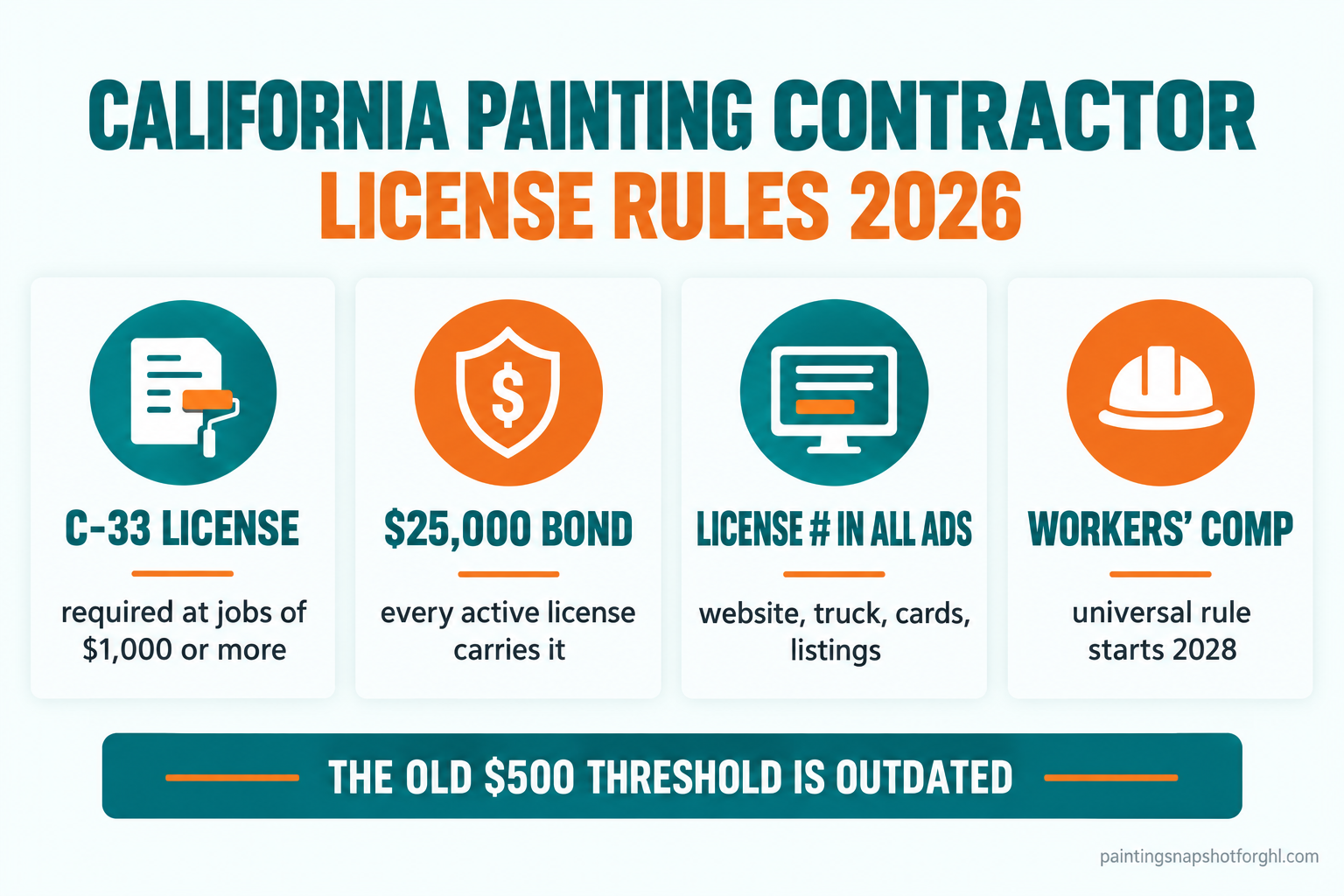
It is a Saturday in the Central Valley and a homeowner just asked, on your estimate, whether your license number is on your truck. It isn’t. You start Googling, and the first three blogs all say California makes you get a license once a job tops $500. All three are wrong. The real number in 2026 is $1,000, the license you need is the C-33, your contractor bond is $25,000, and your license number has to appear in every ad you run, including your website and your truck. Get those four right and you are legal. Get the advertising one wrong and a competitor you underbid can report you for the price of a stamp.
What this guide covers
- Do you even need a California painting license?
- The C-33 license and what it takes to get one
- Workers’ comp in 2026: the rule everyone gets wrong
- Where California law makes you put your license number
- The lead-paint rule that targets painters
- Can you legally text and call your California leads?
- Steal this: the exact compliance copy
- Three California shops, three realities
- Straight answers to the objections
- Frequently asked questions
Do you even need a California painting license?
Short answer: almost certainly yes, and the line is lower than most painters think.
California’s “minor work” exemption lets you do small jobs without a license. For years that line sat at $500. Not anymore. On January 1, 2025, AB 2622 raised the exemption in Business and Professions Code 7048 from $500 to $1,000. A job where the combined price of labor and materials hits $1,000 or more requires a CSLB license. One bedroom and a hallway clears that line. Any real exterior does.
Here is the part the blogs skip: the dollar threshold is not the only trigger. You need a license, at any price, if any of these are true:
- The job needs a building permit.
- You advertise yourself as a contractor (and yes, a website counts).
- You hire anyone to help you, even one day-labor painter.
Read that middle one again. The moment you run a site that says “licensed painting contractor” or a Facebook ad for exterior work, the $1,000 cushion is gone.
How this breaks. A new painter runs $600 repaints all spring, figures he is under the line, then hires his nephew and takes a $4,000 exterior. Both needed a license, the employee one from day one. The CSLB treats unlicensed contracting as a misdemeanor, and he cannot use the courts to collect on work already done. For most two-to-ten-painter shops, all four triggers are true, so the question is not whether to get licensed, but how fast.
The C-33 license and what it takes to get one
The license painters hold in California is the C-33, Painting and Decorating Contractor. The CSLB defines its scope as preparing surfaces and applying coatings for decoration and protection, inside and out. To get one, the CSLB wants four things:
- Experience. Four years of journey-level or higher painting experience, verifiable by someone who saw you do it.
- Two exams. A C-33 trade exam and a separate Law and Business exam. The Law and Business half is where the rules on this page show up, so a chunk of this guide is literally on the test.
- The $25,000 contractor bond. Every active license carries a Contractor’s Bond of $25,000. It rose from $15,000 on January 1, 2023, so a guide quoting $15,000 is stale too. You do not pay $25,000; you buy a surety bond, and good credit keeps the premium to a few hundred dollars a year.
- A workers’ comp decision. A policy or a signed exemption, covered below because the rule just moved.
How this breaks. Painters treat the bond like a fee and forget what it is. It is not insurance for you. It pays a customer or employee who wins a claim against your license, then the surety bills you back. It does not replace general liability or workers’ comp. A shop that thinks “I’m bonded, I’m covered” is one bad job from learning the difference.
California’s “minor work” license exemption threshold, in dollars. A job at or above the current line needs a CSLB license. Raised from $500 to $1,000 by AB 2622, effective January 1, 2025. Source: CSLB, AB 2622 Implementation Bulletin.
Here is the regulatory stretch painters actually have to track, because three separate numbers moved in a four-year window.
- •Jan 1, 2023
Contractor bond rises to $25,000
SB 607 raised the Contractor's Bond from $15,000 to $25,000 for every active license.
- •Jan 1, 2025
License threshold rises to $1,000
AB 2622 raised the minor-work exemption from $500 to $1,000. Jobs at or above $1,000 now need a license.
- •Jan 1, 2028
Workers' comp becomes universal
SB 1455 delayed the all-licensee workers' comp requirement from 2026 to 2028. Until then, a no-employee C-33 can still file for exemption.
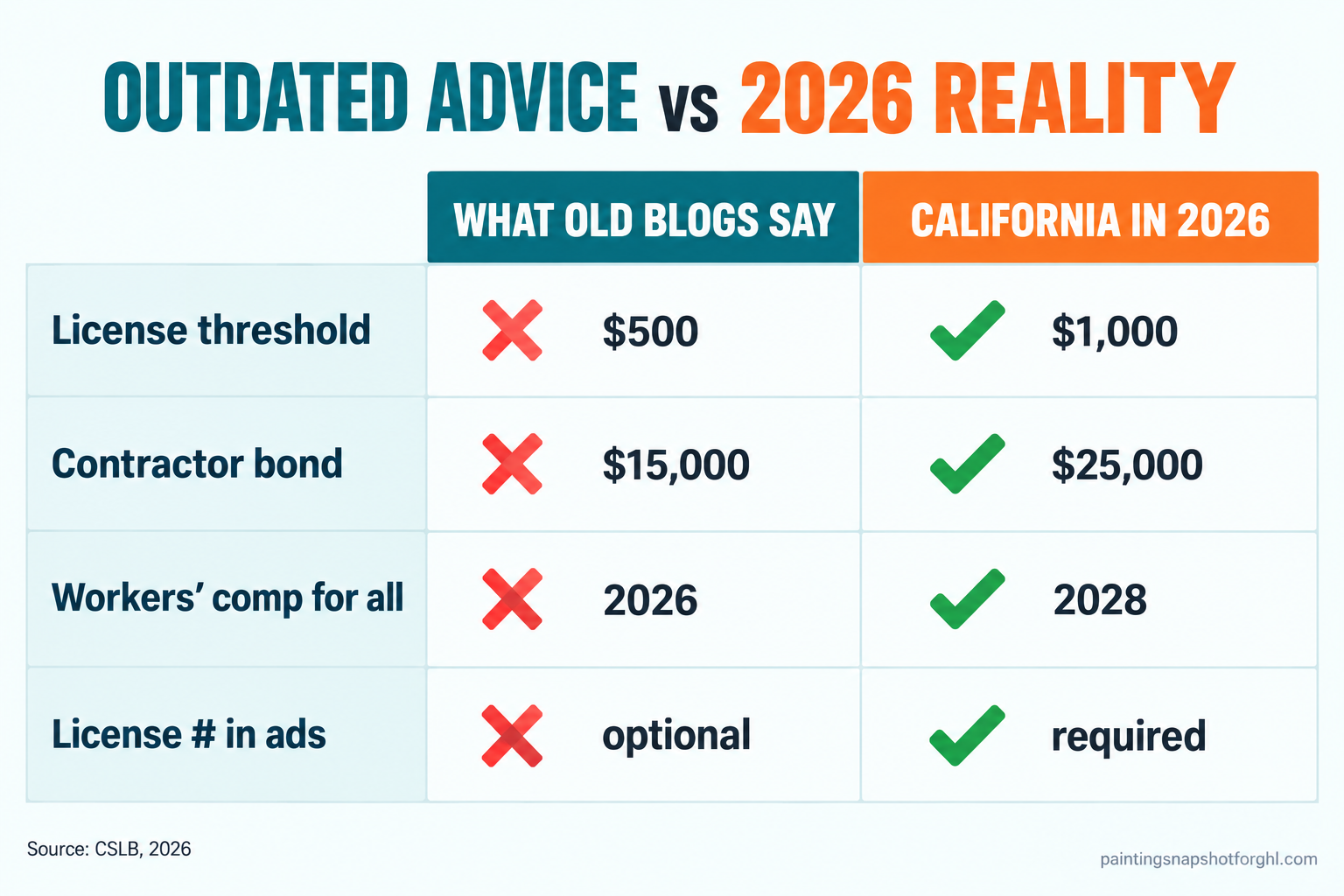
What most contractor-marketing sites still say versus the current California rule. Sources: CSLB AB 2622, CSLB bond bulletin, CSLB SB 1455, and B&P Code 7030.5.
Workers’ comp in 2026: the rule everyone gets wrong
This is where half the advice online is already out of date, so slow down.
A 2022 law, SB 216, set out to require every licensed contractor to carry workers’ comp even with zero employees. The switch-on date for remaining classifications, including C-33 painters, was January 1, 2026, which is why a lot of 2024 and 2025 articles tell you every California painter needs a policy in 2026, period.
They are wrong, because the date moved. SB 1455 pushed the universal requirement to January 1, 2028. What is actually true for a C-33 right now:
- With employees: you must carry workers’ comp. Always the rule, no change.
- Solo, no employees: you can still file a Certificate of Exemption with the CSLB in 2026.
- Trades that must carry it even with no employees today are concrete (C-8), HVAC (C-20), asbestos (C-22), tree service (D-49), and roofing (C-39). Painting is not one of them yet.
How this breaks. It breaks both ways. One painter panics at an old article and buys a policy a true solo does not need. Another hires his first helper mid-season and keeps his exemption on file, which is now false. The second is the dangerous one. The day you put anyone on a ladder for pay, the exemption is void and you need coverage. Do not file an exemption you are about to break.
Where California law makes you put your license number
This is the rule that turns into a complaint, and the easiest one to fix. Business and Professions Code 7030.5 says every licensee “shall include his license number” in all contracts, subcontracts and bids, and all forms of advertising. The CSLB reads “advertising” broadly. Per CSLB guidance, it covers:
- Your website, every page.
- Your vehicles and truck decals (CSLB has a bulletin on this).
- Business cards, flyers, and door hangers.
- Your Google Business Profile, Yelp, and social listings.
- Print, radio, and TV, if you run any.
The number is small. The exposure is not. An ad without the license number is a violation the CSLB can act on, and the people who report it are rarely customers. They are the licensed competitors you just beat on a bid.
Now flip it around. You spend half your week worried about the guy underbidding you with no insurance and no license. He cannot legally advertise or put a number on his truck, because he has none. Your number, displayed where the law wants it, is the fastest trust signal a California homeowner has.
Do not confuse 7030.5 with Business and Professions Code 7030, which requires your written home-improvement contracts to carry the specific CSLB consumer notice. The advertising rule is about ads; the 7030 notice is about contracts.
The lead-paint rule that targets painters
California is full of pre-1978 housing, and that is where the federal lead-paint rule reaches into your trade. The EPA’s Renovation, Repair, and Painting (RRP) Rule says paid work disturbing paint in homes or child-occupied buildings built before 1978 must be done by an EPA Lead-Safe Certified firm, with the work performed or directed by a certified renovator. This is not a rare edge case: the EPA reports about three-quarters of U.S. homes built before 1978 still contain some lead-based paint. Scrape, sand, or power-wash an old exterior, and you are disturbing it.
The part that catches solo operators: a firm has to be certified to even advertise or perform RRP work, and a one-person shop is a firm. “I’m just a painter” is not a defense.
How this breaks. You repaint a 1950s bungalow, do great work, and never mention certification. Federal lead-paint penalties are among the steepest a small contractor can face, and the fix is cheap next to the fine: the firm certification and one-day renovator course cost a few hundred dollars and last for years. On a pre-1978 home, test, document, and work lead-safe.
Can you legally text and call your California leads?
Texting is the fastest follow-up there is. Two rules keep your texts legal and, just as important, actually delivered.
TCPA: consent and STOP. The federal Telephone Consumer Protection Act requires prior express consent before marketing texts or calls, and it requires you to honor an opt-out. The FCC treats a reply of “STOP” as a clear way to pull consent. In plain terms: get a yes before you text, stop the second they ask.
A2P 10DLC: register or get filtered. This one silently costs you jobs. U.S. carriers require any business texting from a regular 10-digit number to register the business and its campaign through The Campaign Registry. Skip it and carriers quietly filter your messages. Your estimate follow-up does not bounce with an error. It just never arrives.
California also runs its own privacy regime on top of federal law, so your intake and opt-out language matters more here than in most states. Keep a record of who said yes and when.
Steal this: the exact compliance copy
Lift this language. Swap in your real license number and business name.
License-number line for your website footer and every landing page:
Licensed and bonded in California. CSLB License #123456 (C-33, Painting and Decorating). Fully insured.
Truck, cards, and flyers (meets the 7030.5 “all advertising” rule):
[Your Business Name] | Painting | CA CSLB #123456
The home-improvement contract notice (the 7030 consumer notice, placed in your written contract):
Contractors are required by law to be licensed and regulated by the Contractors State License Board, which has jurisdiction to investigate complaints against contractors. Any questions concerning a contractor may be referred to the registrar, Contractors State License Board, Sacramento, CA.
(Confirm the current exact wording and mailing address with the CSLB before you print it, because the board updates the notice.)
SMS opt-in checkbox on your estimate request form (TCPA consent):
I agree to receive text messages from [Your Business Name] about my estimate and appointment. Message and data rates may apply. Reply STOP to opt out. Consent is not a condition of purchase.
The missed-call text-back (the single highest-value automation for a painter):
Hi, this is [Name] at [Your Business Name]. Sorry I missed your call. Were you looking for a painting estimate? Reply here and I’ll get you on the schedule. CA CSLB #123456.
That last one is the difference between a booked estimate and a voicemail nobody checks. Every message should carry consent on the way in and your number where it counts, which is exactly what a built-out follow-up system handles on its own.
Three California shops, three realities
The rules are the same statewide. What you do about them changes with your size.
The solo painter or two-person shop. Get the C-33, carry the $25,000 bond, and if you truly have no employees, file the workers’ comp exemption honestly. Put your number on your site, truck, and cards, and get EPA firm certified so you can legally take the pre-1978 jobs, which in California is most of the good residential work. The trap at this size is staying “under the line” on purpose. At $1,000, that limits you to jobs that barely cover gas.
The five-person crew. You have employees, so workers’ comp is mandatory today, not a 2028 question. Your license number needs to be consistent across the website, trucks, cards, and Google profile, and that is where most shops this size have a gap: one truck has it, the website doesn’t. This is also where TCPA and 10DLC stop being theoretical. You text enough leads that filtered, unregistered messages quietly cost you estimates.
The multi-crew shop. Several crews, estimators, an office team, maybe a commercial or HOA book. Compliance is now a system, not a task: qualifying individuals, multiple vehicles, contracts that need the 7030 notice, real exposure on old-building lead work. Make it automatic. The number is baked into every template, the contract notice into your contract software, consent captured before a text goes out. You cannot hold it in your head across a dozen people.
Straight answers to the objections
“I only do small residential jobs, so I don’t need a license.” At $1,000 the exemption barely covers one room with materials, and if you advertise, pull a permit, or hire anyone, you need the license at any price. For a real two-to-ten-painter shop, it does not apply. Get the C-33.
“The bond covers me if something goes wrong.” It does not. The $25,000 bond pays a customer or employee who wins a claim against your license, then the surety bills you back. You still need general liability and, with employees, workers’ comp.
“Putting my license number everywhere invites complaints.” The opposite. Not displaying it is the violation. Displaying it proves you are legal and separates you from the uninsured underbidder who legally cannot advertise at all.
“I heard every California contractor needs workers’ comp in 2026.” You heard a date that moved. SB 1455 pushed the universal requirement to January 1, 2028. In 2026, a genuine solo C-33 with no employees can still file the exemption. The second you hire, that changes.
“Do I really need lead-paint certification for a normal repaint?” If the home predates 1978 and you are paid to disturb paint, yes. The firm certification is cheap. The federal penalty for skipping it is not.
What job size requires a contractor license in California in 2026?
$1,000. A job where combined labor, materials, and other items reach $1,000 or more needs a CSLB license. AB 2622 raised the threshold from $500 to $1,000 effective January 1, 2025. You also need a license at any price if the job requires a building permit, if you advertise as a contractor, or if you employ anyone.
Which license do painters need in California?
The C-33 Painting and Decorating Contractor license from the Contractors State License Board (CSLB). It covers surface preparation and applying coatings for decoration and protection, interior and exterior.
How much is the California contractor bond for painters?
$25,000. The Contractor's Bond rose from $15,000 to $25,000 on January 1, 2023. You do not pay the full amount; you buy a surety bond, and the yearly premium is typically a few hundred dollars depending on your credit.
Do solo painters in California need workers' comp in 2026?
Not if you truly have no employees. SB 1455 delayed the universal requirement from 2026 to January 1, 2028, so in 2026 a solo C-33 with no employees can still file a Certificate of Exemption. With even one employee, workers' comp is mandatory now.
Does my license number have to be on my website and truck?
Yes. Business and Professions Code 7030.5 requires your license number in all advertising, which the CSLB reads to include your website, vehicle decals, business cards, flyers, and online listings like Google Business Profile and Yelp, plus contracts and bids.
Do I need lead-paint certification to repaint an older California home?
If the home predates 1978 and you are paid to disturb paint, you generally need to be an EPA Lead-Safe Certified firm using a certified renovator under the federal RRP Rule. About three-quarters of pre-1978 U.S. homes still contain lead-based paint, and California has many of them.
Is it legal to text my painting leads in California?
Yes, with two conditions. The TCPA requires prior express consent before marketing texts and honoring STOP opt-outs. And to get delivered, you must register your business and campaign for A2P 10DLC through The Campaign Registry, or carriers filter your messages.
The quiet advantage of getting this right
Compliance reads like paperwork, so most painters do the minimum and move on. That is the mistake. Your displayed C-33 number and your lead-safe certification are exactly what the uninsured underbidder can never match. Fix the website line once, register your texting, file your bond and workers’ comp honestly, and get lead-safe certified. Then spend the rest of your week on the thing no paperwork does for you: answering the lead before the next painter does.
For the national version of these rules, see our painting contractor compliance checklist for 2026. To stop handing jobs to the painter who answers first, read why your best painting leads book someone else and how to stop losing jobs to cheaper bids. For the texting rules in depth, see our SMS marketing guide for painters.