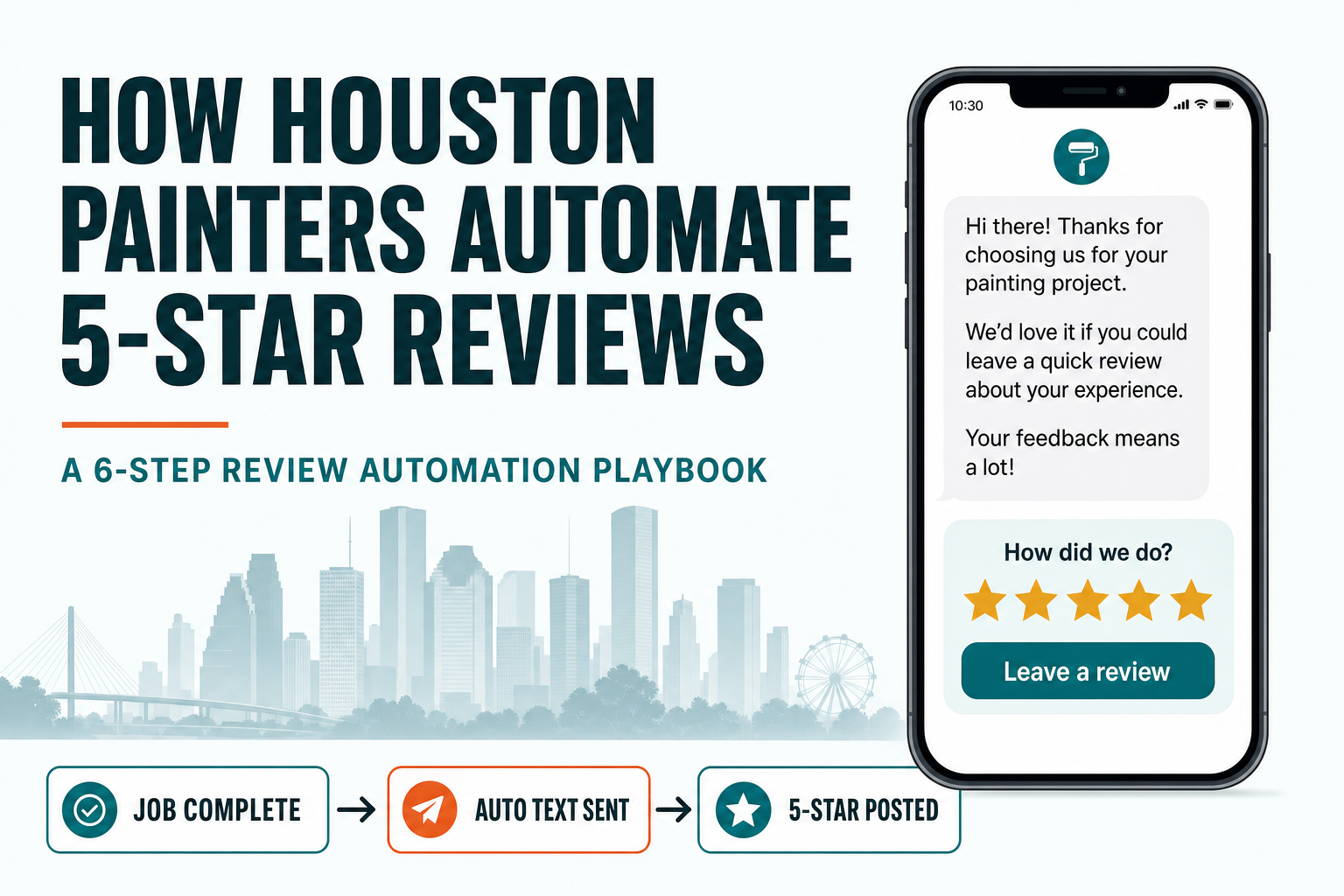
To automate 5-star reviews for a Houston painting business, wire a system that fires the moment a job is marked complete: it texts the customer a one-tap review link within an hour, routes happy customers to Google and unhappy ones to you privately, and auto-replies to every review that posts. Done by hand, the “ask” gets skipped the second the next job pulls you away. Done by automation, every finished job in Katy, The Heights, or Sugar Land turns into fresh social proof — the exact signal that decides which painter a Houston homeowner calls next. This playbook lays out the six steps, the real numbers behind each one, and how to switch it on inside GoHighLevel.
In this post
- Why reviews decide which Houston painter gets the call
- What “review harvesting automation” actually means
- The 6-step automated review system
- What a Houston painter should expect
- Turning it on inside GoHighLevel
- Frequently asked questions
Why reviews decide which Houston painter gets the call
Houston is one of the busiest home-services markets in the country, and it keeps getting bigger. The metro passed 7.9 million residents in 2025, adding roughly 127,000 people in a single year, with Harris County leading every county in the nation for raw numeric growth (Houston CultureMap, 2025 Census data). About 53.8% of Harris County households are owner-occupied (Kinder Institute for Urban Research, Rice University, 2025) — and every one of those homes is a future interior repaint, exterior job, or cabinet refinish.
That demand is the good news. The bad news is how crowded the field chasing it is. Nationally, house painting is a $28.2 billion industry spread across 223,209 contractor businesses (IBISWorld, 2025) employing about 342,200 painters (U.S. Bureau of Labor Statistics, 2024). When a homeowner in Memorial or Pearland searches “house painter near me,” the map pack shows three businesses. Which three? Increasingly, the ones with the most recent, highest-rated reviews.
Here’s why that’s not a soft “reputation matters” point — it’s ranking math. Review signals now account for roughly 20% of what determines Local Pack position, second only to Google Business Profile signals at 32% (Whitespark, 2026). And it’s not just quantity — recency, star average, and whether you respond all feed the algorithm. (If ranking in the map pack is your goal, pair this with the fundamentals in our local SEO guide for painters.)
Then there’s the human side of the same coin. Before a Houston homeowner lets a crew into their house for a week, they read. In BrightLocal’s research, 38% of consumers say a business must average at least 4 stars to be trustworthy, and 59% want to see between 20 and 99 reviews before they’ll trust that average (BrightLocal, 2025). Thin or stale profiles quietly lose jobs you never hear about.
What “review harvesting automation” actually means
Review harvesting automation is a workflow that turns every completed job into a review request — automatically, at the right moment, through the right channel, with the unhappy customers filtered out before they ever reach a public page.
Most painters already know they should ask for reviews. The problem is that asking is a human task, and humans are inconsistent. You finish a great cabinet job in Bellaire, fully intend to text the homeowner for a review, then three new estimates come in and it slips. Multiply that by a busy summer and you’ve got dozens of thrilled customers who would have left five stars if anyone had asked. The gap between “meant to ask” and “asked every time” is where your reputation leaks.
Automation closes that gap by removing the human from the timing. The system watches your pipeline, and the instant a job is marked complete, it does the asking — the same way, every time, whether it’s job number 3 or job number 300 this month. It’s the difference between a discipline you have to maintain and infrastructure that just runs. (It pairs naturally with the missed-call text-back and SMS follow-up automations that catch leads on the front end.)
The 6-step automated review system
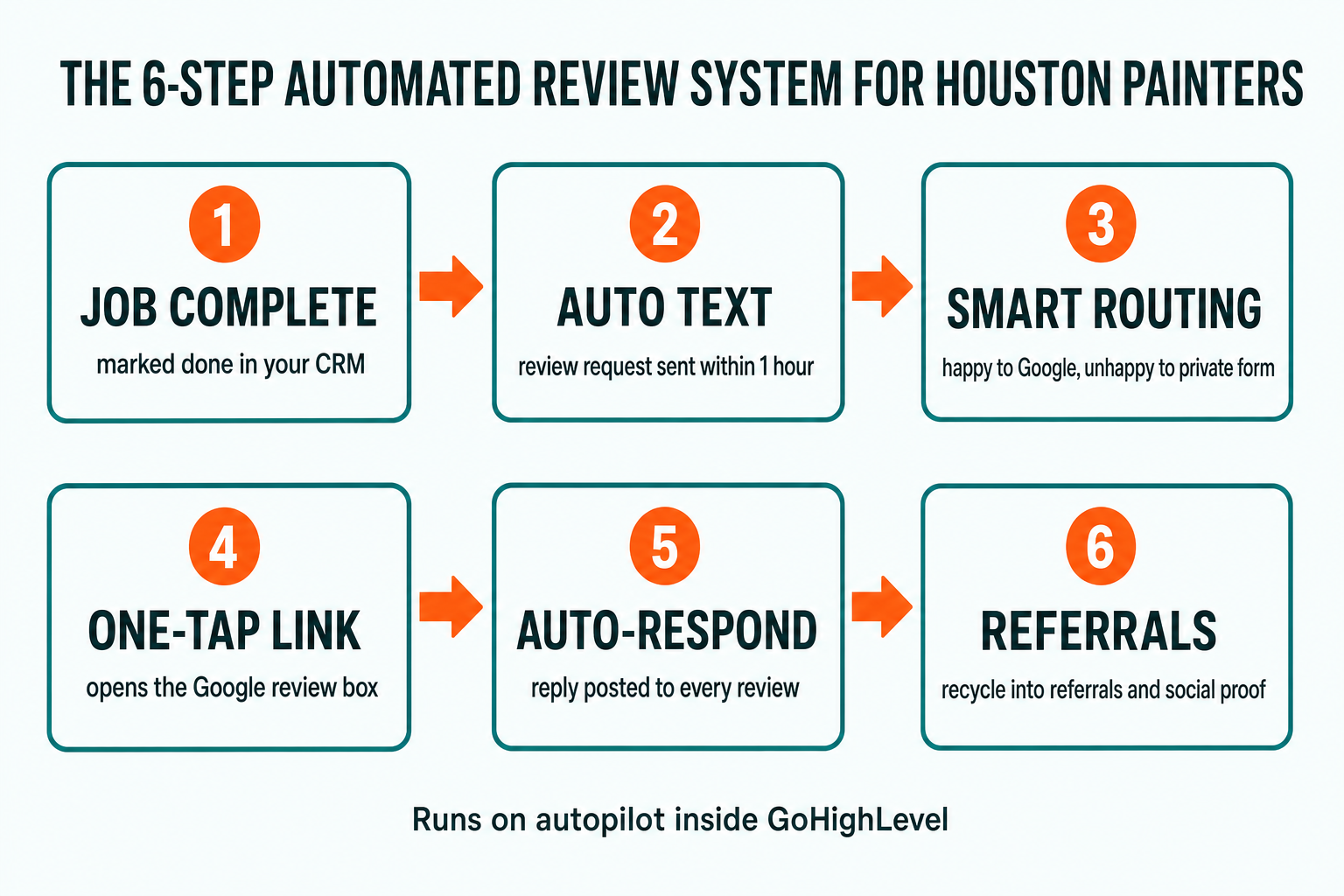
Here is the full loop, start to finish. Each step maps to a real workflow you can build in GoHighLevel, and each solves a specific reason painters fail to get reviews by hand.
Step 1 — Trigger on job completion
The whole system hangs on one event: the job being marked complete in your CRM. When a crew lead or your office manager moves a job to “Completed” (or scans the final walkthrough as done), that status change fires the workflow. No sticky note, no end-of-week catch-up, no “did we ask the Klein job?” The trigger is the job itself.
This is why the automation lives inside your pipeline rather than in a separate reviews app. The moment of truth — job done, customer delighted — is a data event your CRM already has. You’re just attaching an action to it.
Step 2 — Ask fast, and ask by text
Timing is the single biggest lever. The request should go out while the customer is still standing in a freshly painted room, at peak delight — not a week later when the glow has faded and the message feels random. Set the delay to under an hour after completion.
Channel is the second lever, and the data is lopsided. Text messages get a 98% open rate and about a 45% response rate; email requests open at 40–50% (GatherUp). A review link buried in an unopened email earns nothing. A text gets seen almost every time. Lead with SMS, and let email be the backup for anyone who didn’t respond.
Text review requests are opened almost twice as often as email and drive far more responses. Percentages shown; email open rate is the midpoint of GatherUp’s 40–50% range. Source: GatherUp — SMS vs. Email Review Requests.
The ask itself works because people say yes when prompted. BrightLocal found the share of consumers who “always” leave a review when asked rose to 19% in 2024 (up from 12% in 2023), and 69% recalled leaving a review after a business prompted them in the past year (BrightLocal, 2024). Asking works. Asking every time, instantly, by text, works far better.
Step 3 — Smart-route by satisfaction
A good system never blasts every customer straight to a public Google page and hopes. It checks satisfaction first. The initial text asks a simple question — “How did we do?” — and branches:
- Happy customers get the one-tap public review link immediately, while they’re glowing.
- Anything less than thrilled gets routed to you privately — a short feedback form or a direct text to the owner — so you hear about the problem and can make it right before it becomes a public one-star.
This does two jobs at once. It steadily grows your public five-star count from the customers who loved the work, and it catches the rare unhappy customer in private, where you can fix a paint-line touch-up or a scheduling miss and often turn them around. Your public rating climbs while your worst moments stay off the internet — and you get an early-warning system for real service issues.
Step 4 — Make the Google review one tap
Even a happy customer won’t jump through hoops. If leaving a review means logging in, searching for your business, and hunting for the right button, most give up. The automation removes every step of friction: the text contains a direct link that opens your Google review box, ideally with the rating pre-selected, so all the homeowner has to do is type a sentence and hit submit.
A gentle prompt helps too — “feel free to mention the rooms we painted and how the crew treated your home.” Customers often want to leave a review but freeze on what to say; a small nudge gets words flowing, and keyword-rich reviews (“kitchen cabinet repaint in Sugar Land”) quietly help your local ranking on top.
Step 5 — Auto-respond to every review
Getting the review is only half the win. Responding is a ranking and conversion signal in its own right. BrightLocal found 88% of consumers would choose a business that responds to all its reviews, versus 47% for one that responds to none, and most expect a reply within two to three days (BrightLocal, 2024). Whitespark counts response behavior among its review ranking signals, too — and it’s a wide-open gap, because only about 5% of businesses consistently respond to their reviews (BrightLocal, 2024).
Doing that by hand is another task that slips. Automated review response — the kind our Google My Business reply automation handles — drafts and posts a warm, on-brand reply to each new review within minutes, flagging anything negative or nuanced for your personal touch. Every reviewer feels heard, every prospect scrolling your profile sees an engaged business, and Google sees an active, responsive listing.
Step 6 — Recycle reviews into referrals and proof
The loop doesn’t end at “review posted.” Two weeks after the job — while the customer is still enjoying their new walls — the system sends a low-pressure referral ask, because a happy painting customer is sitting on a goldmine of neighbors who can literally see the work. (We break the mechanics down in our painting referral program guide.) Meanwhile, your best new reviews can auto-feed your website and social proof widgets, so the five stars you earned this week are working on the next Houston homeowner comparing three bids tonight.
What a Houston painter should expect
Set the right expectation: this isn’t a growth hack that doubles your leads next week. It’s a compounding asset. The math is simple — if you close even 15 repaint jobs a month and the system reliably converts a healthy share into reviews, you go from a trickle to a steady stream of fresh five-star ratings that never stops.
That stream moves the three numbers that matter together: total reviews, average rating, and recency. And those numbers move revenue. Remember the Harvard Business School finding — a one-star increase in average rating drove a 5–9% revenue increase for independent businesses (Michael Luca, HBS, 2016). Womply’s study of 200,000+ businesses points the same direction: those with more than the average number of reviews earned 82% more annual revenue (Womply). For a painting shop doing $40,000 a month, the top of the HBS range is a real number, earned from work you already did.
Illustrative monthly reviews for a shop closing ~15 jobs/month: inconsistent manual asking captures a handful; automated asking after every completed job captures far more. Figures are illustrative of the consistency gap, grounded in BrightLocal’s finding that most prompted customers do leave a review. Source: BrightLocal, 2024.
The honest catch: results depend on the volume and quality of your work. Automation makes the asking perfect; it can’t make a bad job good. But for the many Houston shops doing genuinely great work and simply failing to ask consistently, closing that one gap is the highest-return marketing move available — and it costs nothing per review.
Turning it on inside GoHighLevel
The whole system runs on GoHighLevel workflows: a pipeline trigger, an SMS/email step, a conditional branch for satisfaction routing, a review-link action, and an automated response layer wired to your Google Business Profile. You can build it yourself if you know the platform — or skip the build entirely.
The Painting Snapshot installs this exact review harvesting engine into your GoHighLevel account, pre-built and wired to your pipeline, in about 24 hours. The trigger, the one-hour text, the smart routing, the one-tap Google link, the auto-responses, and the referral follow-up all ship ready to run — branded to your Houston shop. You keep doing great work; the system turns each finished job into proof. (New to GoHighLevel? See how it stacks up in our GoHighLevel vs Jobber comparison.)
Frequently asked questions
How do painting contractors in Houston automate Google reviews?
Connect a workflow to your CRM pipeline so that when a job is marked complete, it automatically texts the customer a one-tap Google review link within an hour, routes unhappy customers to a private form instead, and auto-responds to every review that posts. In GoHighLevel this is a single pre-built automation; the Painting Snapshot installs it wired to your pipeline in about 24 hours.
Is it against Google's policy to filter out unhappy customers?
You cannot 'gate' reviews by blocking negative ones from a public page you control. What's fine — and what smart routing does — is ask every customer about their experience first, then send only the satisfied ones a direct review link while giving dissatisfied customers a private channel to reach you. You're choosing who to actively prompt, not suppressing anyone's ability to review you on Google.
Should I ask for reviews by text or email?
Lead with text. SMS review requests get about a 98% open rate and a ~45% response rate, versus a 40–50% open rate for email (GatherUp). Send the SMS first, within an hour of job completion, and use email only as a fallback for customers who didn't respond.
How many reviews does my painting business actually need?
BrightLocal's 2025 survey found 59% of consumers want to see between 20 and 99 reviews before they trust a business's average rating, and 38% won't consider a business below a 4-star average. Recency matters as much as volume — a steady flow of new reviews beats a large but stale pile.
Do I really need to respond to every review?
It pays to. 88% of consumers would choose a business that responds to all its reviews versus 47% for one that responds to none (BrightLocal), and response behavior is one of the review signals Google weighs for local ranking. Automated response tools draft and post replies within minutes and flag negative reviews for your personal attention.
How fast can this be set up?
If you build it yourself in GoHighLevel, expect a day or two of workflow configuration and testing. The done-for-you Painting Snapshot installs the complete review harvesting engine — trigger, timing, routing, links, responses, and referral follow-up — into your account in about 24 hours.
About the author
Rachel Okafor is a marketing strategist for home-service brands based in Charlotte, North Carolina. She spent a decade running Google and Facebook lead-gen for painting and remodeling clients before going all-in on automation when she realized the real leak was follow-up, not ad spend. She writes about review harvesting, reputation, and the messaging that gets a homeowner to pick up the phone.