
It is 6:15 on a Thursday. You skipped dinner, drove 22 minutes across town, and now you are standing in a kitchen while a nice woman explains she wants “just a little touch-up” on one bedroom, budget whatever the cheapest guy quotes. You already know this was never your job. You will drive 22 minutes home, and the real repaint that came in at 4 p.m. went cold because you sat in traffic for a $150 wall.
Here is the fix: qualify the lead before you ever start the truck. A simple intake system asks four questions the second a lead lands, sorts the real jobs from the time-wasters, books the good ones while they are still hot, and politely sends the rest somewhere useful. You stop burning windshield time on jobs that were never going to close, and stop losing the ones that would. This guide walks all six stages, where each breaks, and the words to use.
In this post
- Why driving to everything is killing your week
- What unqualified estimates actually cost you
- The six-stage qualification system
- Stage 1: Catch the lead the second it lands
- Stage 2: Ask the four questions that reveal the job
- Stage 3: Score it hot, warm, or not a fit
- Stage 4: Book the hot ones before they cool
- Stage 5: Nurture the warm, deflect the wrong fit
- Stage 6: Flag the compliance jobs at intake
- How this runs at three sizes of shop
- Objections I hear from painters
- Frequently asked questions
Why driving to everything is killing your week
Most painters treat every lead the same. The phone rings, somebody wants a quote, you book it and go. It feels like hustle, but it is the most expensive habit in the business, because time in the truck is time you cannot bill or spend answering the lead that would have paid.
The math is brutal in a crowded trade. There are 326,900 painters in the US (BLS, 2025), and 95% of homeowners get more than one bid (ArcSite, 2022). When a good lead comes in you are racing two or three shops, and every minute spent driving to a job that was never going to buy is a minute the one that would buy is picking someone else.
What unqualified estimates actually cost you
Run the numbers on one dead-end estimate. Say it is 12 miles each way, 24 round trip. At the 2026 IRS business rate of 72.5 cents a mile, that is about $17 in vehicle cost. Add the time: drive, walk-through, and drive back is easily 90 minutes, and at $50 an hour that is $75. So one wrong trip costs roughly $90 before you lift a brush, never mind the lead you missed while out.
Now multiply by how often it happens.
Worked example. Cost per wasted estimate = 24-mile round trip at the 2026 IRS rate of 72.5 cents/mile (about $17), plus 90 minutes of owner time valued at $50/hour ($75), so roughly $92 per trip, times 4.33 weeks. Mileage rate source: IRS, 2026. Your real number depends on drive distance and how you value your time.
That is one to two grand a month leaking out the back of your truck, and it is the cheap part. The expensive part is the hot lead that went cold while you were gone. Firms that reach a new lead within an hour are about 7 times more likely to qualify it than firms that wait (HBR, 2011); that same audit found the average company took 42 hours to respond. For the full picture, read why your best painting leads book someone else.
The six-stage qualification system
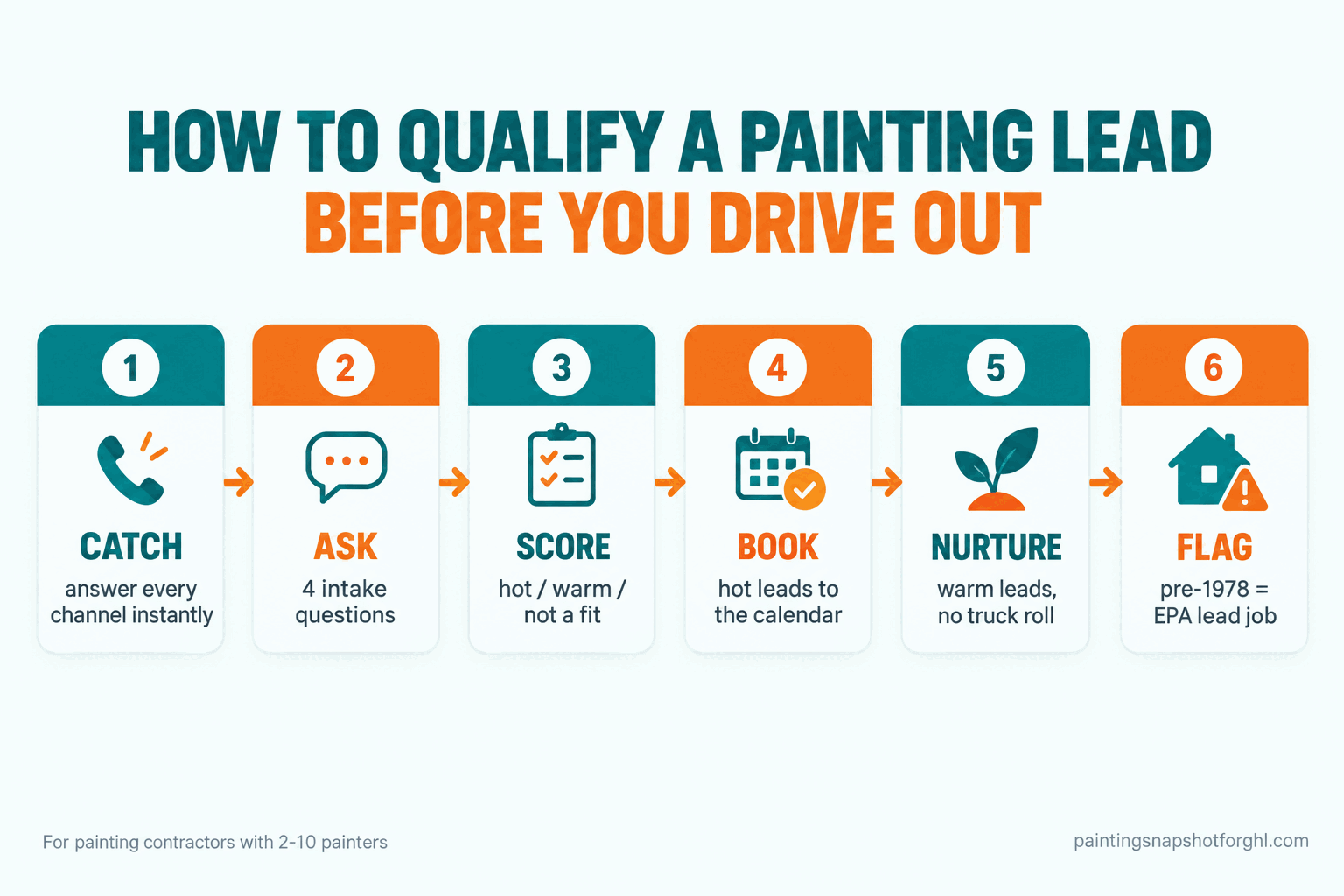
Qualifying is not a gut feeling. It is a repeatable path every lead runs before it earns a spot on your calendar. Six stages, in order:
- Catch the lead the instant it lands.
- Ask four questions that reveal the job.
- Score it hot, warm, or not a fit.
- Book the hot ones before they cool.
- Nurture the warm and deflect the wrong fit.
- Flag the compliance jobs at intake.
The beauty is that stages 1 through 3 happen without you. A form, chatbot, or quick phone script does the qualifying, so by the time a job hits your schedule it has already proven it is worth the drive.
Stage 1: Catch the lead the second it lands
You cannot qualify a lead you never caught. Paint leads come from everywhere: a form, a Google Business message, a Facebook DM, a referral text, and the big one, a missed call while you are up a ladder. Let any of those sit for hours and the lead is already talking to the next painter.
The fix is instant capture on every channel, with an automatic first reply the moment contact happens. A missed call should fire a text back in seconds, not sit in voicemail until lunch. More on that leak in missed-call text-back for painters.
Steal this, the instant auto-reply:
“Hi [Name], this is [Your name] with [Company]. Thanks for reaching out about your painting project. I’m on a job right now but want to get you a real answer fast. Mind telling me what you’re looking to paint, the property address, and when you’d like it done? I’ll come right back to you.”
That message starts qualifying before you have even seen the lead.
Where it breaks: The reply comes from a number she does not recognize, so it reads like spam. Put your name and company in the first line. Or you have no system after hours, so the 7 p.m. lead waits until morning. Capture has to run while you sleep.
Stage 2: Ask the four questions that reveal the job
Four questions tell you almost everything you need to decide whether to drive out. Ask them in the auto-reply, on the web form, or through a chatbot, and let the answers sort the lead.
Steal this, the four intake questions:
- What are we painting? Interior or exterior, how many rooms or roughly what size, walls only or trim and ceilings too. This is the scope, and whether it is a real job or a touch-up.
- What is the property address or zip? The quiet workhorse. It tells you if the job is inside your radius, and whether the home is pre-1978, which changes how you bid it.
- When do you want it done? “This month” is a buyer. “Next year, just getting ideas” is a researcher. Same question, completely different lead.
- Have you had it painted before, or have a rough budget in mind? You are not demanding a number, you are reading whether their expectation is near reality. For the number itself, see how to price a painting job.
Ask for a photo or two as well. A photo tells you in ten seconds whether this is a weekend or a week.
Where it breaks: You ask all four like an interrogation and the lead bails. Space them out, one or two at a time, not a wall of required fields. Or you skip the address because it feels nosy, then learn it is a pre-1978 exterior 40 minutes away after you committed to the drive.
Stage 3: Score it hot, warm, or not a fit
Now the answers sort the lead into three buckets. This is the decision that saves your week:
| Bucket | What it looks like | What happens next |
|---|---|---|
| Hot | Real scope, in your area, wants it done soon, budget in the ballpark | Straight to booking an estimate |
| Warm | Real job but not urgent, or still deciding, or slightly out of range | Into a follow-up sequence, no truck yet |
| Not a fit | Tiny touch-up, far outside your radius, or a budget that will never work | A kind deflection, same day |
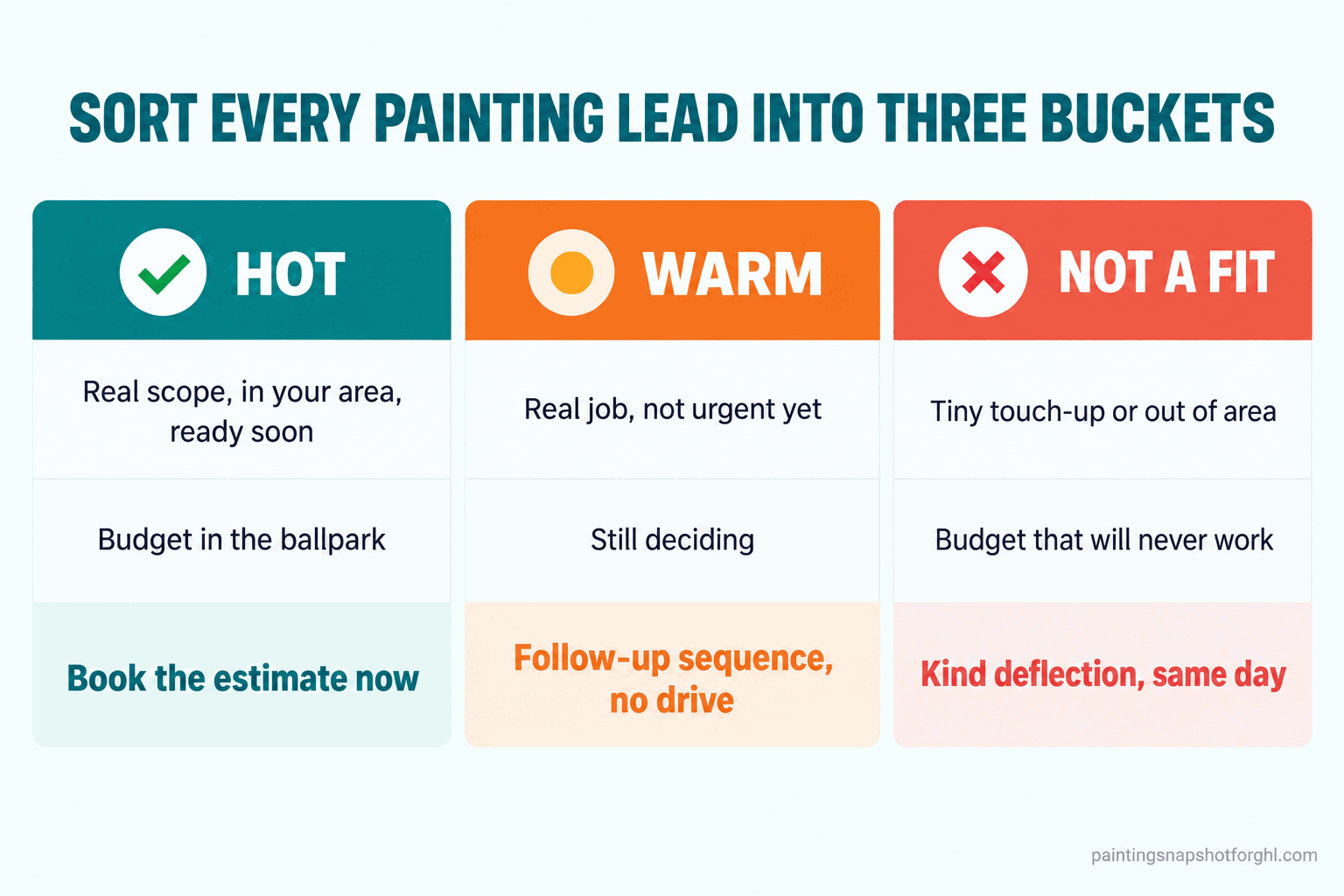
You are not judging the person. You are matching your response to the reality of the job. A hot lead earns your fastest booking, a warm lead earns patience instead of a drive, and a not-a-fit lead earns a quick honest answer so you both move on. The scoring can run on simple rules, so leads sort themselves the second the answers land and you only see the ones worth your attention. That is the core of a real painting lead management system.
Where it breaks: You treat every “not a fit” as a lost sale and chase it out of fear. Or a hot lead sits in the same pile as a tire-kicker, so your fastest response goes to the wrong person. Score first, respond second.
Stage 4: Book the hot ones before they cool
A hot lead has a short shelf life. The second you know it is real, in your area, and ready, get an estimate on the calendar before the conversation ends. “I’ll call you back to schedule” is a second chance for the lead to cool and a competitor to land. The fastest way is a booking link the lead taps to pick a slot, synced to your real availability so there is no double-booking and no phone tag.
Steal this, the hot-lead booking message:
“That’s a job we do all the time, and you’re right in our area. I’d love to come measure it and get you a real number. I’ve got Tuesday afternoon or Thursday morning open. Here’s my calendar, grab whatever works: [link]. I’ll send a reminder the day before.”
Then protect the booking. A confirmed estimate that no-shows is windshield time all over again, so a day-before confirmation and a morning-of reminder matter as much as the booking. The full playbook is in how to reduce painting estimate no-shows.
Where it breaks: You qualify perfectly, then leave the booking for “later,” and later is when the other painter calls. Book in the moment, confirm before you go.
Stage 5: Nurture the warm, deflect the wrong fit
Most leads are not hot, and the win is handling the rest without a truck roll.
The warm lead is a real job that is just not ready. Do not drive out, and do not forget them. Drop them into a light follow-up sequence that checks on their timeline every week or two, so when they are ready you are the painter they remember.
Steal this, the warm-lead check-in:
“Hi [Name], no rush at all, just keeping your [exterior repaint] on my radar. When you’re ready for a real number, I’m one text away. Here’s a quick before-and-after from a job near you: [link]”
The not-a-fit lead gets a kind, fast deflection the same day. A tiny touch-up, a job three towns over, or a budget that will never cover real prep is not work you want, but the person still deserves an answer, and a good deflection sometimes earns a referral.
Steal this, the wrong-fit deflection:
“Thanks for thinking of us, [Name]. Honestly, for a job this size we wouldn’t be your best value, since our minimum is set up for full rooms and whole exteriors. For a single touch-up you’d do better with a local handyman. If you ever plan a bigger repaint, I’d be glad to help.”
That costs two minutes and zero miles. On why chasing every low-budget job is a trap, see why you keep losing jobs to the cheaper bid.
Where it breaks: You ghost the warm leads, so a half-qualified job vanishes. Or you say yes to wrong-fit jobs out of guilt.
Stage 6: Flag the compliance jobs at intake
The address from Stage 2 does one more job: it tells you when a lead is a compliance job before you quote it. The big one is age. Roughly three-quarters of US homes built before 1978 still contain some lead-based paint, so any paid work that disturbs paint in a pre-1978 home falls under the EPA Renovation, Repair, and Painting rule: certification, lead-safe practices, and the Renovate Right pamphlet, all of which change your price and timeline. If your intake flags a pre-1978 address automatically, you walk in already knowing it is an RRP job instead of learning it in the driveway. The full rundown is in our painting contractor compliance checklist.
One more rule touches this system: the auto-reply, reminders, and nurture are all texts, and texting leads is governed by consent. Only text people who contacted you or checked a box asking you to, and honor a STOP instantly. A proper system logs that consent and handles opt-outs, which is why you do not run this off your phone and a notes app.
Where it breaks: You never capture the address early, so lead-rule jobs blindside you after you have quoted a non-lead price. Catch the age at intake and bid it as what it is.
How this runs at three sizes of shop
The system is the same. How you run it scales.
The solo painter. You are on the ladder and on the phone, so automation matters most. A missed-call text-back and a one-page web form that asks the four questions and feeds a booking link is enough. You score in your head, but the capture and first reply run without you, the part you keep dropping.
The three-to-five-painter shop. Volume is the problem: a lead comes in every few hours and you cannot read each in real time. A chatbot or form that scores on rules pays for itself, routing hot leads to a booking link, warm leads into nurture, and not-a-fit leads to the deflection, all before anyone looks.
The larger crew. Here a mis-routed lead costs an estimator’s whole afternoon. You want an AI caller or chatbot answering 24/7, qualifying on the first touch, and a pipeline so every lead has an owner. The payoff is a response time no competitor your size can match.
Objections I hear from painters
“Won’t I scare off good leads by asking questions?” Only if you ask like a gatekeeper. Asked warmly, the four questions make you look organized and serious, which is exactly what a homeowner comparing three bids wants.
“I don’t want to turn down work. Times are tight.” Qualifying is not turning down work, it is spending your hours on the work worth having. Turning down a $150 wall to land a $4,000 exterior is not scarcity, it is math.
“I’m not technical. This sounds like software homework.” It is less work than you do now, not more. Right now you are the system: you answer, remember, chase, and drive. Qualifying moves the repetitive parts off your plate, and a done-for-you setup means you build none of it.
“I already pay for Jobber or Housecall Pro.” Those are great at the back office: scheduling, invoicing, job tracking. They are not built to answer and qualify a lead in thirty seconds across every channel the second it arrives. That front-door, speed-to-lead layer is the gap this fills, and it sits in front of whatever you already run.
“What if a lead refuses to give a budget?” Fine. You never needed a number, you needed a signal, and “Have you had it painted before?” plus the timeline question tell you most of what a budget would. Once you are in the room, closing the estimate is a separate skill.
Frequently asked questions
How do I qualify a painting lead before driving to the estimate?
Ask four questions the moment the lead lands: what they want painted, the property address or zip, their timeline, and whether they have a rough budget or have painted before. Those answers sort the lead into hot, warm, or not a fit, so you only drive out for jobs that are real, in your area, and ready.
What questions should I ask a painting lead first?
Scope (interior or exterior, rooms or rough size), property address or zip, timeline, and a budget signal such as whether they have had it painted before. Ask for a photo or two as well. Those items tell you if the job is worth a visit without a single mile driven.
Isn't asking about budget pushy?
It can be if you demand a number, so don't. Ask whether they have had the space painted before or roughly what they hope to spend. You are reading whether their expectation is near reality, not negotiating. If a lead refuses every question and only wants the lowest price, that is a qualifying answer in itself.
How much do unqualified estimates actually cost?
Each dead-end trip costs roughly $90 once you count mileage at the 2026 IRS rate of 72.5 cents a mile and about 90 minutes of your time at $50 an hour. A few a week runs one to two thousand dollars a month, before the real leads that went cold while you were out.
Will qualifying leads make me lose jobs?
No. Qualifying points your limited hours at the leads most likely to buy and gives the rest a fast, honest answer. You respond to everyone, you just don't drive to everyone. Contacting a lead within an hour makes you about 7 times more likely to qualify it.
How is this different from Jobber or Housecall Pro?
Jobber and Housecall Pro handle the back office: scheduling, invoicing, and job management. They are not designed to answer and qualify a lead in seconds across phone, web, and social the moment it arrives. This qualification layer sits in front of your existing tools and feeds them only the leads worth your time.