It is a Tuesday night and you are staring at a text you did not want: “Hey, thanks for coming out, but we decided to go with someone else.” You already know why. The other guy was two grand cheaper. You quoted it honest, with real prep and two coats of good paint, and they went with a number that does not leave room to do it right. You sit there wondering if you are too expensive, and whether you need to cut your prices to keep the calendar full.
Do not touch your prices yet. The painter who won that job was almost never the cheapest one the homeowner talked to. He was the cheapest painter the homeowner trusted, and those are two very different things. You did not lose on price. You lost on everything that happens before and after the number, and that is the part you can fix.
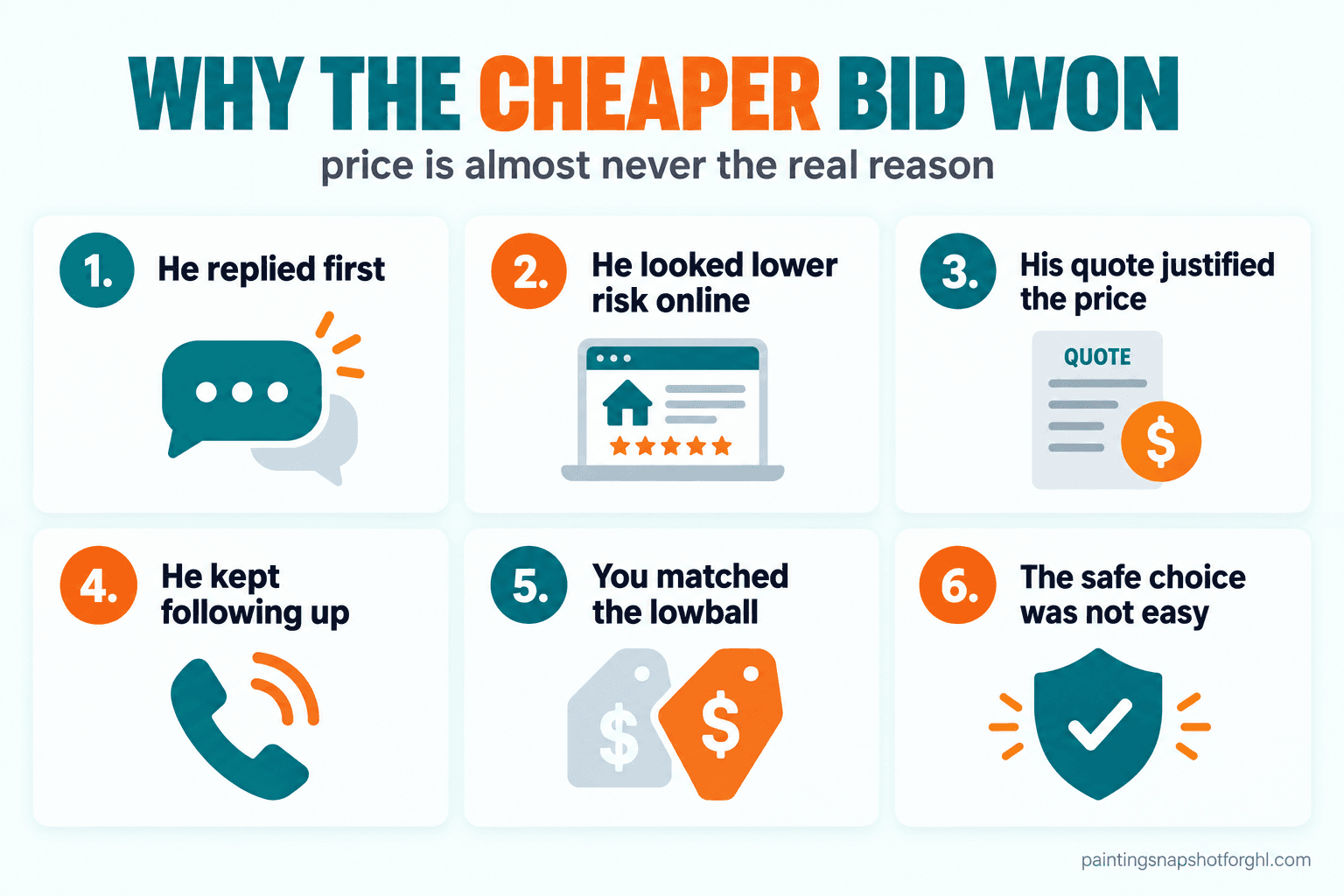
You keep losing jobs to cheaper bids because, by the time the homeowner compares numbers, the other painter has already made himself feel like the safe choice. He replied faster, looked more legit online, sent a quote that made his price make sense, and stayed in front of the customer while you went quiet. Fix those things and you win at a fair price. Drop your price to match the lowball bid and you just join the race to the bottom. This post breaks down the six real reasons the cheaper bid wins, with the fixes and the messages you can steal tonight.
In this post
- The math on dropping your price
- Reason 1: You were slow, so price became the tiebreaker
- Reason 2: You looked like the same risk at a higher price
- Reason 3: Your quote did not show why you cost more
- Reason 4: You went quiet and the cheap bid stayed in front of them
- Reason 5: You tried to match the lowballer instead of exposing him
- Reason 6: The safe choice was not the easy choice
- How this plays out at three sizes of shop
- The compliance part that bites painters
- Objections I hear every week
- Frequently asked questions
The math on dropping your price
Before you cut a dollar, run the numbers, because a discount is worse than it feels. Say a job costs you $7,000 to produce and you quote it at $10,000, for $3,000 of gross profit. Knock 10 percent off to beat a cheaper bid and you quote $9,000, but your cost is still $7,000, so your profit drops to $2,000. You did not give up 10 percent, you gave up a third of your profit on that job. To earn the same money at the lower price you now have to win 50 percent more jobs. The discount comes straight out of the one number that keeps your business alive.
Gross profit on one job with a fixed $7,000 production cost, as you discount the $10,000 quote. A 20 percent cut turns a healthy job into a barely-worth-it one. Illustrative example using typical painting margins.
The trade is not short on work, which is the other reason you do not need to be cheapest. The U.S. had roughly 326,900 painter jobs in 2025 at a median wage near $49,400, and the Bureau of Labor Statistics projects steady demand of about 3 percent growth and 24,900 openings a year through 2035 (U.S. Bureau of Labor Statistics). There are enough homeowners who want it done right that you can fill a calendar without ever being the low bid.
Here is why. A homeowner about to spend five figures is not really comparing three prices, they are comparing three feelings. They have usually been burned before, by the contractor who took the deposit and vanished or the “cheap” job that peeled in two years, so they are not asking “who is cheapest,” they are asking “which one is least likely to turn into a nightmare.” The lowest price often reads as more risk, because it makes a careful buyer wonder what got cut. Your job is to be the one who obviously feels safer, and the six reasons below are where that gets decided.
Reason 1: You were slow, so price became the tiebreaker
The homeowner did not call one painter. They filled out three forms in ten minutes, because that is how a careful buyer shops, and whoever replies first frames the whole conversation and becomes the painter the other bids get measured against. Reply two days later and you are just a number, and the lowest number wins.
The research is blunt. In the most-cited lead-response study, contacting a new web lead within five minutes instead of thirty made a company about 21 times more likely to qualify it (Oldroyd / InsideSales lead-response study). Harvard Business Review found the same across 1.25 million leads: responding within an hour made firms about seven times more likely to reach a decision-maker than waiting one hour longer (Harvard Business Review).
How it breaks: you are up a ladder when the lead lands, so you reply that evening, by which point the homeowner has already talked to the painter who answered in two minutes. The fix is an automatic reply that fires the instant any lead lands, which is exactly what missed-call text-back for painters does, and why a slow quote response quietly costs you jobs.
Reason 2: You looked like the same risk at a higher price
Once you reply, the careful buyer does what a bargain hunter skips: they look you up. If the painter asking for more money looks as thin online as the one asking for less, there is no reason to pay the premium. Same risk, higher price, easy no. BrightLocal’s 2025 consumer survey found that about 96 percent of consumers read online reviews for local businesses, and that 74 percent check two or more review sites before they decide (BrightLocal Local Consumer Review Survey 2025). If your newest Google review is from fourteen months ago while the other painter has 180 recent five-stars and fresh job photos, the homeowner’s gut says the other guy is safer, and that feeling is worth more than two grand.
How it breaks: you do great work but never ask for the review, so your proof stays a trickle while the painter beating you asks every happy customer automatically, and over a year that gap becomes a canyon. Looking safer online is a system, not luck (how to get more 5-star painting reviews).
Reason 3: Your quote did not show why you cost more
The homeowner has two or three numbers and yours is the highest. If your quote is a one-line text that says “roughly $10,000,” you have given them no reason for the gap except that you cost more, so of course they take the cheaper bid. A price without context is just a price. When your quote shows two coats of a named premium paint over proper prep and the cheap bid is a vague “we’ll paint the house,” your higher number looks like the responsible choice and theirs looks like a question mark.
How it breaks: you deliver the number as a tired one-liner at 9pm with no scope, so the homeowner cannot tell what they are getting and defaults to cheaper. The fix is a repeatable written quote you send the same way every time. A fast instant estimate on your website can get a ballpark in front of them within minutes, and a clean line-by-line estimate template makes the walk-through number look like a pro put it together.
Reason 4: You went quiet and the cheap bid stayed in front of them
This one stings, because the job was basically yours. The homeowner liked you, your quote was clear, and then they said “let me talk to my spouse.” Eleven days later they hired the painter who sent one friendly check-in on day two, because he was still there when they were ready and you were a memory. Most lost jobs are lost in the silence after the quote, and the higher bid needs follow-up most because the homeowner is working up the nerve to spend more (painting estimate follow-up playbook).
How it breaks: you either never follow up, or you blow it up with five texts in three days that make a thoughtful buyer feel hounded. The sweet spot is polite persistence: a couple of helpful touches over about ten days, each with a real reason to reply, fired automatically so it happens even on your busiest week, which is exactly the week good leads decide.
Reason 5: You tried to match the lowballer instead of exposing him
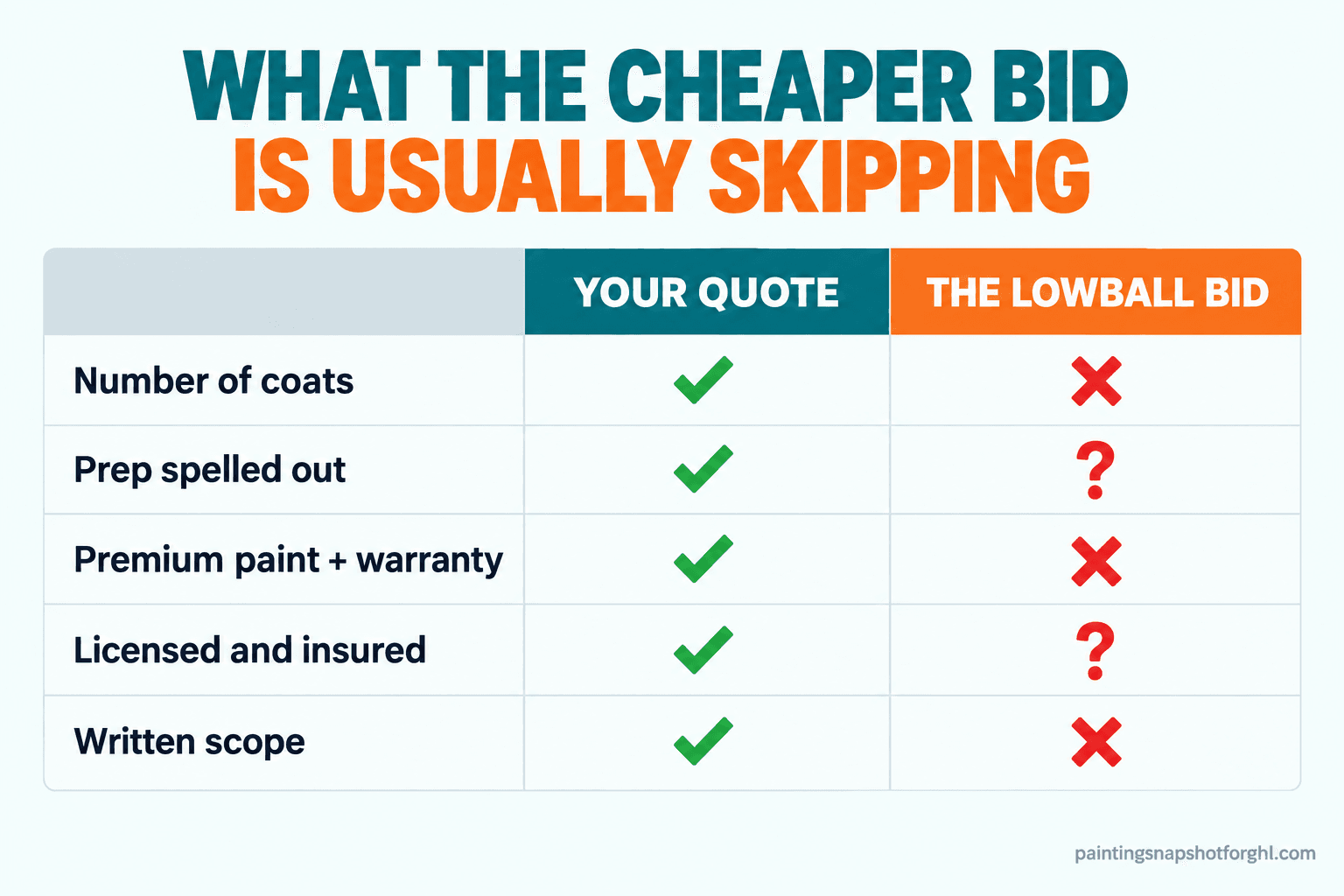
When the homeowner says “the other guy is two grand cheaper,” most painters either cave and discount, which torches the margin, or bad-mouth the competitor, which just looks insecure. The move that wins is to make the gap the homeowner’s decision. You do not attack the cheap painter, you hand them a checklist: how many coats are in each quote, what paint and what warranty, is the prep spelled out, and is the painter licensed and insured. That makes you look confident and honest while quietly pointing at every corner a lowball bid usually cuts.
This is also where the uninsured painter becomes your best sales tool. Many lowball bids are low precisely because the painter carries no liability insurance, no workers’ comp, and often no license. General liability for a painting business averages only about $72 a month (Insureon), so a painter who skips it is cutting a cheap corner that can leave the homeowner exposed. You just make sure the homeowner asks for a certificate of insurance and a license number: the painter who has them hands them over in a text, and the one who does not goes quiet.
Reason 6: The safe choice was not the easy choice
You did everything right, the homeowner trusts you, and then booking the walk-through turns into phone tag: “Does Thursday work? No? How about Friday?” Every round is a chance for a ready buyer to cool off, and the cheaper painter who sent a tappable booking link at 9pm starts to look like less of a hassle. A careful buyer reads friction as a warning: if scheduling is this hard, what will the job be like? The painter who makes the safe choice the easy choice wins the last mile, with a link, a confirmation, a reminder, and an automatic nudge that rebooks a no-show. That is what appointment automation is for.
How it breaks: you book by hand, so a ready homeowner at 9pm waits for you to see their text tomorrow, by which point they have self-scheduled with the painter who made it one tap. Then the loop closes: you win the job, do clean work, and the review you ask for while they are still glowing becomes the fresh trust signal that wins the next buyer back in Reason 2. That is why review harvesting automation makes every future bid easier.
How this plays out at three sizes of shop
The six reasons are the same at every size. What you fix first is not.
The solo painter or owner-plus-one. You cannot reply in five minutes or follow up on day two while painting someone else’s house, so Reasons 1 and 4 are the whole game. At your size, keeping one extra $10,000 job a month instead of discounting it is a serious raise.
The 5-person shop with one or two crews. Good leads pile up faster than anyone can handle by hand, and discounting creeps in when whoever is quoting feels pressure to “just win it.” Your weak spots are usually Reason 2 and Reason 6, because nobody owns the review profile or the booking step. Automate the review ask and put a booking link in every quote, and both your online proof and your close rate climb without cutting a dollar.
The multi-crew company. Your enemy is inconsistency. On a slammed day a five-figure lead waits four hours, gets a bare number, and never hears from anyone again, so it goes to the cheaper bid and you never know. You need all six running as a tracked system so no job’s outcome rides on which estimator was free that afternoon.
The compliance part that bites painters
Every steal-this message above is a business text, and the license-and-insurance play leans on rules that differ by state. Run it carelessly and the system that wins good jobs can get you fined or silently filtered.
First, the TCPA and A2P 10DLC. You need a reasonable basis to text a customer, you must honor a STOP reply promptly, and to send business texts reliably in the U.S. you have to register your number and campaigns under A2P 10DLC, or carriers quietly filter your messages into nowhere (FCC). A homeowner who just asked you for an estimate has given you that basis.
Second, lead paint and your license. If you work on homes built before 1978, the EPA’s Renovation, Repair and Painting Rule requires certification, because about three-quarters of pre-1978 U.S. homes still contain some lead-based paint (EPA). Some states also regulate your advertising directly: California requires your contractor license number on essentially all advertising under Business and Professions Code section 7030.5, which includes the website feeding this system, and its exemption for small jobs rose from $500 to $1,000 in 2025 (California CSLB). Rules really do differ by state, so check yours. We pulled the common ones together in the painting contractor compliance checklist.
Objections I hear every week
“My market is just cheap, everyone shops on price here.” Some do, and those are not the customers you want, the ones who nickel-and-dime change orders and leave three-star reviews. Even in a price-sensitive market there is a layer of homeowners who have been burned and will gladly pay more to feel safe. You are not trying to win everyone, just the ones who value doing it right.
“I already pay for Jobber or Housecall Pro.” Good, and you may not need to replace them. The real question is whether your setup actually fires an instant reply, runs the quote follow-up, and asks for a review on every job, or whether those still live in your head. If the automations are not running, the software is just a filing cabinet (best painting business software breakdown).
“Isn’t it dishonest to point out the other guy is uninsured?” Not even a little. You are not accusing anyone, you are telling the homeowner what to ask for, from both of you, and sending your own proof immediately. If the other painter is fully licensed and insured, no harm done. If he is not, the homeowner just learned something that protects them.
“Do I need to be technical to run this?” No. If you can send a text and use a calendar app, you can run it day to day. The one-time setup is the only technical part, and you can do it yourself, hand it off, or buy it done-for-you.
So the next time you lose a job to a cheaper bid, do not reach for the discount. Ask which of the six you lost: slow to reply, thin online, vague on the quote, silent after it, matching the lowballer, or a hassle to book. Each is a small system you can fix once. Hold your price and the homeowners who want it done right start choosing you on purpose.
Frequently asked questions
Should I ever lower my price to win a painting job?
Rarely, and almost never to match a lowball bid. Dropping a $10,000 quote by 10 percent to $9,000 does not cut your profit by 10 percent, it cuts it by a third, because your production cost does not move. To earn the same money at the lower price you would have to win roughly 50 percent more jobs. It is far cheaper to win at full price by being faster, clearer, and more trustworthy than the competition. Save real discounts for off-season scheduling or multi-job commitments, not for panic-matching a cheaper painter.
Why do homeowners pick a more expensive painter over a cheaper one?
Because for a five-figure project they are buying confidence, not the lowest number. A homeowner who can afford a quality repaint has usually been burned before and is mostly asking which painter is least likely to turn into a nightmare. The painter who replied first, has fresh reviews, sent a clear written quote, carries real insurance, and made booking easy feels safer, and people pay more to feel safe. The lowest bid often reads as more risk, not less, because it makes a careful buyer wonder what got cut.
How do I respond when a customer says another painter is much cheaper?
Do not cave and do not bad-mouth the competitor. Hand the homeowner a checklist and let them do the math: ask how many coats are in each quote, what paint and what warranty, whether prep is spelled out, and whether the painter is licensed and insured. Then offer to send your own license and certificate of insurance right away. That answer makes you look confident and honest while quietly pointing at every corner a lowball bid usually cuts, and the painter who can produce proof in sixty seconds almost always beats the one who stalls.
Is the uninsured low bidder really a problem for the homeowner?
Yes, and it is a legitimate thing to raise. Many lowball bids are low because the painter carries no general liability insurance, no workers' comp, and sometimes no license. General liability for a painting business averages only around $72 a month, so skipping it is a cheap corner to cut. If a worker is injured on the property or the job is botched, the homeowner can end up exposed. You do not have to accuse anyone, you just tell the homeowner to ask both painters for a certificate of insurance and a license number, and watch who can produce it.
How fast do I actually need to respond to win jobs at a higher price?
As close to instant as you can get, and within five minutes at the outside. A serious buyer contacts two or three painters at once, and the most-cited lead-response study found replying within five minutes made a company roughly 21 times more likely to qualify a lead than waiting thirty minutes. Speed is what keeps you from being reduced to just a price. Since you cannot personally reply that fast while painting, an automated first reply that fires the moment a lead lands is the practical way to always be first.
Do online reviews really matter enough to justify charging more?
They matter a lot, especially for high-value jobs. BrightLocal's 2025 survey found that about 96 percent of consumers read online reviews for local businesses and that 74 percent check two or more review sites before deciding. A careful buyer about to spend five figures will absolutely look you up, and a thin or stale profile reads as risky even when your work is excellent. Fresh, deep reviews are what let you look like the safe premium choice instead of the expensive unknown.