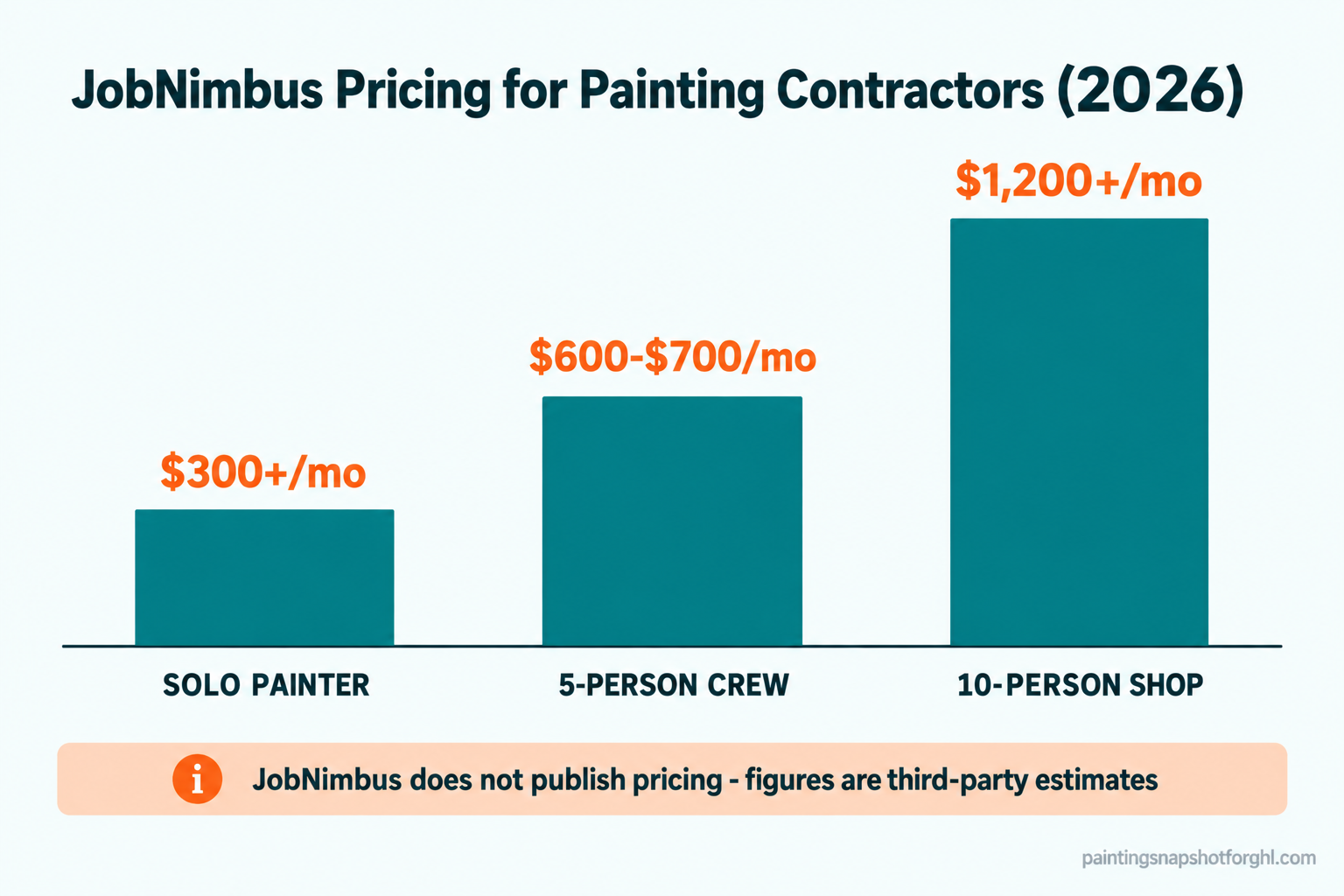
It is 8:15 on a Thursday and you are standing in a driveway with a wet tape measure, wondering if the software everybody in the roofing group swears by is worth it for your painting shop. You go to the JobNimbus site to check the price. There isn’t one. Just a “Get a Demo” button and a form for your phone number. So what does JobNimbus actually cost a painting contractor in 2026? Based on numbers third parties report, a solo painter runs at least $300 a month, a five-person crew around $600 to $700, and a busy multi-crew shop can clear $1,200 once you add seats and texting. JobNimbus publishes none of that, so every figure here is reported by outside sources and needs confirming in writing on your demo call.
In this post
- Why JobNimbus won’t tell you the price
- The reported price ladder: what people actually pay
- The fees the base number leaves out
- Three real cost scenarios: solo, crew, multi-crew
- What you get for the money, and what you don’t
- Steal this: the demo questions and the follow-up JobNimbus won’t run
- Compliance a painting business can’t ignore
- Straight answers to the objections
- Frequently asked questions
Why JobNimbus won’t tell you the price
Four of the five tools a painter shops publish their prices on the site. Jobber, Housecall Pro, PaintScout, and Markate all show a number before you hand over your phone. JobNimbus is the one that doesn’t. You fill out a form, get a call, and the quote depends on how many seats you need, which tier the rep steers you to, and what add-ons get bundled in.
A company hides a price for two honest reasons: the number is high enough that they would rather sell value first, or it flexes so much per customer that no single sticker is accurate. JobNimbus is probably both. It grew up as a roofing CRM, its seats scale with team size, and a solo painter’s deal is not a fifteen-truck outfit’s. Plenty of painters run their whole pipeline on it. But you walk into the call at a disadvantage, because the rep knows the price and you don’t.
The reported price ladder: what people actually pay
Here is the ladder as outside sources describe it. Read every figure as “reported, unconfirmed.”
The two most commonly cited tiers are a “Growing” plan around $225 a month and an “Established” plan around $550 a month. On top of the tier you pay per user, roughly $25 to $75 a seat by role: a field painter sits low, an owner seat with full access sits high. Then there is texting, an add-on that reportedly runs $49 to $249 a month by volume, and for a text-heavy shop it is not optional. The base price on the call is the floor, not the bill.
Reported all-in JobNimbus monthly cost by team size, 2026 (USD), tier plus seats plus texting. JobNimbus does not publish pricing; figures are third-party estimates. Source: Projul, JobNimbus Pricing Analysis, 2026.
Compare that to the tools that print their price: a five-person crew runs Markate for about $65, Jobber Connect for $99, or Housecall Pro Essentials for $149. The reported JobNimbus number for the same shop is several times higher. Next to the published field, it is the premium option.
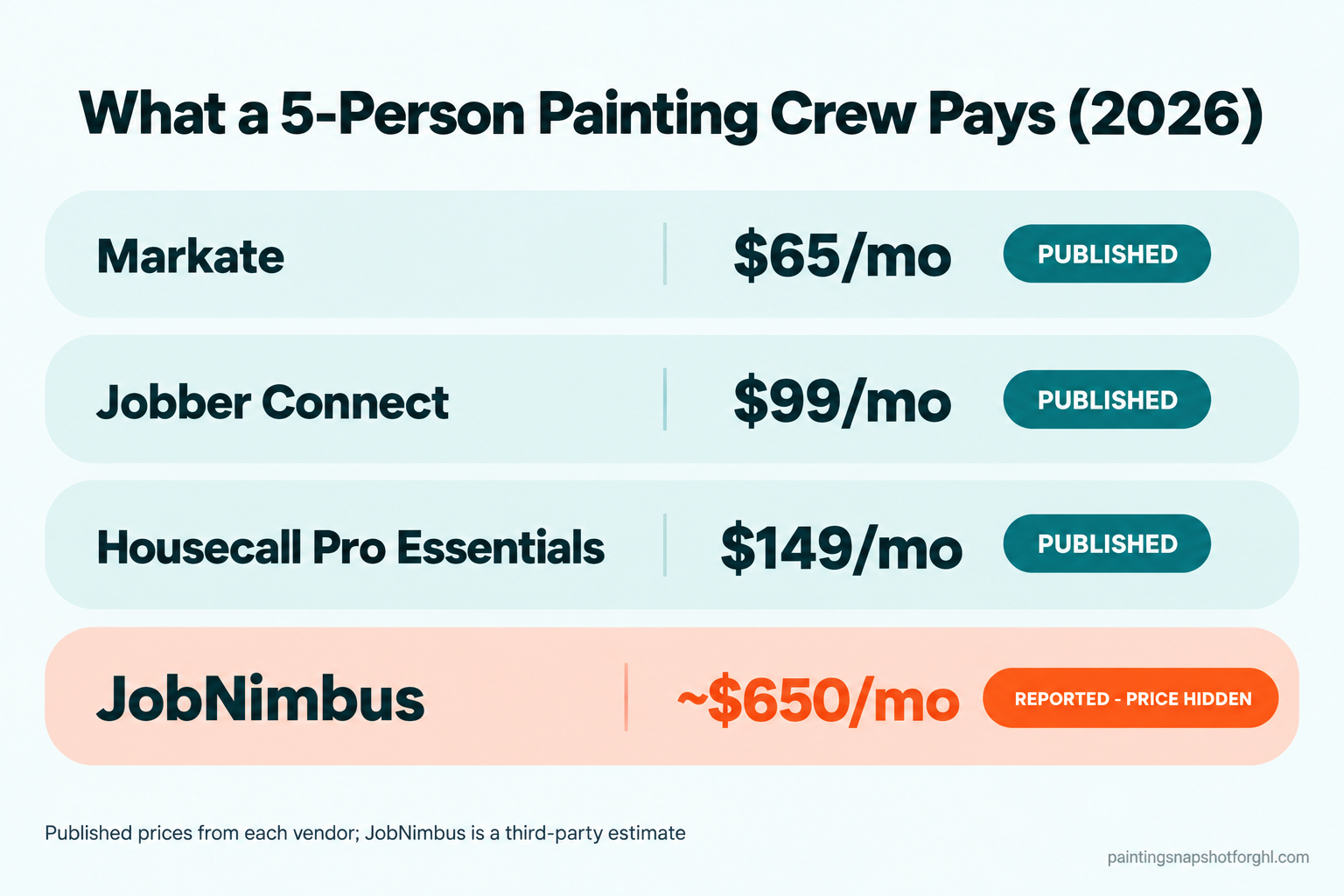
Monthly cost for a five-person crew, 2026 (annual billing). Published: Markate, Jobber, Housecall Pro. JobNimbus is a third-party estimate.
The fees the base number leaves out
The tier price is the part they lead with. These are the parts that show up on the invoice.
Per-user seats are the big one. Reported ranges put a basic field seat near $25 and a full-access owner seat near $75. Add a project manager, a couple of estimators, and crew leads, and seats can outweigh the base plan. This is how a “$225 plan” becomes a $600 invoice. How it breaks: a shop signs on the base number, adds seats one hire at a time, and six months later the bill has doubled. Price every seat you will need in year one first.
Texting is a separate line. SMS is your follow-up: confirm the estimate, remind the no-show, ask for the review. JobNimbus reportedly bills it as an add-on from $49 to $249 a month. How it breaks: you budget for the CRM and forget the texting, then find your follow-up engine is a paid upgrade. Ask what texting costs at your volume and whether outbound texts are metered on top.
SumoQuote is its own subscription. JobNimbus acquired SumoQuote in January 2024, and it is the polished proposal tool a lot of painters want, billed as a separate product with an unpublished price. How it breaks: you assume good proposals are included, then learn quoting is an extra line. Ask whether SumoQuote is bundled or separate, and get the number.
Onboarding and migration. Reported guidance says there is no required setup fee, but paid professional services for data migration are quoted case by case. How it breaks: moving two years of customers, jobs, and photos out of another CRM is real work, and “we’ll help you migrate” can mean a paid engagement. Ask if migration is included, and whether your data exports cleanly if you leave.
Contract length. JobNimbus reportedly offers monthly and annual agreements, with the better rate on annual. How it breaks: you lock into a year for the lower price, then realize in month three it is not the fit. Ask whether the price needs an annual commitment, and what cancellation looks like.
Three real cost scenarios: solo, crew, multi-crew
The right answer changes with your size, so here is the same tool run three ways. Every number is reported, not official.
The solo painter or two-person shop. You are the owner, the estimator, and half the crew. Reported all-in for one or two seats and texting: at least $300 a month. That is a lot next to Markate at $39.95 or Jobber Core at $29. Unless you specifically need JobNimbus’s pipeline, a solo painter overpays, and the money is better spent answering leads first.
The five-person crew. An owner, an office person, three painters, and the pain is coordination scattered across phones. Reported all-in with seats and texting lands around $600 to $700 a month, against $65 to $150 for the published alternatives. JobNimbus can earn the premium if its pipeline runs your operation better, but the question is sharp: is it four to ten times better than what you would otherwise buy? Make the rep prove it.
The multi-crew shop. Several crews, estimators, an office team, and you live in the pipeline all day. Reported all-in can clear $1,200 a month once seats stack up. At this scale the per-seat model is the whole ballgame, so the negotiation is about seat tiers, not the base plan. A shop this size has the volume to justify serious software, and JobNimbus is genuinely built for contractor operations here. Just price every seat first, because at a dozen-plus users a $10 swing per seat adds up fast. The pattern is clear: JobNimbus gets more defensible the bigger you are and harder to justify the smaller you are.
What you get for the money, and what you don’t
JobNimbus is a strong CRM and project platform: pipeline stages, customer history, contractor-grade estimating (especially with SumoQuote), scheduling, and reporting. For a shop managing complex, multi-stage projects, that pipeline view is the draw. Here is the honest side-by-side against the published field.
| What matters | JobNimbus | Jobber / Housecall Pro | Markate |
|---|---|---|---|
| Published price | None (demo only) | Yes, on site | Yes, on site |
| Reported small-crew cost/mo | $99-$149 | $65 | |
| Pricing model | Tier + per seat | Tier, capped users | Base + per employee |
| Estimating / proposals | Strong (SumoQuote extra) | Built in | Built in |
| Scheduling / dispatch | Yes | Yes | Yes |
| Texting follow-up | Paid add-on | Varies by plan | Included tiers |
| Instant lead response | No | No | No |
| Long unsold-estimate follow-up | Manual | Manual | Manual |
Look at the bottom two rows, the same on every tool. None of these platforms answer a brand-new lead in the seconds after they call, and none run a two-week chase on an estimate that went quiet. They manage the work you already won. That matters because the research on speed is blunt: companies that reach a lead within five minutes are far more likely to qualify it than those who wait thirty. The painter who answers first books the job, and a CRM does not make you first.
Steal this: the demo questions and the follow-up JobNimbus won’t run
Two things to use today: the questions that stop the demo leaving you guessing, and the follow-up copy that wins jobs, which no CRM runs for you.
Copy these into your phone before the JobNimbus call:
1. What is the total monthly price for my exact team size,
   tier plus every seat, in writing?
2. What does each seat cost, and which roles need the
   higher-priced seats?
3. Is texting included or a paid add-on? What does it cost
   at my volume, and are outbound texts metered on top?
4. Is SumoQuote bundled or a separate subscription? Exact price?
5. Is there a setup or migration fee? Who moves the data?
6. Does the price require an annual contract? Cancellation policy?
7. Can I export all my customer, job, and photo data if I leave?
Now the part no CRM does for you: the follow-up copy that turns quotes into booked jobs. Steal it and adapt the details.
The instant reply, sent within a minute of a new lead:
Hi [Name], this is [Your Name] with [Company]. Got your
request for a [interior/exterior] painting estimate on
[street]. I can swing by [day] morning or [day] afternoon
to take a look. Which works better?
The missed-call text-back, fired the second a call hits voicemail:
Sorry I missed you, this is [Company]. I'm on a job site.
Looking for a painting estimate? Text me the address and
what you'd like painted and I'll get you a time today.
The unsold-estimate sequence, after you send a quote and hear nothing:
Day 2:  Hi [Name], did you get the estimate for [project]?
        Happy to walk through any of it.
Day 5:  Checking in on the [project] quote. I've got an
        opening the week of [date] if the timing works.
Day 10: Still glad to do your [project]. If you went another
        way, just let me know so I can free up the slot.
Day 21: Last check-in. Want me to hold that price, or close
        it out?
The review request, sent the day the job wraps while the fresh paint is still on their mind:
Thanks for trusting us with your [room/home], [Name]! If
you're happy with it, a quick review really helps a small
crew like ours: [review link]. Takes 30 seconds.
That copy is worth more than most software. The catch is that a CRM stores your contacts but does not fire these on its own timing, in the first minute, at 8pm, without you remembering. That is automation, a different category than pipeline management, and exactly the gap a done-for-you system on GoHighLevel fills.
Compliance a painting business can’t ignore
No vendor saves you from these.
EPA lead-paint RRP. Disturb painted surfaces in homes built before 1978 and federal law requires your firm to be RRP certified. Not a small edge case: the EPA estimates about three-quarters of pre-1978 US homes still contain some lead-based paint. If your intake does not flag the home’s age, you can walk a crew into a job you are not certified to do.
Advertising your license number. Some states make you put your contractor license number in your advertising. California requires it under Business and Professions Code 7030.5, covering your website, ads, and vehicle wraps. A templated site with no license field is a fixable gap.
Texting law: TCPA and A2P 10DLC. The follow-up texts above are gold, but SMS is regulated. Under the TCPA and carrier A2P 10DLC rules, you need proper consent, a registered business number, and a working opt-out on every marketing text. Get it wrong and you risk carrier blocking and real fines. Whatever sends your texts, JobNimbus included, confirm it handles 10DLC registration and STOP compliance.
Straight answers to the objections
“Everyone in my contractor group uses JobNimbus, isn’t it the safe pick?” Roofers love it, and roofing is where it grew up. Painting has different rhythms: color consults, seasonal exterior windows, more small residential jobs. Popular in a Facebook group is not the same as right for your budget. Run your own seat count first.
“I already pay for a CRM. Do I need anything else?” Maybe not another CRM. But look at where jobs actually leak. Most painters do not lose work because their pipeline is messy. They lose it because a lead sat four hours before anyone called, or an estimate went quiet and nobody followed up. Instant response and long follow-up are a separate layer that runs in front of whatever CRM you keep.
“Won’t automated texting annoy my customers?” Only if it is generic and constant. A homeowner who gets a real, specific reply in the first minute feels taken care of, not spammed. The annoying part is a shop that never texts back at all. Keep the copy human, cap the frequency, honor every opt-out, and follow-up reads as good service. And you do not need to be technical to run it: the right setup is done for you and quiet, so you just get the booked jobs on your calendar.
Frequently asked questions
How much does JobNimbus cost for a painting contractor in 2026?
JobNimbus does not publish pricing, so every figure is third-party reported. Reported numbers put the base around $225/mo for Growing and $550/mo for Established, plus roughly $25 to $75 per user and a texting add-on from $49 to $249/mo. In practice a solo painter can pay at least $300/mo, a five-person crew around $600 to $700, and a ten-person shop over $1,200. Confirm every number in writing before you commit.
Why doesn't JobNimbus show its price online?
It prices per seat and per add-on, so the total flexes a lot by team size, and it prefers to sell on a demo first. Four of the five tools painters shop (Jobber, Housecall Pro, PaintScout, Markate) publish their prices. JobNimbus is the only one that gates it, so walk into the call already knowing the reported ranges.
Does SumoQuote cost extra on top of JobNimbus?
Yes. SumoQuote is JobNimbus's proposal tool, acquired in January 2024, and it is billed as a separate subscription on top of your plan. The standalone price is not published, so ask on the demo whether it is bundled or an add-on and get the exact figure.
Is JobNimbus worth it for a small painting shop?
It gets more defensible the bigger you are. For a multi-crew shop living in a pipeline all day, the per-seat cost can pay off. For a solo painter or small crew, the reported cost runs several times higher than Markate, Jobber, or Housecall Pro, so unless you need its pipeline, you usually overpay.
Will JobNimbus answer my leads and follow up automatically?
No. JobNimbus manages jobs you have already won: pipeline, scheduling, estimating, reporting. It does not answer a brand-new lead in the first minute or run a multi-week chase on an unsold estimate. That is marketing automation, a separate category, and where most painting revenue leaks. A done-for-you system built on GoHighLevel fills that gap and runs alongside your CRM.
About the author. Travis Bergeron is an operations and workflow consultant based in Denver, Colorado. A recovering project manager who ran scheduling for a commercial and HOA painting outfit before moving into systems consulting, he is the person crews call when the pipeline is a mess of sticky notes and missed reminders. He writes about CRM design, software cost, and the unglamorous automations that quietly save the most money. Read more from Travis on the Painting Snapshot blog.
Related reading:
- Best Painting Business Software in 2026: Jobber vs Housecall Pro vs JobNimbus vs PaintScout vs Markate
- GoHighLevel vs Jobber for Painters: Which One Do You Actually Need?
- GoHighLevel vs Housecall Pro for Painters (Austin)
- Painting Estimate Follow-Up: The Sequence That Turns Cold Quotes Into Booked Jobs
- Painting Contractor Compliance in 2026: Licensing, EPA Lead Rules, and Texting Laws
Painting Snapshot is a GoHighLevel automation product for house painting contractors. We are not a painting company and do not perform painting work or quote project pricing. Pricing, plans, and features for JobNimbus, Jobber, Housecall Pro, PaintScout, Markate, and SumoQuote are set by those companies and change over time. JobNimbus does not publish pricing, so its figures here are third-party reported estimates to verify on a demo; the other figures reflect publicly published 2026 pricing and are provided for planning only. All product names are trademarks of their respective owners and are not affiliated with Painting Snapshot. Verify current terms on each vendor’s site before buying.