
It is Sunday night. The crew is set for Monday and you finally have ten quiet minutes to pick the software you keep meaning to set up. You land on the Housecall Pro page and there it is in clean type: plans from $59 a month. Feels fair. So you sign up, add your office person a month later, start taking card payments, and by spring the bank statement reads nothing like $59.
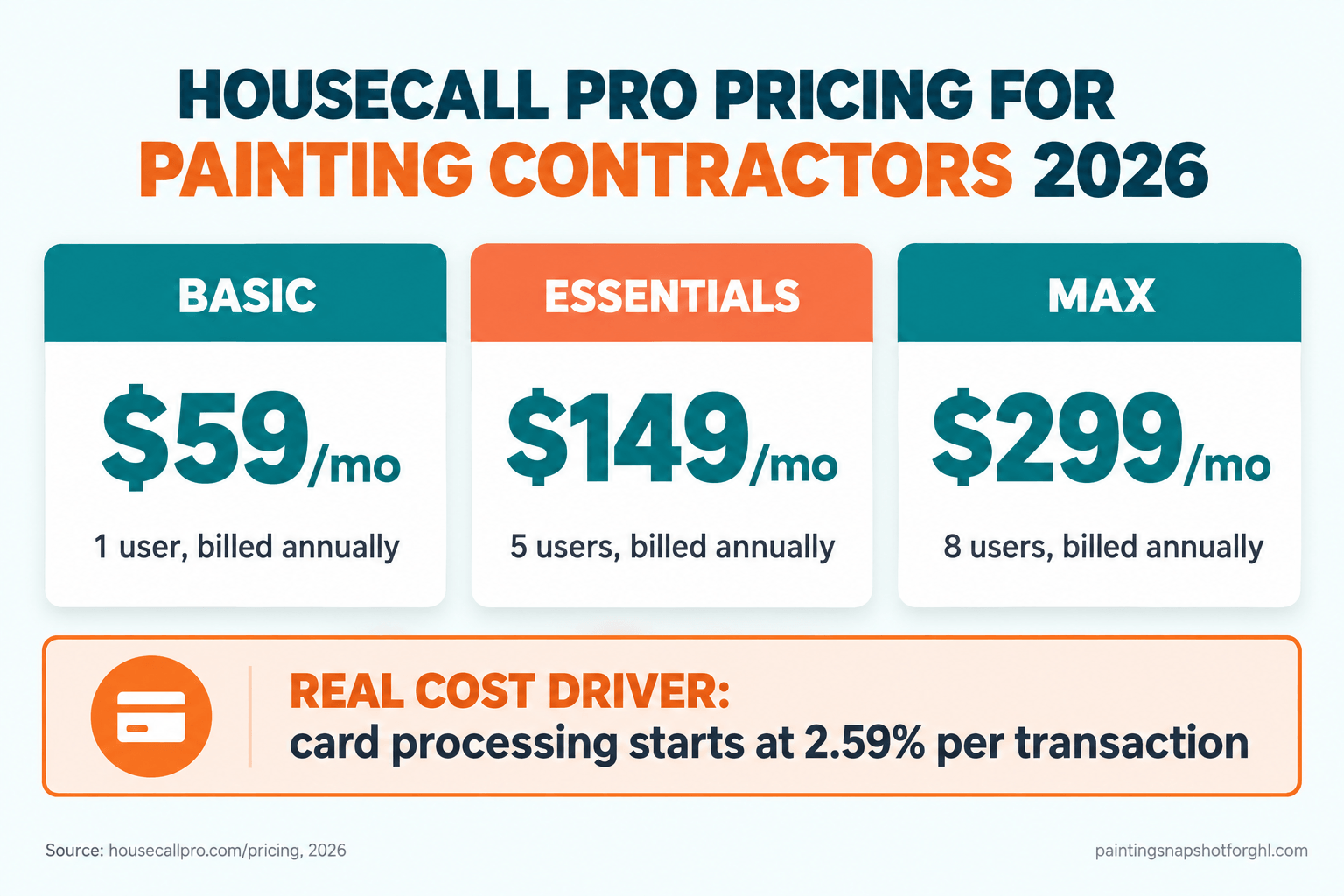
So what does Housecall Pro actually cost a painting contractor in 2026? The published plans run $59 a month on Basic, $149 on Essentials, and $299 on Max, all billed annually (Housecall Pro pricing). But the subscription is the easy part. Card processing starting at 2.59% on every transaction, a seat rule that forces a full tier jump the moment you add one person past your plan, and a shelf of add-ons with no public prices quietly push the real number two to ten times the sticker. A five-person crew lands near $149 a month in subscription and well over $1,000 once the cards start swiping.
In this post
- Why the $59 sticker isn’t your bill
- Every Housecall Pro plan, what it costs, and who it fits
- The fees and the seat jump the plan price leaves out
- Three real cost scenarios: solo, crew, multi-crew
- Where the Housecall Pro bill bites painting shops
- Steal this: the questions to ask and the follow-up no CRM runs
- The rules Housecall Pro doesn’t handle for you
- Straight answers to the objections
- Frequently asked questions
Why the $59 sticker isn’t your bill
Give Housecall Pro credit. Like Jobber, and unlike JobNimbus, which hides its price behind a demo call, it publishes the plans on the site, which is more than most contractor software gives you.
The trap is that the sticker answers the wrong question. “How much is the plan” is not “what will this cost my shop a month,” and the gap is wide for three reasons: the seat rule, the card fee, and the add-ons with no prices. Stack a working crew’s real needs onto the $59, a second login, card payments, the reminders and reviews the cheapest plan leaves out, and it becomes a few hundred, sometimes a few thousand, a month by year end.
Every Housecall Pro plan, what it costs, and who it fits
The prices below are billed annually, the cheapest way to buy; month-to-month runs $20 to $40 higher per plan (Housecall Pro pricing).
| Plan | Annual price | Users included | What you get | Who it actually fits |
|---|---|---|---|---|
| Basic | $59/mo ($79 monthly) | 1 | Scheduling, estimates, invoicing, basic payments, text and email | A true solo painter running it all from one phone |
| Essentials | $149/mo ($189 monthly) | 5 | Basic plus QuickBooks Online sync, review requests, reporting, more automation | A small crew with an office person that wants reminders and reviews on autopilot |
| Max | $299/mo ($329 monthly) | 8 | Essentials plus the Sales Proposal Tool, recurring service plans, open API, and add-a-user at $35 each | A multi-crew shop needing more seats, proposals, and integrations |
A few things jump out. Basic is genuinely single-user: the moment your estimator needs a login, it is done, with no way to add a seat. Essentials is the real starting point for most shops. Max is where proposals, recurring plans, and API access live, and it is the only plan that sells extra seats, at $35 a month each (Housecall Pro pricing).
Figure: Housecall Pro plan price by tier (billed annually, USD per month).
Source: Housecall Pro pricing page, 2026, billed annually. Month-to-month is higher: $79, $189, and $329 respectively.
One note for cross-shoppers: Housecall Pro’s Essentials at $149 for five users lands on the exact same sticker as Jobber’s Connect plan at five users. Same headline, two different bills once you count seats, processing, and add-ons.
The fees and the seat jump the plan price leaves out
Three costs ride on top of your plan, and for a painting business one usually dwarfs the subscription.
Card processing. Housecall Pro Payments starts at 2.59% per card and 1% on bank (ACH) transfers (Housecall Pro payments). The words “starts at” matter: the published rate is a floor, not a ceiling. A shop collecting $600,000 a year by card pays roughly $15,500 in processing alone, more than four years of a Max subscription. ACH at 1% is under half the cost, so steering larger invoices to bank payment is one of the few levers on this bill. Two more lines to watch: Instapay instant payouts add 1% plus your standard fee, with 75 cents extra under $75 (Instapay FAQ), and customer financing runs through Wisetack at a customer APR of 0% to 35.9%, with no charge to you.
The seat jump. This surprises painters more than the card fee, because it hits only when you grow. Most field software, Jobber included, lets you add one user for a flat fee, around $29, with your tier unchanged. Housecall Pro does not: Basic and Essentials have no add-a-user option at all, and only Max sells extra seats, at $35 each (Housecall Pro pricing). So your sixth user on Essentials is not a $35 add. You move up to Max at $299, and that one hire just doubled your subscription for a single login. If you can see six or seven coming within the year, price Max from the start.
Paid add-ons with no public prices. This is the real transparency knock. Housecall Pro lists a shelf of add-ons, including Pipeline, CSR AI, the Sales Proposal Tool, Payroll, and Campaigns, but does not publish what any of them cost (Housecall Pro pricing). You find the number on a sales call, after you are already in.
This is the chart most painters never see: subscription versus card processing for a five-person crew running $600,000 through cards. The subscription is the short bar.
Figure: Housecall Pro subscription vs card processing for a 5-person crew (estimated monthly, USD).
Source: subscription from the Housecall Pro pricing page, 2026 (Essentials, 5 users, annual). Processing estimated at 2.59% on ~$600,000 of annual card volume, shown monthly; your figure depends on your card vs ACH mix and your actual rate.
The takeaway is not that Housecall Pro is expensive software. By subscription it is reasonable. It is that for a painting business the processing fee is the line item that actually moves your bank balance, and you cut it by moving work to ACH.
Three real cost scenarios: solo, crew, multi-crew
What Housecall Pro costs depends on your size, seat count, and card volume. Here are three shops.
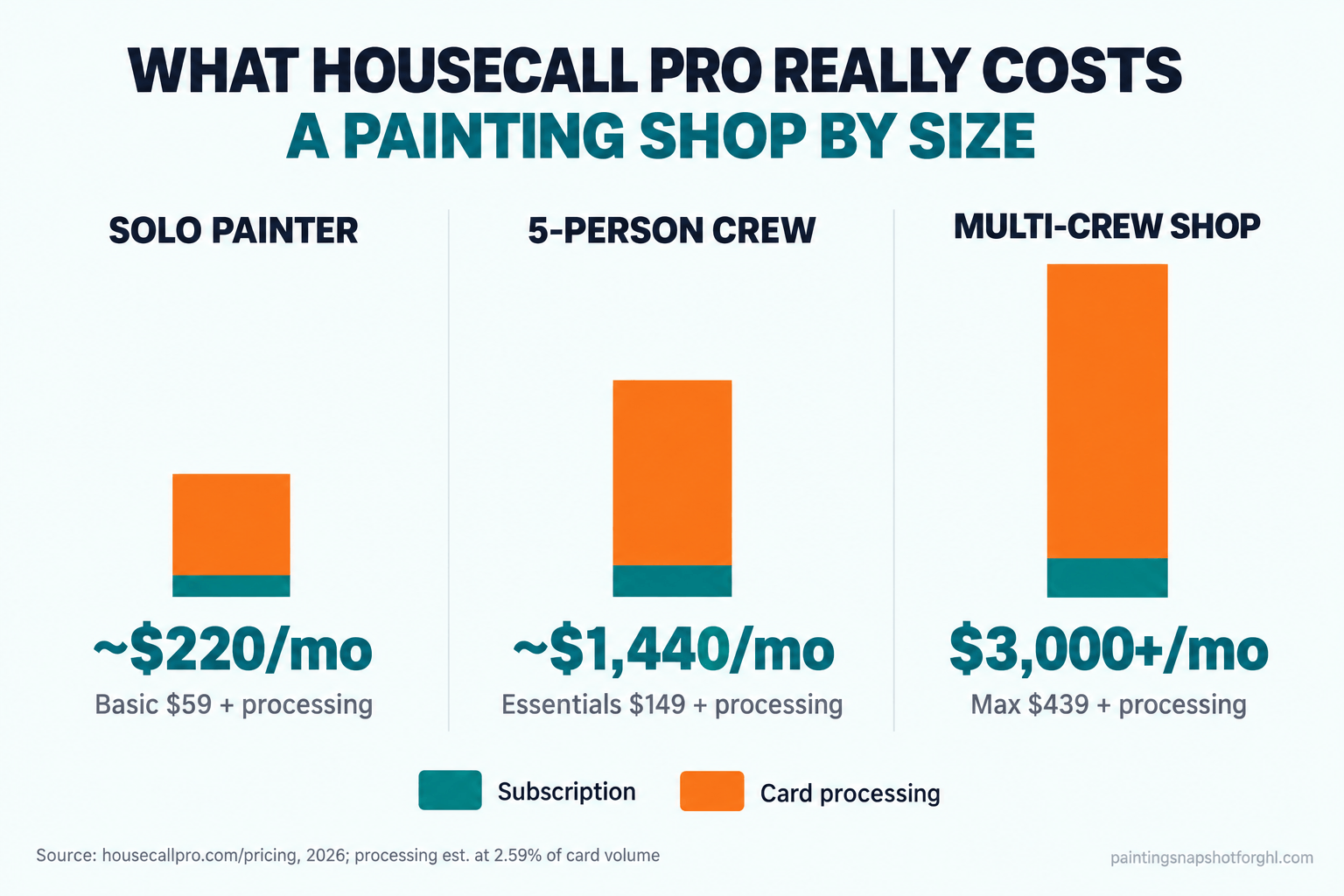
The solo painter. One truck, maybe a helper with no login, $150,000 a year. Basic at $59 fits, as long as you are the only person in the software. If half your revenue runs through cards ($75,000), processing at 2.59% is roughly $1,900 a year, about $160 a month. All-in near $220, and the $59 plan is a quarter of it. The real risk is the seat cliff: the day you add an office person, you are on Essentials at $149. Collect deposits by ACH or check to keep card volume down.
The five-person crew. An estimator, an office person, and three painters, $600,000 a year. Five users fits Essentials exactly at $149, with the QuickBooks sync and review requests a growing shop wants. But $600,000 of card revenue is roughly $15,500 a year in processing, about $1,295 a month. All-in near $1,440, and the subscription is only $149 of it. This is the shop that gets the biggest shock: the sticker said $149, the bill says four figures, almost all card fee. Routing even a third to ACH saves well over $3,000 a year.
The multi-crew shop. Three crews, 12 users, $1.5 million. On Max at $299 for eight users plus four extra seats at $35, call it $439 a month. Card processing on $1.5 million, even with a decent ACH mix, can clear $30,000 a year. At this scale the subscription is a rounding error and the processing is a cost center worth negotiating a custom rate on. Housecall Pro runs an operation this size well. Just do not pretend the plan price is the cost.
The pattern is the same every time: the bigger you get, the more the card fee swamps the subscription, with the seat rule adding a step-change in the middle. The headline price is the least important part of the decision.
Where the Housecall Pro bill bites painting shops
Software rarely fails you on the day you buy it. It fails three months in, when a cost you did not plan for shows up on the statement. Three places Housecall Pro surprises painters, and what to do.
You buy Basic and hit the one-user wall. Basic is a single login with no way to add a seat. The day a second person needs in, you jump to Essentials at $149. If anyone besides you will ever touch the software, start on Essentials and skip the whiplash.
The card fee creeps because everything defaults to card. Housecall Pro makes paying by card easy, great for getting paid and rough on your margin. Set ACH as the default on larger invoices, reserve cards for deposits and small balances, and you cut your single biggest cost on the platform roughly in half.
You budget the plan and forget the add-ons. Pipeline, CSR AI, the Sales Proposal Tool, and Payroll are sold separately with no published price. It is easy to sign up and then get talked onto three add-ons that cost more than the subscription. Decide what you need before the call, and make them quote every add-on in writing.
Steal this: the questions to ask and the follow-up no CRM runs
Two things to take with you: the questions that keep the real cost from sneaking up, and the follow-up copy that wins jobs, which every CRM leaves for you to run by hand.
Price it honestly before you commit. Answer these for your own shop:
1. How many logins will I REALLY need through busy
   season? (Decides Basic vs Essentials vs Max.)
2. What is my card volume, and what is 2.59% of the
   share I'll run through HCP Payments?
3. How much can I move to ACH (1%) to halve the fee?
4. Which add-ons do I need, and what does each cost?
   Get it in writing before signing.
Now the part no field-service CRM does for you: answering a brand-new lead in the first minute and chasing a quiet estimate for two weeks. Speed is the whole game: firms that respond within an hour are far more likely to reach the decision maker, and the painter who replies first usually books the job.
The instant reply, sent within a minute of a new lead landing:
Hi [Name], this is [Your Name] with [Company]. Thanks
for the request for a [interior/exterior] painting
estimate. I can take a look this week. Does [day]
morning or [day] afternoon work better for a quick
walk-through?
The follow-up on a quote that went quiet, day four:
Hi [Name], just following up on the painting estimate
I sent for [project]. Happy to walk through the scope
or adjust anything. Are you still looking to get this
done before [season/event]?
Housecall Pro can store these as templates, but it will not fire them the second a lead lands or run the full two-week chase on its own. That gap, between managing the work and winning it, is exactly what a done-for-you automation system is built to close.
The rules Housecall Pro doesn’t handle for you
Whatever software you pick, the rules on how you advertise, who you paint for, and how you text land on you, not the vendor. Three to keep straight.
EPA lead-paint RRP. Roughly three-quarters of homes built before 1978 still contain some lead-based paint, and disturbing it requires an EPA-certified renovator using lead-safe practices (EPA RRP Program). No CRM makes you compliant.
State licensing and your ads. California requires a contractor license for most jobs over $1,000 and, under Business and Professions Code 7030.5, your license number must appear in all advertising (CSLB). Texas has no state general contractor license at all. See the full compliance checklist for the state detail.
Texting law. Automated marketing texts need prior express written consent under the TCPA, and business texting now runs through A2P 10DLC registration (FCC). Build consent into your intake form and keep an opt-out on every text.
Straight answers to the objections
“I already pay for Housecall Pro. Did I overpay?” Probably not for what it does. It is good at scheduling, invoicing, and collecting on work you already booked. The question is whether it is also winning you new work, and it is not built to. Keep it for operations and add something that answers leads and chases quotes.
“Isn’t $59 basically nothing? Why overthink it?” Because $59 is Basic for one user, and almost no shop with an office person stays there. Once you add the tier you need, the seat jump, and processing on every card, the real number is several hundred to a few thousand a month.
“Should I just switch to Jobber instead?” They are close competitors, and the Jobber vs Housecall Pro breakdown walks the differences. But switching CRMs does not fix the lead-response gap, because neither answers a new caller in the first minute. Pick the operations tool you like and solve lead response separately.
“Do I need the add-ons?” Usually not at first, and you cannot budget for them from the public page anyway. Start with just the plan, find your real bottleneck, and add only what earns its keep. If the add-on you want is lead response or follow-up, compare it against a system that handles answering, chasing, and reviews together.
Frequently asked questions
How much does Housecall Pro cost for a painting contractor in 2026?
Three plans, billed annually: Basic at $59/mo for 1 user, Essentials at $149/mo for 5 users, and Max at $299/mo for 8 users (month-to-month is $79, $189, and $329). On top of that you pay card processing starting at 2.59% per transaction, 1% on ACH, plus any add-ons. A realistic all-in for a five-person crew is about $149/mo in subscription and well over $1,000/mo in card processing.
Is Housecall Pro Basic at $59 enough for a painting business?
Only for a true solo operator. Basic is a single user with no option to add a seat, so the moment an office person or second estimator needs a login, you jump to Essentials at $149/mo. Most shops with any staff start on Essentials rather than the $59 sticker.
What are Housecall Pro's card processing fees?
Housecall Pro Payments starts at 2.59% per card and 1% on bank (ACH) transfers, and the 2.59% is a floor, so your real rate can be higher. Instapay instant payouts add 1% plus the standard fee, with 75 cents extra under $75. Processing is usually the single biggest cost of the platform, so pushing larger invoices to ACH saves real money.
Does Housecall Pro charge extra for additional users?
Only on Max, at $35/mo per extra user. Basic (1 user) and Essentials (5 users) have no add-a-user option, so outgrowing your seat count means jumping a whole tier. Going from a sixth user on Essentials up to Max is a $150/mo increase, not $35.
Are there setup fees or contracts with Housecall Pro?
No long-term contract and no listed setup or onboarding fee. The $59/$149/$299 prices assume annual billing paid up front; month-to-month costs more. Add-on prices are not published and are quoted on a sales call.
Will Housecall Pro answer my leads and follow up on quotes automatically?
No. Housecall Pro manages the work you already won: scheduling, dispatching, invoicing, and collecting. It does not answer a brand-new lead in the first minute or run a multi-week chase on an unsold estimate on its own. That is marketing automation, a separate category, and where most painting revenue leaks. A done-for-you GoHighLevel system fills that gap alongside it.
Related reading:
- Best Painting Business Software in 2026: Jobber vs Housecall Pro vs JobNimbus vs PaintScout vs Markate
- Jobber vs Housecall Pro for Painting Businesses (2026): Real Pricing and 8 Criteria Compared
- Jobber Pricing for Painting Contractors (2026): What You Actually Pay
- JobNimbus Pricing for Painting Contractors: What It Actually Costs in 2026
- GoHighLevel vs Housecall Pro for Painters
- Painting Estimate Follow-Up: The Sequence That Turns Cold Quotes Into Booked Jobs
Painting Snapshot is a GoHighLevel automation product for house painting contractors. We are not a painting company and do not perform painting work or quote project pricing. Pricing, plans, and features for Housecall Pro, Jobber, JobNimbus, PaintScout, and Markate are set by those companies and change over time; the Housecall Pro figures here reflect publicly published 2026 pricing and are provided for planning only. Processing estimates assume a sample card volume and your actual rate and mix will differ. All product names are trademarks of their respective owners. Verify current terms on each vendor’s site before buying.