

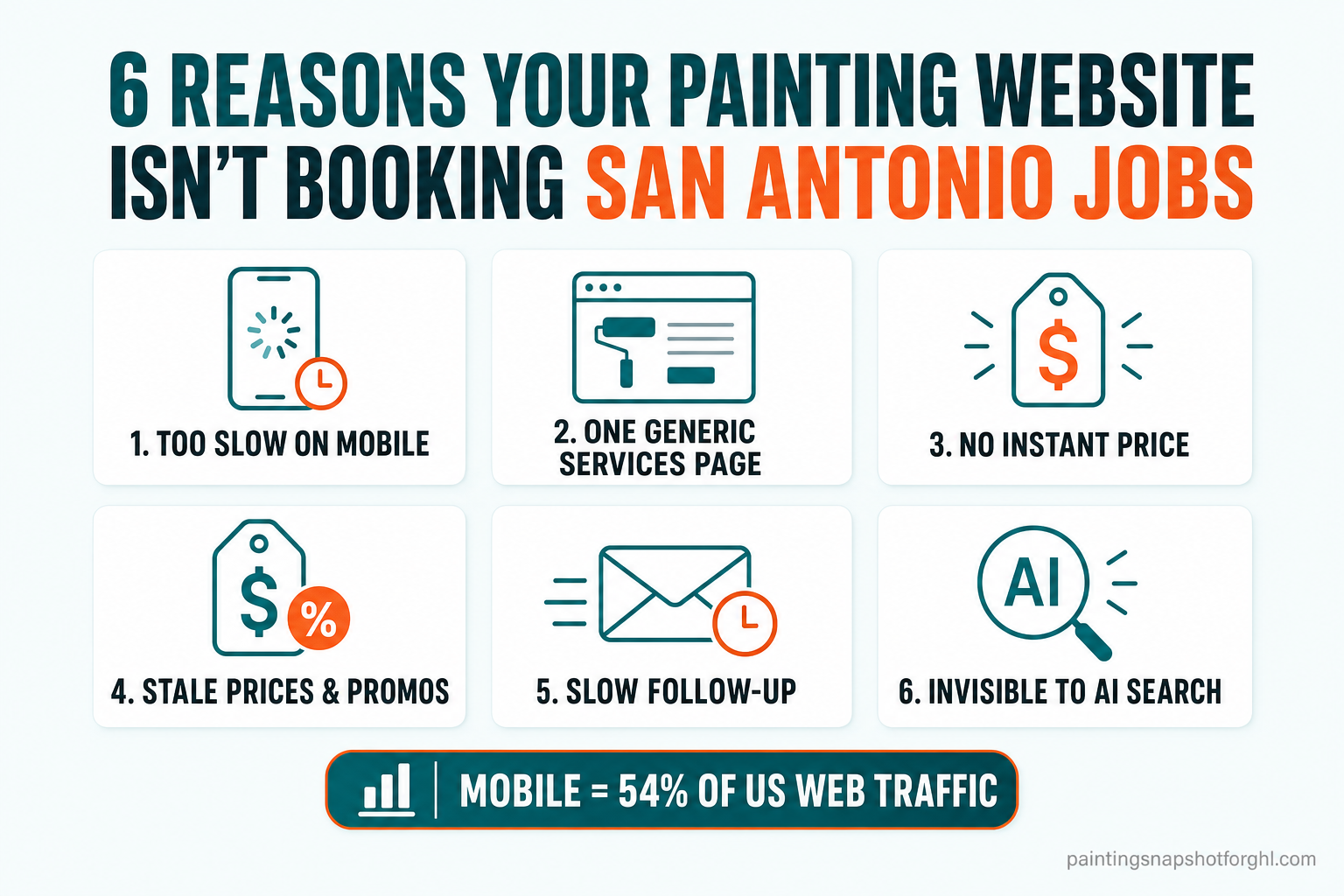
Your San Antonio painting website isn’t losing jobs because your work is bad — it’s losing them because it loads too slowly on a phone, hides your prices, buries every service on one page, and takes hours to follow up. The homeowner on Loop 410 comparing three painters at 9pm doesn’t pick the best crew; she picks the site that opens fast, gives her a real number, and answers first. Every one of those failures is fixable, and none of them requires you to become a web developer. This post walks through the six specific reasons a painting site quietly leaks leads across San Antonio — each with the current data behind it — and shows what a website built to book estimates actually looks like.
In this post
- Why San Antonio paint jobs are won on your website
- The 6 reasons your website isn’t booking jobs
- What a website that books San Antonio jobs looks like
- Frequently asked questions
Why San Antonio paint jobs are won on your website
San Antonio is one of the largest home-service markets in Texas, and it keeps making repaint work. The city counts a 2020 population of 1,434,625, estimated at 1,495,295 by 2023, spread across 547,883 households with a 52.4% owner-occupied housing rate (U.S. Census Bureau QuickFacts) — from the 1920s bungalows of Alta Vista and Monte Vista to the stucco tract homes out toward Stone Oak and Alamo Ranch. Every one of those owner-occupied homes is a future interior repaint, exterior job, or cabinet refinish.
That demand is the good news. The field chasing it is the catch. Nationally, house painting spans about 220,891 contractor businesses (IBISWorld, 2024) employing roughly 342,200 painters (U.S. Bureau of Labor Statistics, 2024). When a homeowner off Bandera Road or in Alamo Heights searches “house painter near me,” your website isn’t competing with your reputation — it’s competing with a dozen other painters one thumb-tap apart, on a screen, in the same minute.
And that screen is almost always a phone. Mobile devices now generate about 54% of all US web traffic (StatCounter, 2025). The homeowner isn’t at a desk weighing bids. She’s standing on the driveway of the house she wants painted, on one bar of signal, deciding in seconds whether your site is worth her time. If it stalls, confuses her, or gives her nothing to act on, she’s back to the results before your first before-and-after photo loads.
The 6 reasons your website isn’t booking jobs
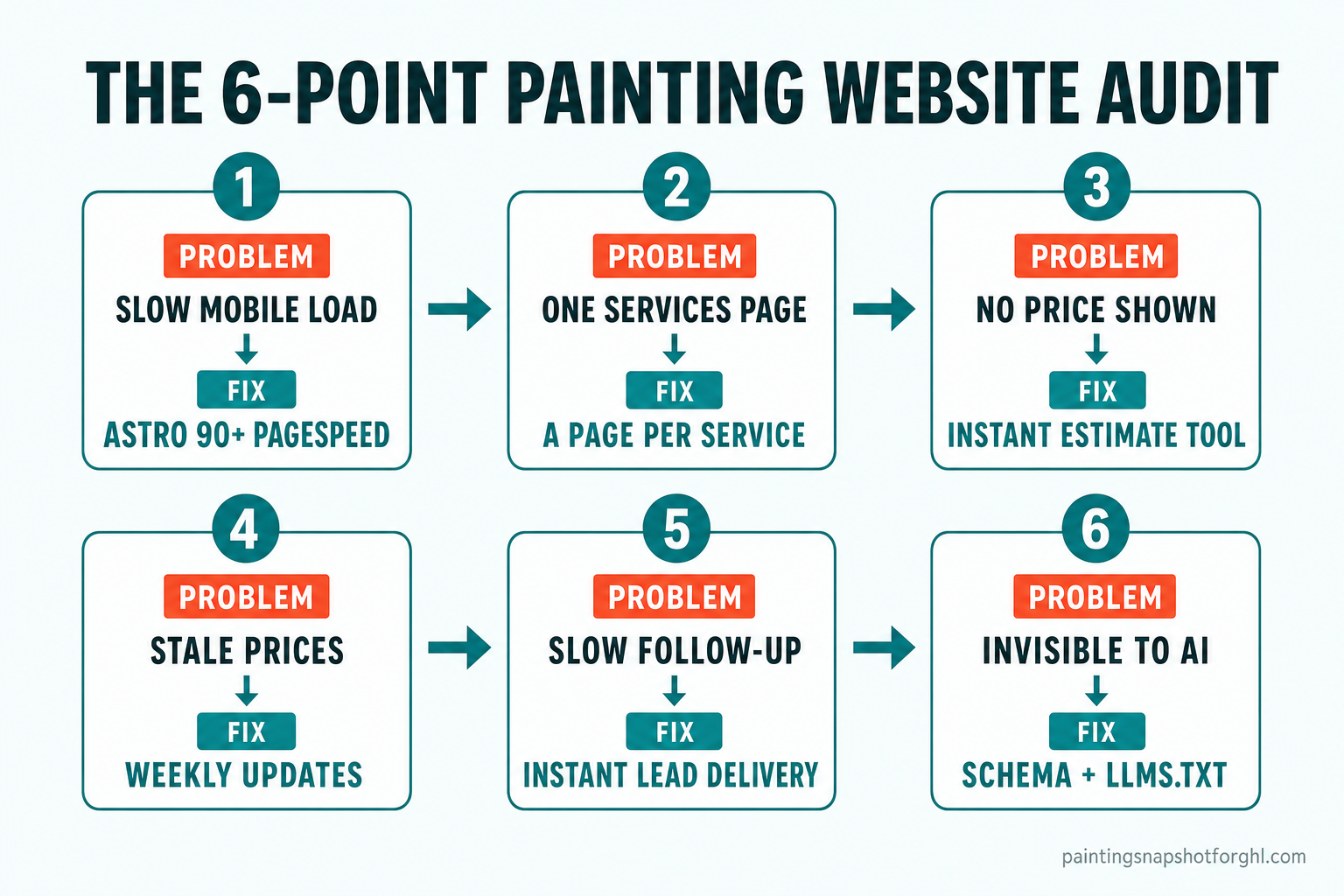
Here are the six failures that quietly cost San Antonio painters estimates — in the order a homeowner runs into them.
1. It’s too slow on a phone
Speed is the first filter, and most painting sites fail it before a word is read. Google considers a page fast only when its Largest Contentful Paint is 2.5 seconds or less for the bulk of visits (Google / web.dev) — that’s the moment your main photo or headline actually appears. Typical page-builder themes, with a slideshow and four tracking scripts, blow well past that on a phone with one bar.
The cost is not abstract. In Google’s benchmark study of mobile landing pages, the probability that a visitor bounces climbs 32% as load time goes from one second to three, and 123% by ten seconds (Think with Google).
Increase in probability a mobile visitor bounces as page load time grows. Source: Think with Google.
Speed isn’t just about who stays — it’s about who buys. Deloitte’s “Milliseconds Make Millions” study, run with Google across 37 brands and 30 million-plus sessions, found that a 0.1-second improvement in mobile speed lifted retail conversions 8.4%, average order value 9.2%, and travel conversions 10.1% (Deloitte + Google, 2020).
Percentage lift from a single 0.1-second mobile speed improvement. Source: Deloitte + Google, 2020.
If you want the full page-speed breakdown for a Texas market, we wrote one for Dallas painters here. The short version: a heavy, script-loaded site is a leak you can measure.
2. One generic “Services” page can’t rank
Most painting sites have a single page titled “Services” that lists interior, exterior, cabinets, decks, and commercial in a few bullet points. That page cannot rank in San Antonio for any of them. Search engines — and AI answer engines — reward the page that answers a specific question in depth, and one page trying to cover five services answers none of them well.
When a homeowner searches “cabinet painting San Antonio,” Google wants a page that is about cabinet refinishing: the prep, the spray finish, how long the kitchen is out of use, what it costs. The painter with a dedicated cabinet refinishing page — and a separate one for exteriors, and another for decks — is the painter who shows up. You lose the job you were better placed to do because your site never made the case for that specific service.
The same logic applies to place. Painters don’t serve a county in the abstract; they serve the neighborhoods a crew will drive to at 7am. A site with a real page for the areas you actually work — Stone Oak, Alamo Heights, Boerne, New Braunfels — ranks for those searches. One contact page with a map pin does not.
3. It hides the one thing every homeowner wants: a price
Before a homeowner lets anyone into her house, she wants a rough number. If your site gives her nothing, she keeps clicking until she finds a painter who will put a range in front of her — and you never learn she was looking.
You don’t have to quote a firm bid to win here. An instant estimate tool — square footage, interior or exterior, number of coats, ceilings and trim in or out — that returns an honest range does two things at once: it gives the homeowner the number she was hunting for, and it hands you a lead who won’t fall over when you say the real figure at the door. (Estimate outputs are ballpark figures for lead capture — the real bid still comes from your walkthrough.) A site with no self-serve estimate sends your most motivated buyers straight to a competitor who has one.
4. Your prices, crew, and promos are out of date
Materials moved. Your day rate moved. The number you charge for a two-story exterior in June isn’t the number you charge in November. But the price on your website is the one you typed in a different year — so when your estimator hands the homeowner a figure, the conversation starts with you defending a number instead of selling the work.
It’s the same story with everything else that goes stale: the spring promo that’s still up in October, the new commercial service that never got a page, the crew member who left in March and is still on the About page. The reason it’s all outdated is that changing anything on a typical site means an email to a developer, a quote, and a two-week wait — so nobody bothers. A site you can’t keep current isn’t a marketing asset; it’s a liability quietly contradicting your estimator.
5. It doesn’t answer fast enough
Say your site does its job and the homeowner submits a quote request. What happens next is where most jobs are actually lost. The lead lands in a website inbox nobody checks until the crew is off the ladder at 5pm — and by then it’s cold.
The speed-to-lead research is brutal on this point. A lead you contact within five minutes is 21 times more likely to qualify than one you reach at thirty minutes (MIT / InsideSales Lead Response Management Study). Yet Harvard Business Review’s audit of 2,241 companies found the average first response took 42 hours, and 23% never responded at all (HBR, 2011). You can’t paint and answer leads in the same minute — which is exactly why the answer has to be automatic. A site wired so every submission is pushed instantly to your phone and CRM, with an AI caller or chatbot replying in seconds, is the difference between booking the estimate and funding your competitor’s. We broke down the mechanics for painters in missed-call text-back.
6. It’s invisible to AI answer engines
More San Antonio homeowners are asking an AI assistant — ChatGPT, Google’s AI Overviews, Perplexity — “who’s a good painter for cabinets near me?” instead of scrolling a list of blue links. Those engines can only recommend a business they can read and understand, and they read structured data: schema markup that states you’re a painting contractor, what you do, where you work, and when you’re open, plus a clean sitemap and an llms.txt file that lays your content out for them.
Most painting sites ship none of that. They’re built on themes that never emitted schema, so to an AI assistant your business is a blank. The painter whose site declares itself properly is the one who gets named when a homeowner asks an assistant for a recommendation — a channel that barely existed two years ago and is growing fast. (We wrote a full guide to showing up in AI search for painting contractors.)
What a website that books San Antonio jobs looks like
Fixing these six problems one plugin at a time is how painters end up with a slow, half-broken site nobody wants to touch. The cleaner path is a site built correctly from the start — which is exactly what our done-for-you painting websites deliver. Here’s how each failure above gets answered:
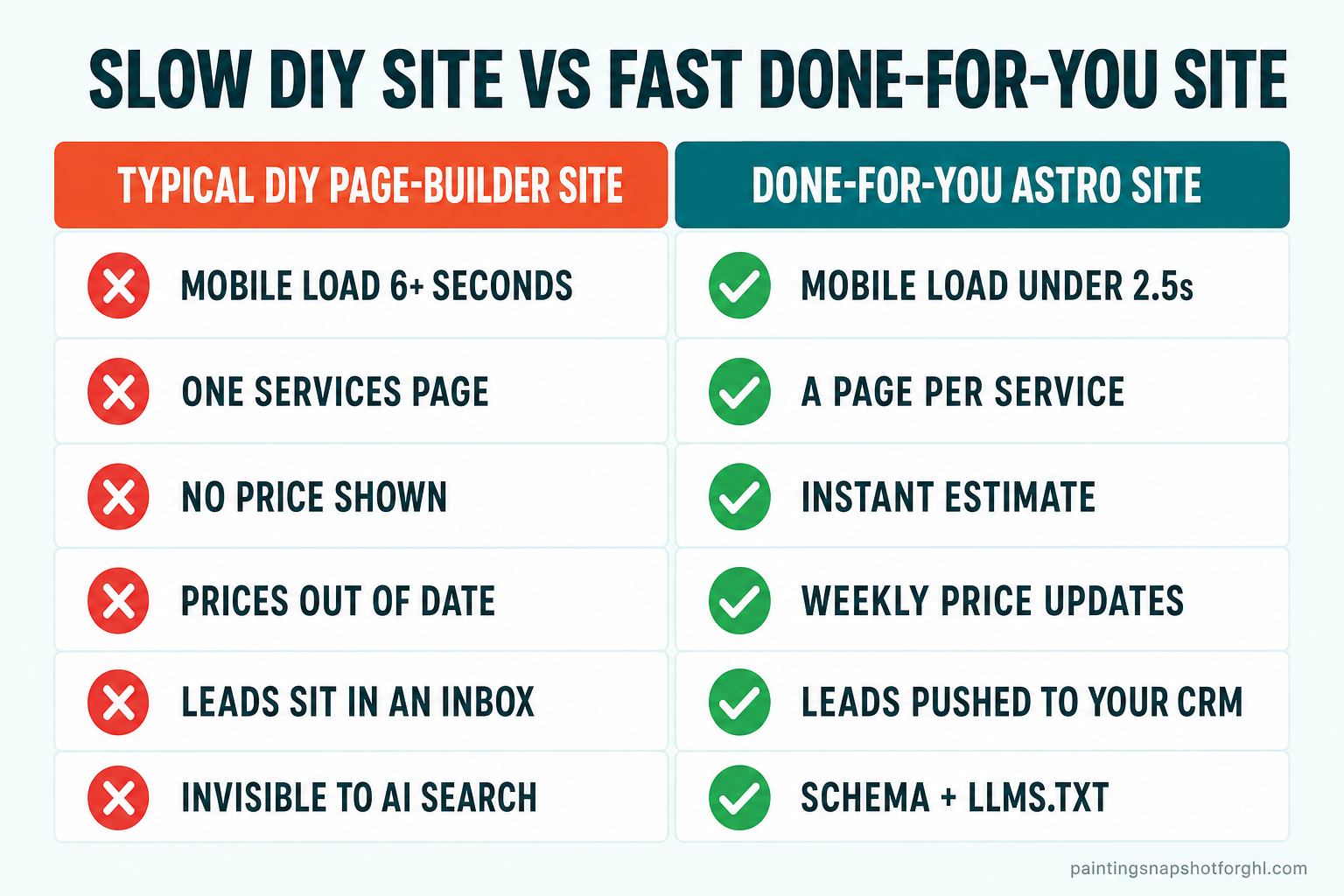
- Fast on a phone. Built on the Astro framework, which ships almost no JavaScript, and served from Cloudflare’s edge — we guarantee a 90+ Google PageSpeed score on mobile and desktop, so the homeowner on the driveway sees your work before she loses patience.
- A page for every service and every place. Interior, exterior, cabinets, decks, commercial, HOA — each gets a real page that can rank, plus pages for the towns you actually send crews to.
- An instant estimate. A square-footage calculator set to your own rates gives the homeowner the number she wants and gives you a pre-qualified lead.
- Weekly price updates. Your rates and ranges are kept current every week, so your site never contradicts your estimator.
- Instant lead delivery. Every form submission is pushed straight into your CRM or phone by API, Zapier, or Make — where your office already looks.
- Schema, sitemap, and
llms.txtdone properly, so the AI answer engines read your business correctly and recommend it.
It’s fully managed — hosting, SSL, backups, uptime, and updates are ours — starting at $117/month plus a one-time build fee, with the build fee charged only after the site is live and you’ve signed off. Full pricing and plans are on the Get a Website page.
If you’re weighing platforms first, we compared the common builders for painters in Wix vs Astro for painting websites — the same speed-and-editability trade-offs apply in San Antonio.
Frequently asked questions
Why is my painting website not getting leads in San Antonio?
Usually one of six reasons: it loads too slowly on a phone, it puts every service on one generic page that can't rank, it gives no price so homeowners bounce to a painter who does, its prices and promos are out of date, it follows up too slowly after a form is submitted, and it lacks the schema and llms.txt that let AI answer engines recommend you. Each one is fixable — the fastest route is a lightweight, well-structured site built for lead capture.
How fast should a painting website load on mobile?
Google considers a page fast when its Largest Contentful Paint — when your main image or headline appears — is 2.5 seconds or less for most visits. Since about 54% of US web traffic is mobile, and bounce probability rises 32% just going from a 1-second to a 3-second load, speed on a phone is the single highest-leverage fix for a painting site.
Do I really need a separate page for each painting service?
Yes. One page covering interior, exterior, cabinets, and decks can't rank for any of them, because search and AI engines reward pages that answer one specific question in depth. A dedicated cabinet-refinishing page, exterior page, and deck-staining page each rank for their own searches and speak directly to that buyer — which is why single-page 'Services' sites lose to competitors with a page per service.
Should my painting website show prices?
It should show a range, not necessarily a firm bid. Homeowners want a rough number before they let anyone in the house, and a self-serve estimate calculator set to your rates gives them that while handing you a pre-qualified lead. Estimate outputs are ballpark figures for lead capture; the binding quote still comes from your walkthrough.
How much does a done-for-you painting website cost?
Our managed painting websites start at $117/month plus a one-time build fee, and the build fee is only charged after the site is live and you've approved it. That includes fast Astro hosting, a page per service, an instant estimate, weekly price updates, and lead delivery into your CRM. See the Get a Website page for full plans.
How quickly can a new painting website go live?
A focused build can be live in about 7 days after a single onboarding call where we take your services, rates, service areas, brand, and job photos. Plans that add an AI receptionist or a content engine take a little longer — 10 to 15 days — because those systems are trained on your specific services and pricing.
Written by Rafael Montoya, Founder & GHL Automation Lead at Painting Snapshot. Rafael spent eleven years running an exterior-and-cabinet repaint crew across the Phoenix valley before he ever touched a CRM. After watching too many summer leads die in a full voicemail box, he taught himself GoHighLevel to answer every estimate request the moment it landed. Today he builds done-for-you painting systems and writes about the tools that let a shop book jobs without the owner glued to a phone.
Related posts