To show up in AI search as a New York City painting contractor, you have to feed the answer engines what they read: a fast, crawlable website, structured data (schema) that spells out who you are and where you work, answer-first content built around the exact questions NYC homeowners ask, real neighborhood pages, an llms.txt file, and a steady stream of Google reviews. ChatGPT, Perplexity, and Google’s AI Overviews don’t rank ten blue links — they read a handful of trustworthy, machine-readable sources and name a few businesses in a sentence. If your Manhattan or Brooklyn paint shop isn’t one of the sources they can parse, you’re invisible in the exact moment a homeowner is deciding who to call. This playbook lays out the seven steps to become one of the businesses the AI actually cites.
In this post
- Why AI search decides which NYC painter gets the call
- What GEO and AEO actually mean
- The 7-step playbook to show up in AI search
- Step 1 — Start with a fast, crawlable website
- Step 2 — Add structured data so AI can parse you
- Step 3 — Write answer-first, question-shaped content
- Step 4 — Build real NYC location and borough pages
- Step 5 — Publish an llms.txt and keep pages AI-readable
- Step 6 — Earn reviews and lock down your NAP
- Step 7 — Catch the AI-referred visitor with a chatbot
- What a NYC painter should expect
- Turning it on: a website built to be cited
- Frequently asked questions
Why AI search decides which NYC painter gets the call
New York City is one of the deepest home-services markets in the country. It’s home to 8,804,190 people (U.S. Census / NYC Dept. of City Planning, 2020), and it added 247,573 housing units — a 7.3% increase — between 2010 and 2020 (NYC DCP, 2020 Census). It also carries one of the oldest housing stocks of any major U.S. city (Citizens Housing & Planning Council) — pre-war co-ops, brownstones, and rowhouses that need interior repaints, trim, and plaster work on a cycle. Every one of those homes is a future paint job. Nationally, house painting is a $28.2 billion industry spread across roughly 223,209 contractor businesses (IBISWorld, 2025) — so the demand is real, and so is the crowd chasing it.
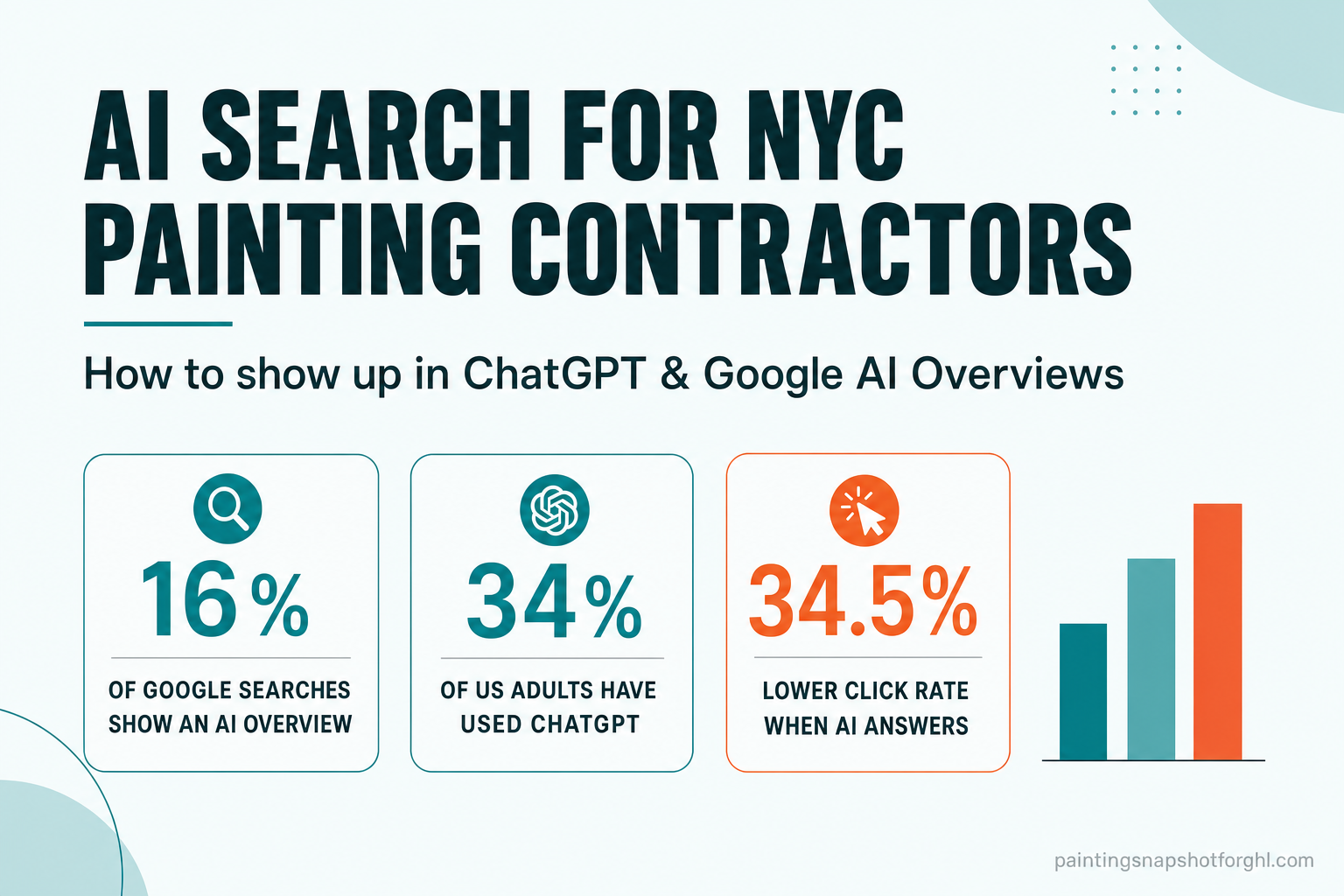
Here’s what changed. For twenty years, “getting found” meant ranking in Google’s ten blue links. That’s no longer where the search ends. Google’s AI Overviews now sit on top of a large share of results — about 16% of queries by late 2025, after a mid-year peak near 25% (Search Engine Land, 2025). And when that AI answer appears, it swallows the click: Ahrefs measured a 34.5% drop in click-through rate for the top-ranking page when an AI Overview is present (Ahrefs, 2025).
Zero-click search was already the norm before AI made it worse. In SparkToro’s study, only about 374 of every 1,000 U.S. Google searches send a click to the open web, and roughly 58.5% end with no click at all (SparkToro / Datos, 2024) — a number their 2026 update pushed even higher, with fewer than one in three searches still sending a click (SparkToro, 2026).
Share of Google queries showing an AI Overview across 2025 — a fast rise, then a plateau around 16%. Percentages shown. Source: Semrush data via Search Engine Land, 2025.
Then there’s the other front: people asking AI assistants directly. 34% of U.S. adults have now used ChatGPT (Pew, 2025), and it’s crossed 800 million weekly active users (reported Oct 2025). A NYC homeowner typing “who are good painters in Park Slope for a pre-war apartment?” into ChatGPT or Perplexity gets a short list of names — and you’re either on it or you aren’t. The old game was ranking. The new game is being one of the few sources the machine trusts enough to quote.
What GEO and AEO actually mean
GEO (Generative Engine Optimization) and AEO (Answer Engine Optimization) are the practice of making your website easy for AI systems to read, trust, and cite in their generated answers. It’s the natural next layer on top of traditional local SEO for painters — same foundations, aimed at a new kind of reader.
The key mental shift: an AI answer engine is not a human skimming a page. It’s a program that fetches pages, extracts facts, and assembles an answer from the sources it can parse most cleanly. It rewards clarity a person might not even notice — an explicit business name, a stated service area, a plainly answered question, a machine-readable schema block. Where classic SEO optimizes to rank a page, AEO optimizes to be the sentence the AI writes — and the citation underneath it.
The 7-step playbook to show up in AI search
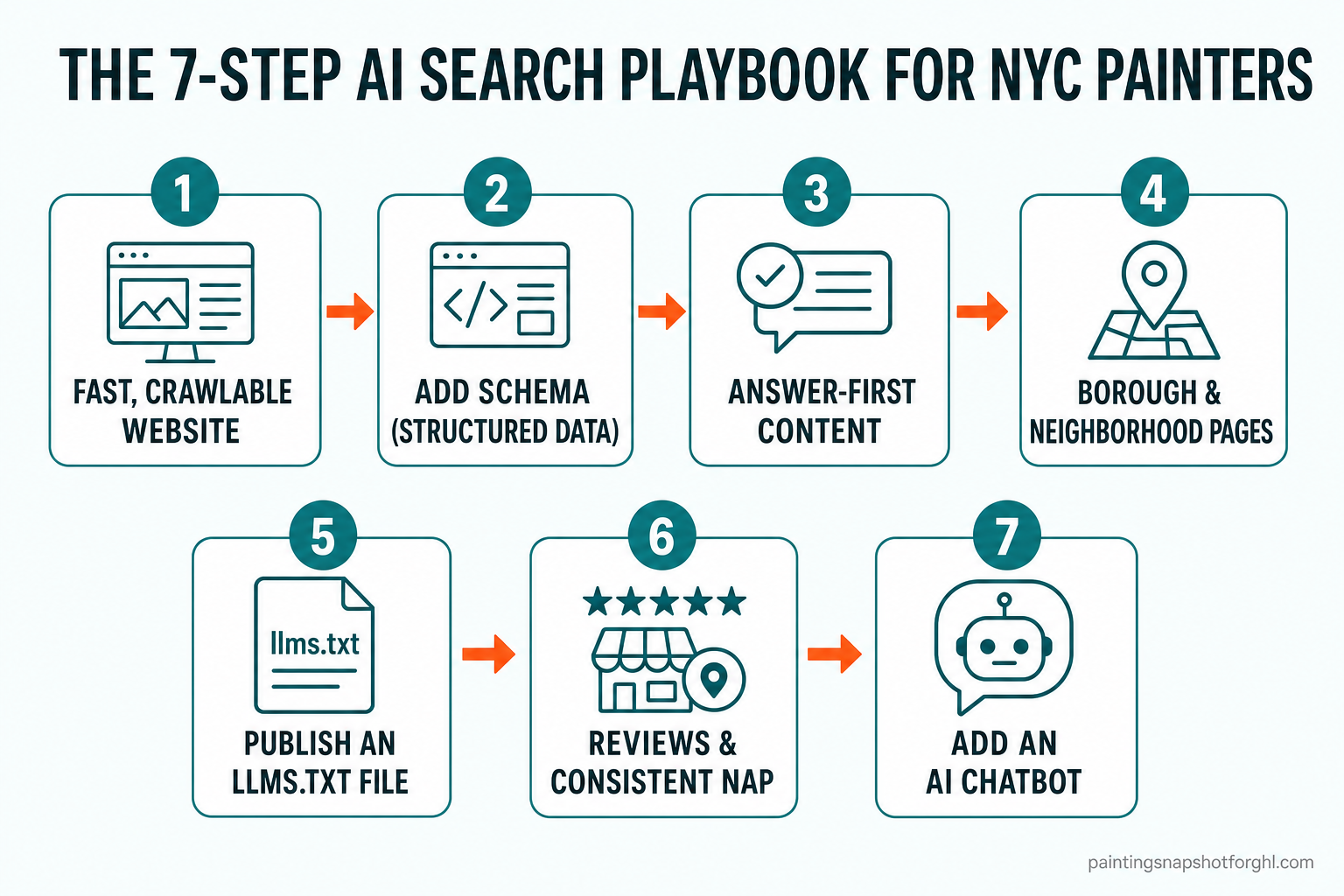
Here’s the full system, in order. Each step makes your NYC painting business more readable, more trustworthy, and more likely to be the source an answer engine names.
Step 1 — Start with a fast, crawlable website
Everything downstream depends on this. If an AI crawler can’t load and read your pages quickly, none of the schema or content matters. Speed is also a proven conversion lever for the humans who do click through: Deloitte’s study for Google found a 0.1-second improvement in mobile load time lifted retail conversions by 8.4% (Deloitte for Google, 2020).
Most painting websites are built on WordPress or a page-builder like Wix or GoHighLevel, which ship heavy JavaScript that slows the page and can hide content behind rendering that crawlers handle poorly. A static-first framework like Astro serves clean, fast HTML that both Google and AI crawlers read on the first pass — the same reason we cover it in our Wix vs Astro breakdown and our painting website speed guide. Fast, semantic HTML isn’t a nice-to-have here; it’s the price of admission to AI search.
Step 2 — Add structured data so AI can parse you
Structured data (schema.org markup, in JSON-LD) is a labeled summary of your business that machines read directly — your name, service area, services, reviews, address, and hours, stated in a format built for parsing. It’s the single highest-leverage AEO move because it removes all guesswork about who you are and where you work.
The payoff is measurable. Google’s own published case studies show schema lifting click-through: Nestlé found pages shown as rich results earned an 82% higher CTR, and Rotten Tomatoes saw a 25% higher CTR across 100,000 pages with structured data added (Google Search Central). The same LocalBusiness, Service, and FAQPage schema that earns those rich results is exactly what an answer engine reads to decide it can trust and quote you.
Measured lift after adding structured data, from Google’s official case studies. Percentages shown. Source: Google Search Central — structured data case studies.
For a NYC painter, that means LocalBusiness schema with an areaServed of your boroughs and neighborhoods, Service schema for interior painting, cabinet refinishing, and exterior work, and FAQPage schema on every page that answers real questions. Do it by hand and it’s fiddly to maintain; the right approach is a site that generates this markup automatically for every page.
Step 3 — Write answer-first, question-shaped content
AI engines assemble answers from passages that already read like answers. That means leading each page and section with a direct, self-contained response to a real question — then supporting it — instead of burying the answer under three paragraphs of throat-clearing.
Structure content around the exact phrasing NYC homeowners use: “How much does it cost to paint a two-bedroom apartment in Manhattan?”, “Do I need my co-op board’s approval to repaint?”, “How long does cabinet refinishing take in a Brooklyn brownstone?” Give each its own heading and a clear opening sentence that answers it outright. A passage the AI can lift verbatim — self-contained, specific, and correct — is a passage it can cite. Back every claim or number with a source, the way this article does; citation-friendly writing is what earns citations.
Step 4 — Build real NYC location and borough pages
Generic “we serve the tri-state area” copy gives an answer engine nothing to attach you to. Dedicated pages for the places you actually work — Manhattan, Brooklyn, Queens, and down to the neighborhood level like Park Slope, Astoria, or the Upper West Side — give AI and Google a specific, structured entity to associate with each location query.
Each page should carry its own LocalBusiness/Service schema with the right areaServed, genuinely local content (the co-op and landmark-district realities of that neighborhood, typical building ages, parking and access notes for crews), and its own FAQ. That specificity is exactly what a hyper-local query — “painters near me in Williamsburg” — needs to surface you, in both the map pack and the AI answer.
Step 5 — Publish an llms.txt and keep pages AI-readable
llms.txt is a simple file at the root of your site (like robots.txt) that gives AI systems a clean, plain-text map of your most important pages and facts — a front door built specifically for large language models. It’s an emerging standard, and adding it is low-effort, high-signal: you’re handing the crawler a tidy summary instead of making it reverse-engineer your navigation.
Pair it with the basics that keep pages machine-readable: a valid XML sitemap, a robots.txt that doesn’t accidentally block AI crawlers, clean semantic HTML, and descriptive alt text on images. None of this is glamorous, but it’s the plumbing that determines whether an answer engine can actually read your site or quietly gives up.
Step 6 — Earn reviews and lock down your NAP
AI engines lean heavily on third-party trust signals to decide who to recommend — and for local businesses, that means reviews and consistent business information across the web. It’s still how humans decide, too: 75% of consumers always or regularly read online reviews for local businesses, and Google is the most-used platform, cited by 81% (BrightLocal, 2024).
Two moves matter most. First, get a steady flow of recent Google reviews — the volume, rating, and recency all feed how both Google and AI weigh you. (Automating the ask after every job is the reliable way; see our review automation playbook.) Second, make your NAP — Name, Address, Phone — identical everywhere it appears: your site, Google Business Profile, Yelp, and directories. Inconsistent details make an AI unsure you’re one business, and uncertainty means it leaves you out.
Step 7 — Catch the AI-referred visitor with a chatbot
AI search changes how people arrive, but the visit still has to convert. When someone does click through from an AI answer or an Overview, they arrive further along — they’ve already been told you’re a good fit and they’re ready to act. Meeting them with an instant response captures that intent before it cools.
An AI chatbot on your own site answers the visitor’s question in seconds, qualifies the job, and books the estimate — 24/7, including the late-night browsing when a lot of NYC homeowners actually research contractors. It’s the bridge between “the AI sent them” and “the job is on your calendar.”
What a NYC painter should expect
Set the expectation honestly: AI search visibility is a compounding asset, not an overnight switch. Schema and a fast site can be read almost immediately, but building the review base, location pages, and content depth that make an engine confident enough to name you takes months of consistent work. Anyone promising you’ll be ChatGPT’s top pick next week isn’t being straight with you.
What you can expect is durable. As the click keeps shrinking — remember, roughly 58.5% of U.S. searches already end with no click (SparkToro, 2024) — the painters who are readable and citable will absorb the attention that used to spread across ten blue links. In a market as competitive as New York, being one of the three names an AI mentions is worth far more than being result number seven on a page fewer and fewer people scroll.
Turning it on: a website built to be cited
Steps 2 through 7 all assume one thing: a website that can actually do them. Most painting sites can’t — the schema is missing or stale, pages take seconds to load, and adding a neighborhood page means a support ticket and a bill. That’s the real reason painters stay invisible in AI search. It isn’t a content problem; it’s a platform problem.
Our Get a Website service is built for exactly this. Every site ships on the Astro framework with a guaranteed 90+ Google PageSpeed score, schema and clean meta on every page, location pages, a sitemap, robots.txt, and an llms.txt generated automatically, plus an AI chat widget wired in — for $497 one-time + $97/month, live in about 10 working days. It’s the foundation this entire playbook sits on, done for you. (Pair it with the full Painting Snapshot and the automations that book the job feed straight off it.)
Frequently asked questions
How do I get my NYC painting business to show up in ChatGPT and Google AI Overviews?
Make your website easy for AI to read and trust: a fast, crawlable site; structured data (LocalBusiness, Service, and FAQPage schema) with your NYC service area; answer-first content built around the exact questions homeowners ask; dedicated borough and neighborhood pages; an llms.txt file; and a steady stream of recent Google reviews with consistent business info everywhere. AI answer engines assemble responses from the sources they can parse most cleanly, so readability and trust signals are what earn the citation.
What is the difference between SEO and AEO/GEO?
Traditional SEO optimizes to rank your page in Google's list of results. AEO (Answer Engine Optimization) and GEO (Generative Engine Optimization) optimize to be the source an AI system quotes in its generated answer. They share the same foundations — fast pages, clean structure, schema, reviews — but AEO adds emphasis on self-contained, answer-first passages and machine-readable markup so an AI can lift and cite your content directly.
Does schema markup really help with AI search?
Yes. Structured data gives AI systems an unambiguous, labeled summary of your business, which removes guesswork about who you are and where you work. Google's own case studies show schema lifting click-through — Nestlé measured an 82% higher CTR on pages shown as rich results — and the same LocalBusiness, Service, and FAQPage markup that earns rich results is what answer engines read to trust and quote you.
Why does website speed matter for AI search?
If an AI crawler can't load your pages quickly, it can't read your content or schema — so speed is the price of admission. It also helps the humans who click through: Deloitte's study for Google found a 0.1-second improvement in mobile load time lifted retail conversions by 8.4%. A static-first framework like Astro serves fast, clean HTML that both Google and AI crawlers read on the first pass.
How long does it take to show up in AI search results?
Schema and a fast site can be read almost immediately, but building the reviews, location pages, and content depth that make an engine confident enough to name you takes months of consistent work. It's a compounding asset, not an overnight result — anyone promising instant AI rankings isn't being honest.
Do I need a new website, or can I optimize my current one?
If your current site is fast, emits clean schema on every page, and lets you add new location pages easily, you can optimize it in place. Most painting websites on WordPress, Wix, or GoHighLevel struggle on all three, which is why a purpose-built, Astro-based site — with schema, location pages, and an llms.txt generated automatically — is often the faster path to being readable and citable.
About the author
Rafael Montoya is the founder and GHL automation lead at Painting Snapshot, based in Phoenix, Arizona. He spent eleven years running an exterior-and-cabinet repaint crew before teaching himself GoHighLevel to answer every estimate request the moment it landed. He builds done-for-you painting snapshots and writes about the systems — and now the websites — that let a shop get found and book jobs without the owner glued to a phone.