

It is 2:15 on a Thursday. Your three-man crew is rolling the last wall of a whole-house interior, and one of them asks the question you have dreaded all week: “What are we on tomorrow?” You do not have a good answer. The next job does not start until Monday because the homeowner is still deciding on colors. So Friday, your crew goes home with no pay, or you keep them on the clock sweeping a garage. Either way, you just lost a day.
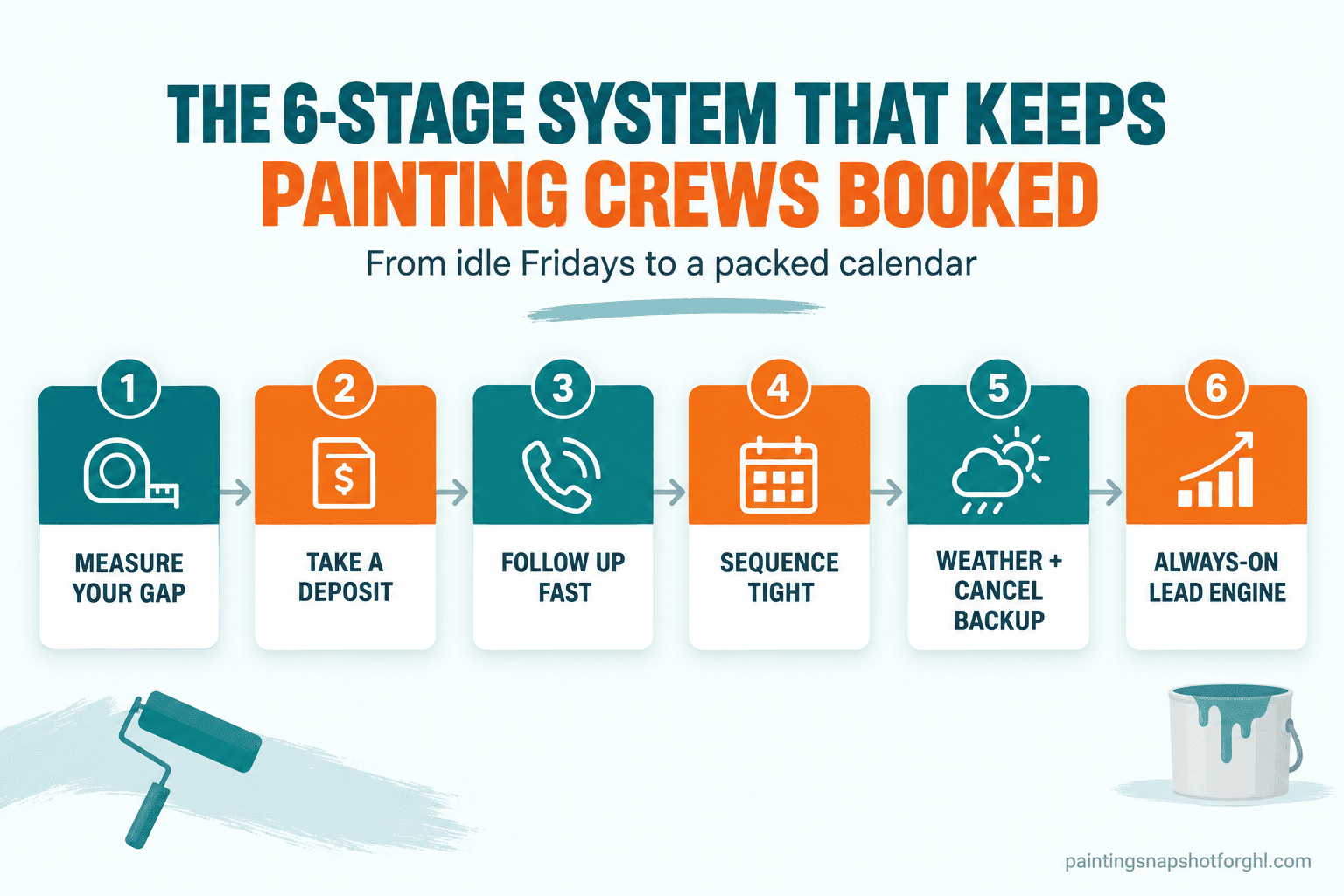
A painting crew that finishes early and sits idle is the most expensive problem in the business that nobody puts on a spreadsheet. The fix is not more leads. It is a booked-work backlog deep enough that the next job always starts the morning the last one ends. This post walks through the six stages that get you there, what each one costs when it breaks, and the exact scheduling messages you can copy tonight.
In this post
- What an idle crew-day actually costs you
- The real reason crews sit: it is a pipeline-depth problem
- Stage 1: Measure your gap before you fix it
- Stage 2: Build a booked-work backlog with deposits
- Stage 3: Turn estimates into booked jobs faster
- Stage 4: Sequence jobs tight so days do not leak
- Stage 5: Build a weather-and-cancellation shock absorber
- Stage 6: Keep an always-on engine feeding the top
- How this changes for a solo painter, a 5-person shop, and a 3-crew company
- The compliance part nobody warns you about
- Objections I hear every week
- Frequently asked questions
What an idle crew-day actually costs you
Most owners feel a slow week but never put a number on it. The number is what makes you fix the process.
Start with wages. The median annual wage for U.S. painters is $48,660, or roughly $24 an hour across about 2,000 working hours a year (U.S. Bureau of Labor Statistics). An eight-hour day is about $195 per painter, so a three-person crew on the clock with nothing to bill is roughly $585 gone before lunch.
Wages are the small half. The bigger loss is the revenue that day was supposed to produce. A small residential crew bills $2,000 to $3,500 for a solid interior day, leaving gross profit of maybe $1,000 to $1,500 per crew-day after labor and materials. When the crew sits, that profit does not pause. It is gone, because you cannot sell that Friday twice. Here is what that looks like across a year if you lose one crew-day a week:
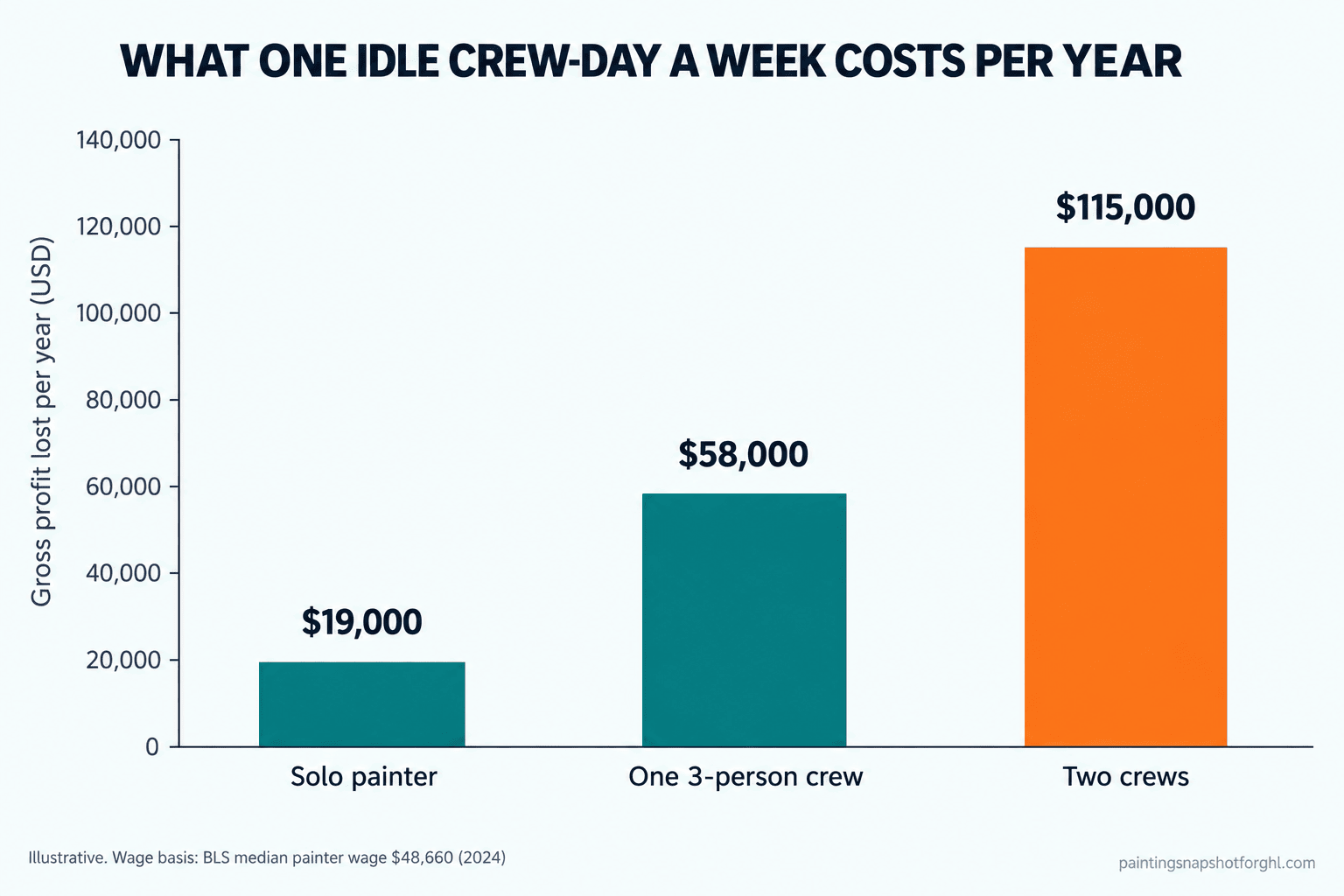
Illustrative annual gross profit lost to one idle crew-day per week (~48 weeks), assuming crew-day gross profit of ~$400 (solo) to ~$1,200 (3-person crew). Your figures depend on your rates and job mix. Wage basis: BLS.
It is not a niche worry. FMI’s 2023 Labor Productivity Study estimated U.S. contractors lost $30 billion to $40 billion to labor inefficiencies in 2022, and 45% of the self-performing contractors it surveyed said their productivity had declined (Construction Dive). Idle and poorly sequenced crew time is a big slice of that.
How self-performing U.S. contractors rated their own labor productivity trend (%). Source: FMI 2023 Labor Productivity Study, via Construction Dive.
The real reason crews sit: it is a pipeline-depth problem
When the crew sits, the gut reaction is “I need more leads,” so you spend more on ads. Usually that does not help, because the leak was never at the top of the funnel. Walk it backward: you probably have plenty of estimate requests. What you do not have is enough of them turned into committed jobs with a deposit and a firm start date. A calendar full of “he wants it done in the spring” is not a backlog. It is a wish list, and a wish list does not put anyone to work.
Pipeline depth is the fix: the number of confirmed, deposited crew-days sitting in front of your crew right now. When it is healthy, a color delay on one job does not create an idle Friday, because Friday already belongs to a job that is ready. When it is thin, every hiccup, a cancellation, a rain day, a slow decision, turns straight into downtime. The next six stages build and protect that depth. Even the first three will change your Fridays.
Stage 1: Measure your gap before you fix it
You cannot fix a number you are not looking at. For two weeks, track one thing each day: did every crew have a confirmed job to walk onto the next working day, yes or no? Count the no’s. That is your gap. Then track pipeline depth weekly: how many confirmed, deposited crew-days sit ahead of today. For most residential shops, two to three weeks per crew is the sweet spot. Less than a week and you are living hand to mouth.
How it breaks: Owners “measure” from memory, and memory lies. You remember the busy weeks and forget the three Fridays your crew washed the trailer. Write it down every day. The honest number is almost always worse than the one in your head, and that gap is the money in the chart above. To catch gaps early, text your lead painter each afternoon (or automate it as a daily task): “EOD check: is tomorrow’s crew fully loaded? Reply with the job and address, or NO JOB so I can fill it tonight.” Catching a gap at 2pm gives you the afternoon to fill it; catching it at 7am means the day is already lost.
Stage 2: Build a booked-work backlog with deposits
A job is not in your backlog until money has changed hands and a date is on the calendar. Everything softer than that is optimism. The fastest way to deepen your pipeline is to stop treating “verbal yes” as the finish line and start treating “deposit paid, date confirmed” as the finish line. Deposits do three jobs at once: they filter out tire-kickers, they commit the homeowner so they stop shopping other painters, and they fund your materials. A common structure is a modest deposit to hold the start date, then the balance on completion. Set the number to fit your market, but take one.
How it breaks: You skip the deposit “to keep it easy,” the homeowner reschedules twice, then goes with whoever called the week they were ready. You held a slot for someone with no skin in the game, and that slot became an idle day. A deposit is not friction. It is the thing that makes the date real.
Stage 3: Turn estimates into booked jobs faster
Speed is where most of your backlog is hiding. A homeowner who requested an estimate is comparing you to two or three other painters, and across home services the contractor who responds first with something credible usually wins. The classic lead-response study found that reaching a new lead within five minutes made a company far more likely to qualify it than waiting thirty (Lead Response Management Study), and a Harvard Business Review analysis of 1.25 million leads found firms that responded within an hour were seven times more likely to have a real conversation than those that waited one hour longer (Harvard Business Review). So “respond fast” has two parts: answer the new lead in seconds, then move the estimate to a decision without a two-week silence in the middle.
How it breaks: You quote fast, the homeowner says “let me talk to my spouse,” and then nothing. You are slammed on a job, forget to circle back, and eleven days later they hire someone who followed up on day two. Estimate follow-up is the least glamorous automation in the business and it books more work than any ad. We broke it down in the estimate follow-up playbook and in missed-call text back for painters.
Stage 4: Sequence jobs tight so days do not leak
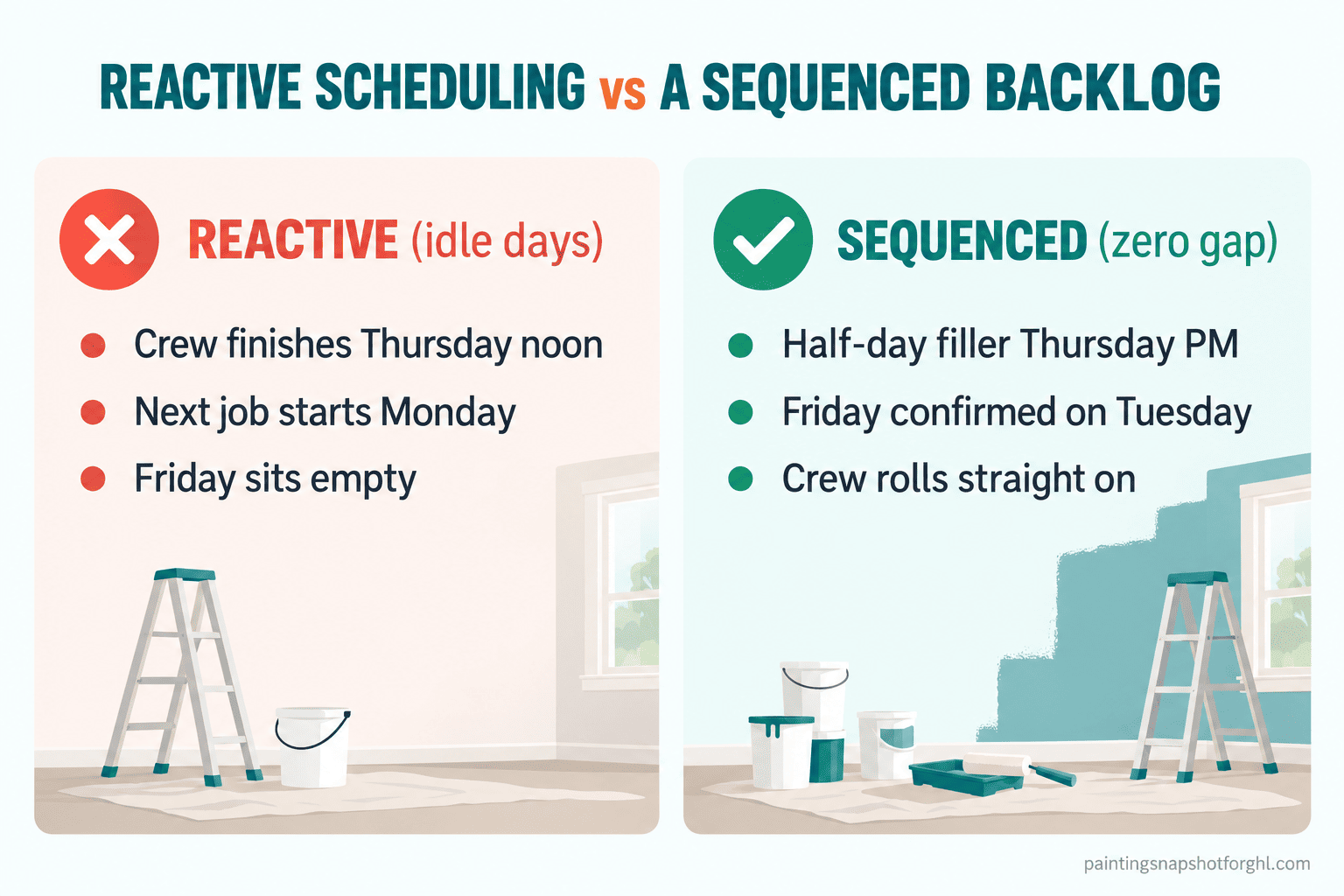
Even with a full backlog, sloppy sequencing burns days. The classic leak: a crew finishes at noon Thursday, the next job is not “supposed” to start until Monday, so Thursday afternoon and all of Friday evaporate. A day and a half gone, on a calendar that had work in it. Tight sequencing means booking start dates back to back and staging the next job so the crew rolls straight in. Three habits do it: confirm the next homeowner is truly ready (colors chosen, house accessible, deposit in) before the current job ends, keep a short “half-day filler” list of small paying jobs for a Thursday afternoon, and pre-stage materials so nobody loses a morning at the paint store.
How it breaks: The next job is not actually ready. Colors are not picked, the room is not cleared, or access is a question mark. You find out the morning you show up, and the crew is standing in a driveway. Confirm readiness two or three days out, not the night before.
Stage 5: Build a weather-and-cancellation shock absorber
Two things blow up even a well-built schedule: a rained-out exterior week, and a homeowner who cancels last minute. With no plan, one bad week undoes a month of good scheduling. The fix is a shock absorber: two lists and two messages ready to go.
The first is an interior backup list for your exterior crews. Manufacturers spec minimum temperatures and dry conditions for exterior coatings, so a cold snap or wet stretch can shut you down, and the season window is genuinely shorter in some markets than others. Keep a running list of interior and cabinet jobs that can move up, so a rained-out Tuesday becomes an interior Tuesday instead of a lost one. The second is a short-notice waitlist: homeowners who said “sooner is better” and would take a slot that opens. When a cancellation hits, you are not scrambling. You are texting the waitlist.
How it breaks: You treat weather as an act of God and eat the days, or a cancellation comes in and you have no one to call. Both are avoidable with a list you build in advance, when you are not panicking.
Stage 6: Keep an always-on engine feeding the top
Everything above protects the work you already have. Stage six keeps the top of the funnel full, so you refill the backlog faster than the crew empties it. This is where an owner living on his phone finally gets to put it down.
The engine has three parts that never sleep: an instant reply to every new lead, automated estimate follow-up so no quote goes cold, and a review-and-rebook ask the day a job wraps. Do those by hand and you will do them well for two weeks, then stop, because you are running crews. Automate them and they run whether you are on a ladder, at your kid’s game, or asleep. Most painting shops run this on GoHighLevel, which ties texting, follow-up, booking, and review requests into one system instead of five apps that do not talk to each other. (Disclosure: that is our affiliate link, and we may earn a commission if you sign up through it, at no extra cost to you.) If you are weighing tools first, we compared the options in the best painting business software breakdown and what a painting lead actually costs.
How it breaks: You automate lead capture but not follow-up, so leads pour in and still go cold. Or you turn on reminders but never ask for the review, so a driveway full of happy customers never becomes proof for the next job. The engine works when all three parts run, not one.
How this changes for a solo painter, a 5-person shop, and a 3-crew company
The framework is the same. The knobs differ by size.
The solo painter or owner-plus-one. Idle days cost less in raw dollars but hurt more, because you are the sales team, the crew, and the office. You cannot follow up on estimates at night after painting all day, which is why leads go cold. Priority: automate the instant reply and estimate follow-up first (stages 3 and 6). One saved job a month is real money at your size.
The 5-person shop with one or two crews. This is where idle days get expensive fast, roughly $58,000 a year per idle crew-day-per-week. You have enough volume that a wish list feels like a backlog, so you coast until a slow week exposes it. Priority: deposits and pipeline depth (stage 2) plus tight sequencing (stage 4).
The 3-crew company. Your risk compounds: one rained-out day is three crews idle, and a thin backlog on one crew cascades as you shuffle people between jobs. Priority: the shock absorber (stage 5) and a measured pipeline (stage 1), because you cannot hold the whole schedule in your head.
The compliance part nobody warns you about
Every steal-this text here is a business text message, and business texting is regulated. Two rules matter.
First, the TCPA and A2P 10DLC. You need consent to text a customer, you must honor a STOP reply promptly, and to send business texts reliably in the U.S. you have to register your number and campaigns under A2P 10DLC, or carriers filter your messages (FCC). The good news: a homeowner who asked for an estimate has given you a reasonable basis to text about their project. Keep it relevant, give an easy opt-out, and you are fine. We covered the full picture in the painting contractor compliance guide.
Second, licensing in your advertising. Some states require your contractor license number on your marketing, and rules genuinely differ by state, so check yours rather than copying a competitor. It is a small thing that gets expensive if a complaint surfaces it.
Objections I hear every week
“I don’t have a scheduling problem, I have a not-enough-work problem.” Maybe. But before you spend another dollar on leads, count your idle days for two weeks and count how many estimates never got a second follow-up. Nine times out of ten the work is already in your pipeline, stuck between “quoted” and “booked.” Fixing follow-up is cheaper than buying leads that also go cold.
“Won’t customers get annoyed by all the texts?” Not if they are relevant. A reminder, a heads-up that an earlier slot opened, a quick “did you get the estimate” are things homeowners want. The annoying version is the painter who goes silent for two weeks and then calls at dinner.
“I already pay for Jobber or Housecall Pro.” Good, and you may not need to replace them. The question is whether your setup actually runs the instant reply, the estimate follow-up, the deposit links, and the waitlist texts, or whether those still live in your head. If the automations are not running, the software is a filing cabinet, not an engine.
“Do I need to be technical?” No. If you can send a text and use a calendar app, you can run this. Setup is the one-time technical part, and you can do it yourself, hand off, or buy it done-for-you. Daily use is reading replies and showing up to booked jobs.
Idle days are not bad luck, and they are not a lead problem you have to outspend. They are a depth-and-follow-up problem you fix with a deposit, a few scheduled texts, and two short lists. Build the backlog, protect it, refill it automatically. Do that and the next time your painter asks “what are we on tomorrow,” the answer is already on the calendar.
Frequently asked questions
How many jobs should I have booked ahead to keep a crew busy?
For most residential shops, two to three weeks of confirmed, deposited work per crew is the sweet spot. Under a week and any hiccup creates an idle day. Over five or six weeks and you start losing homeowners who will not wait.
Should I take a deposit to hold a start date?
Yes. A deposit filters out tire-kickers, commits the homeowner so they stop shopping, and funds your materials. It is the fastest way to turn a soft wish list into a real backlog. A verbal yes with no money down is not a booked job.
What do I say to move a job up when I get a cancellation?
Text your short-notice waitlist: 'A spot just opened on [date] and I remembered you wanted your [project] done sooner. Want it? First to confirm gets it, and I can send the deposit link now.' That turns a cancellation into a filled day.
Isn't texting customers about scheduling going to annoy them?
Not when the texts are relevant. Reminders, an earlier-slot offer, and a quick estimate check-in are things homeowners appreciate. Keep messages about their specific job, give an easy opt-out, and stay compliant with the TCPA.
I already use Jobber or Housecall Pro. Do I need something else?
Not necessarily. The real question is whether your setup actively runs the instant reply, estimate follow-up, deposit links, and waitlist texts, or whether those still live in your memory. If the automations are not running, add that layer.
How do I keep exterior crews busy when the weather turns?
Keep a running interior backup list of repaints and cabinet jobs that can move up when a cold snap or wet stretch shuts down exterior work. A rained-out Tuesday becomes an interior Tuesday. Season windows vary by region, so plan around your own climate.
Do I need to be technical to set this up?
No. If you can send a text and use a calendar, you can run it day to day. The one-time setup is the only technical part, and you can do it yourself, delegate it, or buy it done-for-you.