If you paint houses in Pittsburgh and your estimating tool, your CRM, your accounting, and your phone all live in separate apps that never sync, you are quietly paying for it twice — once in the hours your team spends retyping the same job into three systems, and again in the warm leads that go cold while nobody’s watching the right screen. The fix isn’t another app. It’s connecting the tools you already use into one system — GoHighLevel — so a lead that comes in on your website, a Jobber estimate, and a QuickBooks invoice are all the same record, updated once. This guide breaks down what disconnected software actually costs an Allegheny County painting shop, and exactly what “connected” looks like.
In this post
- The real problem: your shop runs on five apps that don’t talk
- The hidden tax of double data entry
- Where disconnected tools cost you actual paint jobs
- What “connected” looks like: one source of truth in GoHighLevel
- Zapier duct tape vs. a real custom integration
- Why this matters in Pittsburgh specifically
- Frequently asked questions
The real problem: your shop runs on five apps that don’t talk
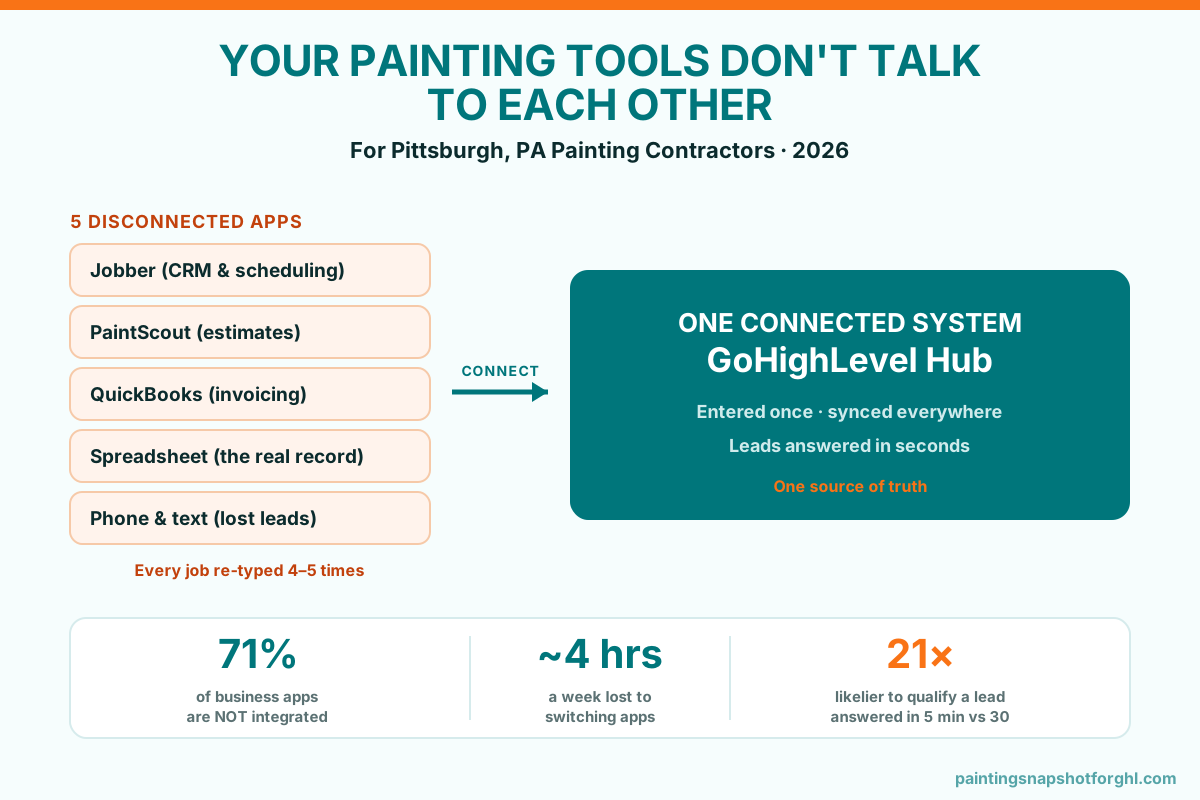
Walk into most painting businesses and you’ll find the same stack, cobbled together over years: an estimating tool like PaintScout or Estimate Rocket, a scheduling/CRM tool like Jobber or Housecall Pro, QuickBooks for invoicing, a spreadsheet the office manager actually trusts, and a cell phone where half the real conversations happen. Each one is fine on its own. The problem is the gaps between them.
None of this is unusual — it’s the default state of business software. Salesforce and MuleSoft’s Connectivity Benchmark found the average organization runs 1,061 different applications, yet only about 29% of them are integrated with one another, and 70% of organizations say those disconnected data silos actively hold them back (MuleSoft/Salesforce, 2023). Enterprises have entire teams to paper over that. A five-crew painting shop has you and an office manager.
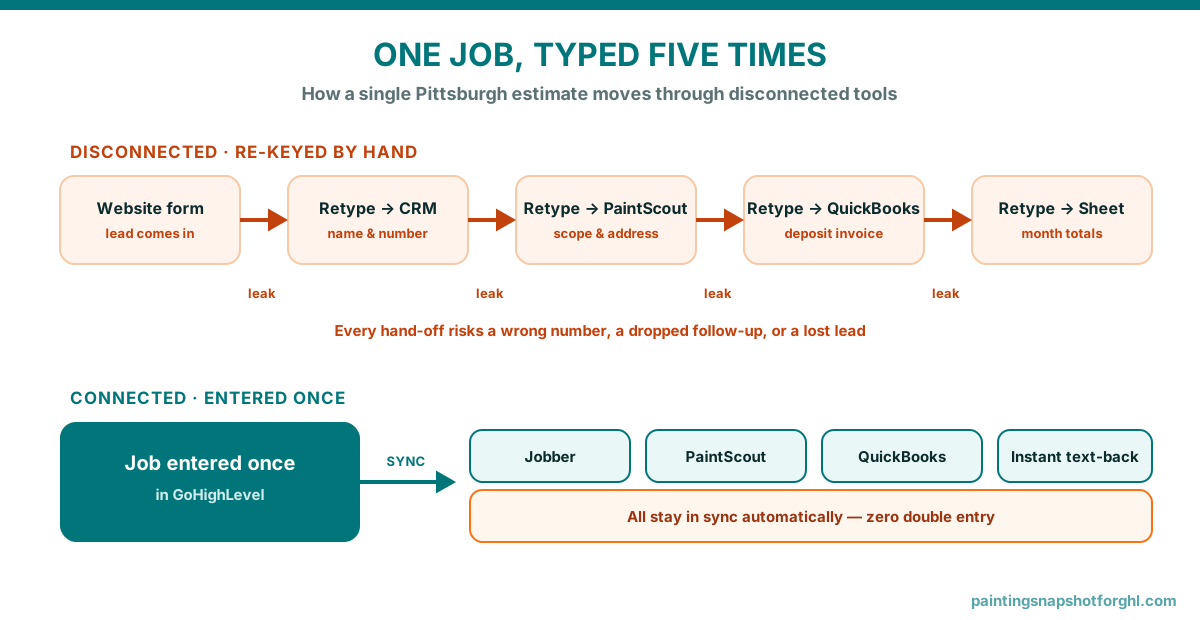
So the seams become manual labor. A homeowner in Squirrel Hill fills out your website form. Someone copies their name and number into the CRM. When they book, the address and scope get retyped into the estimating tool. When the estimate is accepted, the numbers get keyed into QuickBooks. When the job wraps, someone updates the spreadsheet so you can see the month. The same job gets entered four or five times — and every hand-off is a chance to fat-finger a phone number, drop a follow-up, or lose a lead entirely.
The hidden tax of double data entry
The cost of all that re-keying isn’t dramatic. It’s worse — it’s invisible and constant. Harvard Business Review studied how knowledge workers actually spend their time and found people toggle between different apps and websites about 1,200 times per day, and that all that switching adds up to roughly four hours a week — nearly 9% of total work time — just spent reorienting after each jump (HBR, 2022). That’s before anyone actually retypes a single record; it’s pure friction from having the work spread across too many places.
Add the duplicated work itself. Asana’s Anatomy of Work research estimated US workers lose about 308 hours a year to duplicated effort — doing tasks that were already done somewhere else (Asana, Anatomy of Work Index). For an office manager splitting time between the phone, the calendar, and four apps, “already done somewhere else” is the whole job.
And re-keyed data is wrong data more often than anyone admits. Bad data quality is expensive enough that Gartner pegged its average cost to organizations at $12.9 million a year (Gartner). Your shop isn’t losing eight figures — but a wrong number in the estimate, a missed deposit in QuickBooks, or a duplicate contact that splits a homeowner’s history across two records costs you real jobs and real hours to untangle.
The average organization runs 1,061 apps and integrates only ~29% of them — leaving roughly 71% disconnected. Source: MuleSoft/Salesforce Connectivity Benchmark, 2023.
Where disconnected tools cost you actual paint jobs
Here’s the part that shows up in revenue, not just in wasted afternoons: when your tools don’t talk, nobody is watching the one screen that matters — the new lead — in real time. A form fill sits in your website inbox. The estimating tool doesn’t know it exists. Your phone doesn’t buzz. By the time someone copies it into the CRM and calls back, the homeowner has already talked to two other painters.
The data on this is brutal and consistent. The Lead Response Management Study (run out of MIT with InsideSales, across 15,000+ leads) found that contacting a web lead within 5 minutes versus 30 minutes makes you about 21× more likely to qualify that lead — and about 100× more likely to even reach them (Lead Response Management Study). Harvard Business Review’s audit of 2,241 US companies found the average firm took 42 hours to respond to an inbound lead, and 23% never responded at all — while companies that answered within an hour were 7× more likely to qualify the lead than those who waited just 60 minutes longer (HBR, 2011).
Speed like that is impossible to fake by hand when your lead lives in one app, your calendar in another, and your crew notifications in a third. It’s easy when they’re the same system: the lead lands, an automation texts the homeowner in seconds, the estimate request routes to your calendar, and the job is booked before your competitor has checked their voicemail.
Relative likelihood of qualifying a web lead by response time — replying in 5 minutes is about 21× more effective than waiting 30. Source: Lead Response Management Study, MIT/InsideSales.
What “connected” looks like: one source of truth in GoHighLevel
The goal isn’t to rip out the tools your crew already knows. It’s to make them share one record. GoHighLevel becomes the hub — the single place where every lead, conversation, estimate, and job status lives — and the tools you keep feed into it through custom integrations instead of through your office manager’s fingers.
In practice, for a painting shop, that looks like:
- Jobber ↔ GoHighLevel two-way sync. A won job in GHL creates the Jobber job automatically; a Jobber status change moves the GHL pipeline stage. Enter the job once, both systems stay current.
- PaintScout → GoHighLevel. Every PaintScout estimate becomes a GHL opportunity with its value and line items attached; an accepted estimate triggers your deposit-request workflow — no re-keying, no forgotten follow-up.
- QuickBooks invoicing bridge. Deposit and final invoices are created in QuickBooks straight from GHL deal stages, and payment status flows back into GHL so the pipeline closes itself.
- Website + phone into one inbox. Form fills, missed calls, and web-chat all land in GHL and trigger instant text-back — so the 5-minute response window in the chart above is automatic, not a heroic effort.
That’s the exact work we do in our GoHighLevel development and integration service: custom two-way connectors between GHL and Jobber, Housecall Pro, PaintScout, Markate, Estimate Rocket, QuickBooks, or any tool with an API — built, documented, and delivered with a fixed scope. A platform-to-GHL integration typically runs two to four weeks. If your problem is that you’re stuck on an old CRM rather than beside it, that’s a migration, and we cover the step-by-step version in our Chicago migration playbook.
Zapier duct tape vs. a real custom integration
Plenty of painters try to solve this with a no-code tool like Zapier or Make, and for a single simple hand-off, that can be enough. Where it breaks down is the two-way, painting-specific logic — custom-field mapping for surface type and square footage, status changes that flow both directions, deposit triggers, and error handling when an API hiccups mid-season. Here’s the honest tradeoff.
No-code glue vs. a real custom integration
| Plan | No-code glue (Zapier/Make) | Custom GHL integration recommended |
|---|---|---|
| Price | Fine for simple hand-offs | Fixed-price scope |
| Feature 1 | Good for a single one-way hand-off | Built for two-way sync — status flows both directions |
| Feature 2 | Two-way status sync is fragile or unsupported | Surface type, square footage & coats mapped and documented |
| Feature 3 | Painting field mapping (surface, sq ft, coats) is manual | Retries and logging built in for API errors |
| Feature 4 | Often fails silently on API errors or duplicates | Deduplicates so a homeowner stays one record |
| Feature 5 | Cost rises with task volume | One fixed price, no per-task metering |
| Feature 6 | Lives inside one person's account | Delivered with a Loom and docs your shop owns |
| See GHL integrations |
The rule of thumb: if a hand-off is simple and one-directional, no-code is fine. The moment you need jobs, estimates, and invoices to stay in sync both ways without someone babysitting it, that’s a custom build — and it pays for itself in the hours and leads it stops leaking.
Why this matters in Pittsburgh specifically
Pittsburgh is exactly the kind of market where the connected shop wins. The city itself is home to about 307,668 residents (U.S. Census Bureau QuickFacts), and the broader Allegheny County market has 612,446 housing units with a 65.2% homeownership rate and a median owner-occupied home value around $227,600 (U.S. Census Bureau QuickFacts). That’s a large base of owner-occupied homes — a lot of older Pittsburgh housing stock that gets repainted on a cycle, inside and out.
It’s also a competitive one. Nationally, house painting is a $28.2 billion industry spread across roughly 223,000 contractor businesses (IBISWorld, 2026). In a metro with that many homeowners and that many painters chasing them, the shop that answers first and never drops a follow-up doesn’t need to be the cheapest — it just needs to be the one whose systems actually work together. When a Mt. Lebanon homeowner requests an exterior estimate on a Sunday night, the connected shop has already texted them back and offered a Tuesday slot before Monday’s coffee. The disconnected shop finds the form fill on Wednesday.
Frequently asked questions
I already use Jobber and QuickBooks. Do I have to switch to GoHighLevel?
No. The point of an integration is that you keep the tools your crew already knows. GoHighLevel becomes the hub that ties them together — leads, conversations, and pipeline live in GHL, while Jobber and QuickBooks keep doing what they do, synced automatically. You only 'switch' if you decide you want to consolidate; connecting is the more common path and usually the faster win.
How is this different from just using Zapier?
Zapier and Make are great for a single, simple, one-way hand-off. Painting workflows usually need more: two-way status sync, custom-field mapping for surface type and square footage, deposit triggers, and clean handling when an API errors out mid-season. That two-directional, niche-specific logic is where no-code tools get fragile, so we build it as a documented custom connector instead.
What does connecting my painting software to GoHighLevel actually cost?
It's scoped, not a flat sticker price. We look at your current GHL setup, the tools you use, and what you're trying to connect, then send a written fixed-price scope with a timeline before any work starts. A typical platform-to-GHL integration runs two to four weeks. You can get a quote by booking a scoping call — there's no obligation.
Will connecting everything fix my slow lead response?
That's usually the biggest single payoff. When your website form, missed calls, and web chat all land in one GHL inbox, an automation can text the homeowner within seconds instead of hours. Given that answering in 5 minutes instead of 30 makes you roughly 21× more likely to qualify a lead (MIT/InsideSales), collapsing that response window is often where a Pittsburgh shop sees the fastest return.
How long before a painting business sees the benefit?
The double-data-entry time savings show up immediately — the day a job stops being typed into four apps. The lead-response and follow-up gains show up over the next few weeks as fewer estimates slip through the cracks. Most integration builds themselves take two to four weeks from a signed scope, with a 30-day bug-fix warranty after launch.
Is this only for big painting companies?
No. A one-truck shop feels the double-entry tax just as sharply as a 12-crew operation — often more, because there's no office staff to absorb it. The scope scales to your setup, so a smaller shop can start by connecting just the two or three tools that cause the most re-keying and expand later.
Rafael spent eleven years running an exterior-and-cabinet repaint crew across the Phoenix valley before he ever touched a CRM. After watching too many summer leads die in a full voicemail box, he taught himself GoHighLevel to answer every estimate request the moment it landed. Today he builds done-for-you painting snapshots and custom GHL integrations, and writes about the systems that let a shop book jobs without the owner glued to a phone.
Related posts
- How to Migrate Your Chicago Painting Business to GoHighLevel
- Custom Software for Painting Contractors (Charlotte): When Off-the-Shelf Isn’t Enough
- Missed-Call Text-Back for Painters: Never Lose a Lead to Voicemail
- Stop Losing Painting Leads After Hours
- The Real Cost of Running GoHighLevel Yourself: Why Contractors Hire a GHL VA
Painting Snapshot builds done-for-you GoHighLevel automation systems, custom integrations, fast Astro websites, and social content for house painting contractors. We are not a painting company and do not perform painting work or quote project pricing. The app-integration, productivity, data-quality, lead-response, industry, and census figures above are drawn from the cited third-party sources (MuleSoft/Salesforce, Harvard Business Review, Asana, Gartner, the MIT/InsideSales Lead Response Management Study, IBISWorld, and the U.S. Census Bureau) and reflect general benchmarks, not a guarantee of results for any specific painting business. Service scope and timelines reflect current published terms and may change — verify on our GHL development and pricing pages.