

It is 8:30 on a Tuesday night. The kids are down, the truck is loaded, and you are at the kitchen table writing up the estimate for the repaint you walked this afternoon. You type a text: “Hey Linda, looking at about $4,200 for the whole upstairs, let me know.” Send. Done.
Three days later Linda books the other painter. His number was $4,450, higher than yours, and she still went with him. Why? He sent a one-page estimate that listed every room, named the paint, spelled out two coats and the prep, gave her a standard and a premium option, and told her the deposit and the start date. Yours was a text with a number. His looked like a decision she could make. Yours looked like a guess.
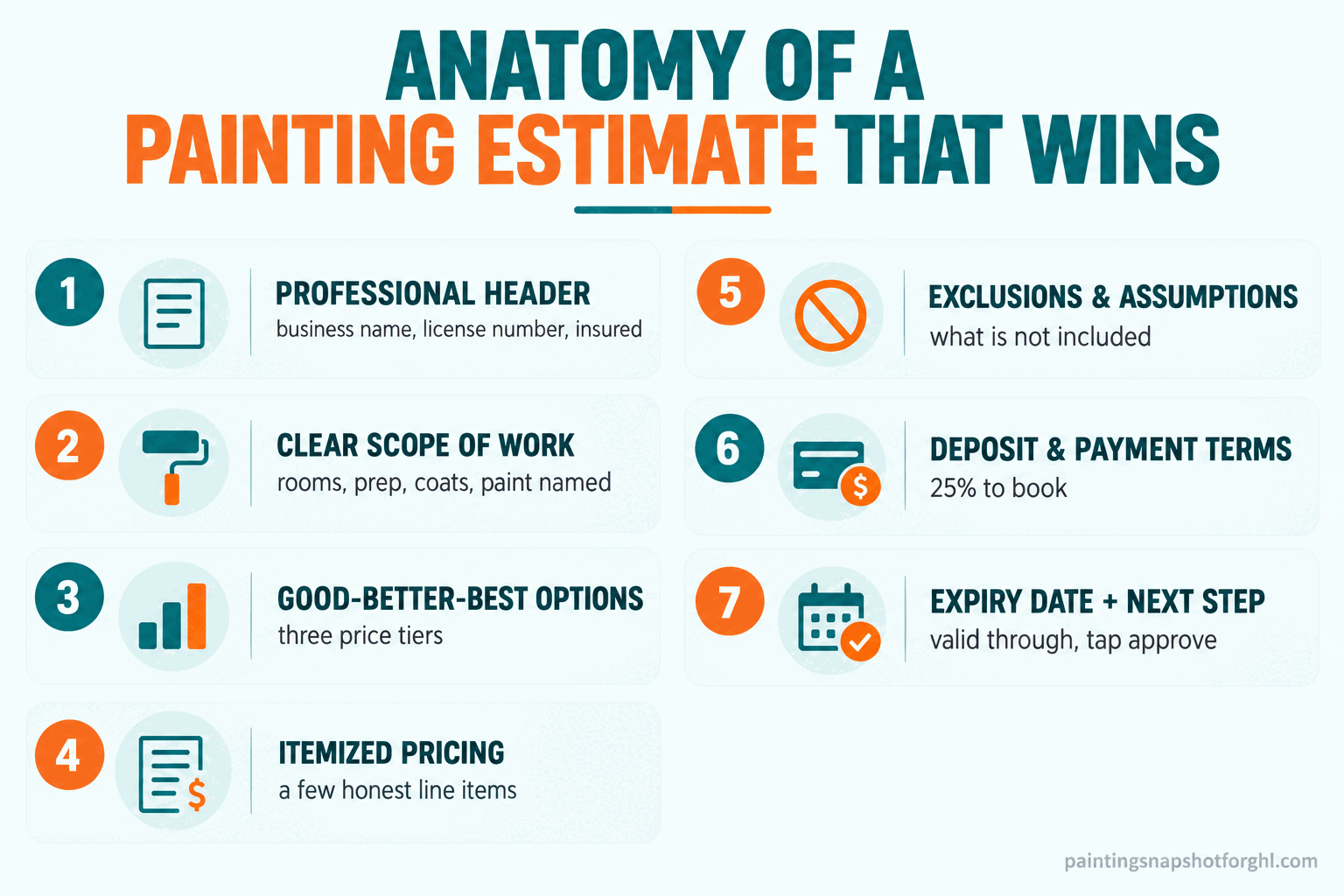
A painting estimate is not a price. It is the sales document that decides whether a homeowner trusts you with their house. The estimate that wins is almost never the cheapest one. It is the one that is specific, easy to say yes to, and in the homeowner’s hands first. This is the line-by-line template: the seven parts every winning estimate contains, the language you can copy tonight, how fast to send it, and the follow-up that closes the ones that go quiet.
In this post
- What a vague estimate actually costs you
- The seven parts of a painting estimate that wins
- How fast you send it matters
- The follow-up that closes a quiet estimate
- The same template for a solo, a 5-person shop, and a multi-crew company
- The compliance fine print
- Objections I hear every week
- Frequently asked questions
What a vague estimate actually costs you
Most owners never put a number on what a sloppy estimate costs them, so it stays invisible. Let me make it visible.
Start with how homeowners shop. In a 2024 survey of 1,000 U.S. homeowners, about 57 percent said they get quotes from two or three companies before hiring (Roto-Rooter State of Home Repair, 2024). That is home services broadly, but the behavior is the same on every driveway: your estimate sits next to one or two others. When all three are a texted number, the cheapest wins. When yours is the only one that reads like a plan, price stops being the only lever.
Now the money. Say you walk 12 estimates a week and close around a third. One extra job a month that a better estimate would have won, at roughly $1,500 gross profit per repaint, is $18,000 a year. The median annual wage for a U.S. painter is about $49,400, with roughly 326,900 painter jobs in 2025 (U.S. Bureau of Labor Statistics). That is a third of a painter’s wage gone to a document you could fix this week.
A speed cost sits on top. Research by Dr. James Oldroyd with InsideSales and MIT found that contacting a web lead within five minutes instead of thirty makes a company about 21 times more likely to qualify it (Harvard Business Review, 2011). A homeowner who waits three evenings for your write-up has read someone else’s.
Relative likelihood of qualifying a web lead by response time. Source: Oldroyd / InsideSales-MIT Lead Response Management Study; Harvard Business Review, 2011.
The seven parts of a painting estimate that wins
A winning estimate is not longer. It is structured. Build it once as a template in your CRM or estimating tool, and you fill in the blanks on site instead of staring at a blank text box at night. Here it is, part by part, with the language to steal and the way each part breaks when you skip it.
1. A header that looks like a real business
The top of the estimate decides whether the homeowner reads the rest as a professional or a guy with a brush: business name, logo, contact details, license and insurance, and a date and estimate number so it feels tracked, not improvised.
[YOUR COMPANY NAME]  ·  Estimate #2026-0418
Interior & Exterior Painting  ·  Licensed & Insured
[Phone]  ·  [Email]  ·  [City, State]
License #[number]   ·   General Liability: [carrier], [coverage]
Prepared for: Linda M.  ·  123 Oak Street  ·  Date: April 18, 2026
Valid through: May 2, 2026
How it breaks: leaving off license and insurance is the most common own-goal. In several states it is not optional (see the compliance section), and even where it is, a homeowner choosing between three bids reads it as a reason to pick you.
2. A scope the homeowner can picture
This is where most estimates fall apart. “Paint upstairs, $4,200” tells the homeowner nothing and tells your crew less. The scope lists the actual work: rooms or surfaces, what gets prepped and how, how many coats, what gets protected. Write it so they can picture the finished room.
SCOPE OF WORK: Interior Repaint, Second Floor

Walls, ceilings, trim, doors, and closets in: primary bedroom,
two secondary bedrooms, upstairs hallway, and upstairs bathroom.

Prep: fill and sand nail holes and minor cracks, caulk trim gaps,
spot-prime bare and patched areas, mask and protect floors,
fixtures, and furniture.

Application: two finish coats on walls, ceilings, trim, and doors.

Paint: Sherwin-Williams Emerald, matte on walls, satin on ceilings,
semi-gloss on trim. Colors confirmed at color consult.

Not included: see Exclusions below.
How it breaks: a vague scope is the root of almost every job that goes sideways. A specific scope makes the change-order talk easy. A vague one turns every gray area into an argument you eat.
3. Good, better, best: give them a choice
This is the single biggest change most painters can make, and almost nobody does it. Instead of one price to accept or reject, you give three options at three price points. The question shifts from “do I hire this painter” to “which of these do I want,” a much easier yes. Same quality of work, three scopes:
| Option | What it includes | When it fits |
|---|---|---|
| Good | Walls and ceilings, standard prep, two coats, quality paint | Budget-focused, clean walls |
| Better | Good, plus trim, doors, closets, upgraded paint | Most repaints, the usual pick |
| Best | Better, plus accent walls, minor drywall repair, premium low-VOC paint | Done once, done right |
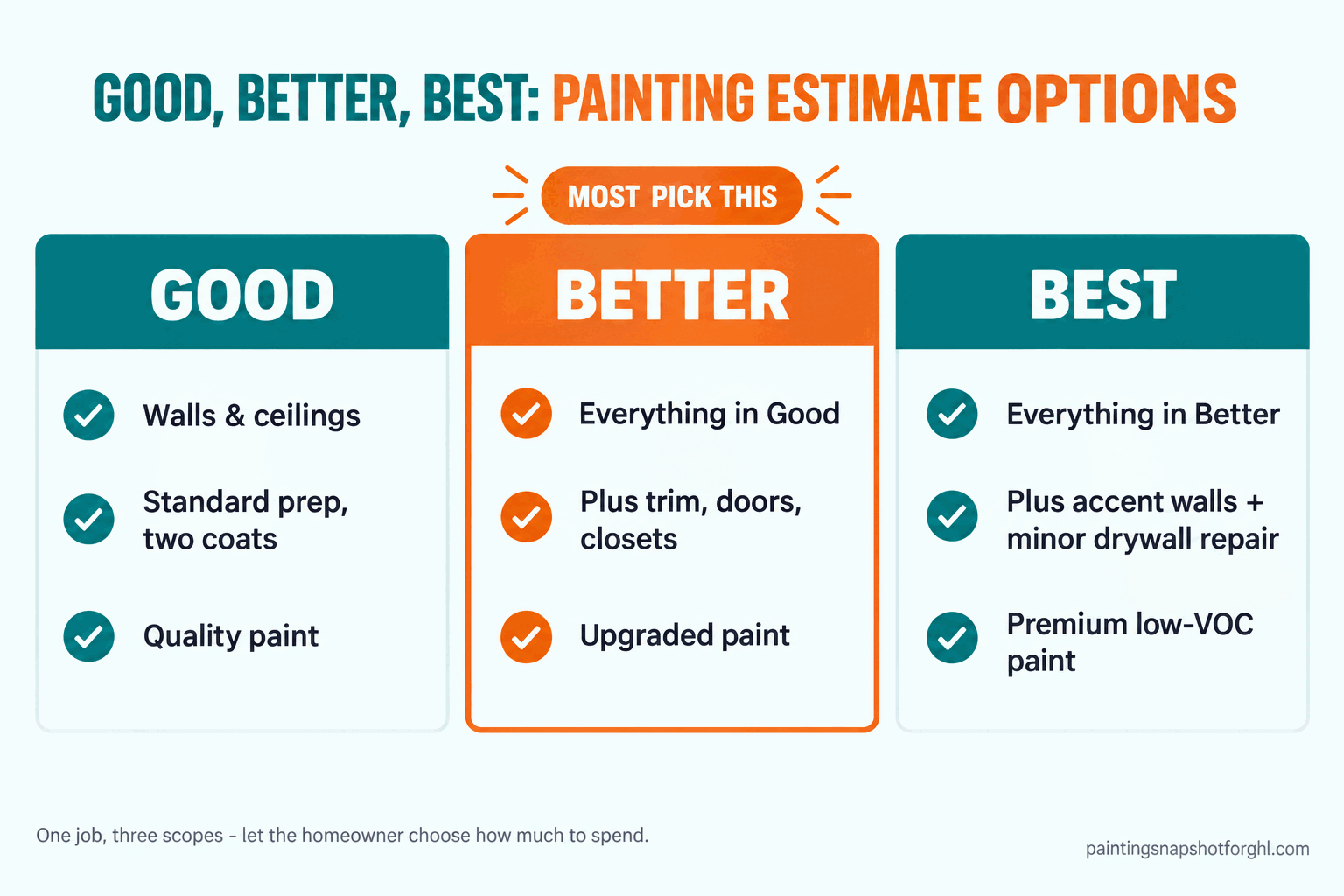
Put the option you most want chosen in the middle, and most people choose the middle. You are not tricking anyone; you are letting them spend to the level they care about instead of walking.
How it breaks: this only backfires with confusing tiers or huge gaps between them. Keep the jumps sensible and never make the cheapest option feel like a punishment.
4. Itemized pricing, not one mystery number
Within the option they pick, show where the money goes without publishing your margins. A few honest line items give the total a shape:
BETTER OPTION: Second Floor Repaint

Surface prep & protection ............................ $   640
Walls & ceilings (4 rooms + hallway), two coats ...... $ 1,980
Trim, doors & closets, two coats ..................... $ 1,120
Paint & materials .................................... $   560
--------------------------------------------------------------
Project total ........................................ $ 4,300
Deposit to schedule (25%) ............................ $ 1,075
A total with a shape is easier to trust than a round number, and it makes changes clean: drop the closets, and you both see what that line costs.
How it breaks: do not over-itemize. Twenty lines turn the estimate into something to negotiate line by line. Four to six is the sweet spot.
5. Exclusions and assumptions
This boring section saves your margin more than any other. Exclusions say what is not in the price; assumptions say what you are counting on being true. Together they draw the line before a dispute, not after.
EXCLUSIONS & ASSUMPTIONS

Not included: repair of rotted wood, drywall replacement beyond
minor patching, lead-paint abatement, mold remediation, wallpaper
removal, or moving heavy furniture and appliances. Color changes
needing a third coat are quoted separately.

Assumes: surfaces are structurally sound and dry, power and water
are available on site, and the home was built after 1978 OR
lead-safe (RRP) practices have been quoted where required. Hidden
damage found during prep is reported and priced in writing before
any added work.
How it breaks: without this, “I thought that was included” is the homeowner’s trump card and you usually fold to protect the review. With it, you point at the document and write a quick change order. It is a two-minute addition that pays for itself the first time a job surprises you.
6. Deposit and payment terms
Tell the homeowner what it takes to lock the job and how the rest gets paid. If deposits are a recurring headache, there is a full playbook on how to collect deposits automatically as a painting contractor. The estimate itself only needs a short clause:
PAYMENT TERMS

A 25% deposit confirms your spot on the schedule and covers
materials. The balance is due on completion and your walkthrough
sign-off. We accept card, ACH, or check. A link to pay the deposit
is included with your approval.
How it breaks: “we’ll sort out payment later” is how later never comes. State the deposit as the thing that reserves the date, not a favor you are asking, and pair it with a payment link.
7. An expiry date and a clear next step
End by telling the homeowner what happens next and by when. Prices move with material costs, so a validity date is honest and gives a reason to decide. Make the next step one obvious action.
TO BOOK YOUR PROJECT

1. Reply or tap Approve on this estimate.
2. Pay the 25% deposit with the secure link.
3. We confirm your start date and schedule your color consult.

Valid through May 2, 2026. Material prices after that date may
change the total. Questions? Reply here or call [phone] and you
will reach a real person.
How it breaks: an estimate with no expiry and no next step waits forever. The homeowner is not refusing you; they are busy, and nothing is telling them to move. A validity window and a one-tap approve turn “someday” into a yes.
How fast you send it matters
You can build the best estimate on this page and still lose if it lands three days after the walkthrough. The homeowner’s urgency fades by the hour, so aim for same-day, ideally within an hour or two of leaving the driveway.
That is only possible if the estimate is a template, not a blank page. When the header, scope language, options, exclusions, and terms already exist, filling in a job takes minutes. On larger or photo-heavy jobs, photo-backed instant estimates and a booking funnel do this automatically. Send it with a short, human message, not a cold attachment:
Hi Linda, great meeting you today. Your estimate for the upstairs
repaint is attached. I put together three options so you can pick
the scope that fits, and I'm holding a start date the week of the
5th. Tap Approve or reply with questions and I'll walk you through
it.  - Rafael, [Company]
If quote speed is your real leak, the deeper fix is a system that replies to a quote request in under a minute.
The follow-up that closes a quiet estimate
Most estimates do not get a no. They get silence. The homeowner meant to reply, life happened, and the estimate slid down the inbox. A short, polite follow-up cadence recovers a real share of those. Here is the sequence I run, which pairs with the full estimate follow-up playbook:
DAY 2 (text):
Hi Linda, just checking the estimate came through okay. Happy to
tweak the options or answer anything. Still holding that
week-of-the-5th start if you want it.

DAY 5 (text):
Hey Linda, no pressure at all. If the timing isn't right now I can
note your file and follow up in the spring. Want me to hold the
quote price through the end of the month?

DAY 10 (call or voicemail):
Hi Linda, it's Rafael with [Company]. Wanted to reach you in case
the estimate got buried. If you've gone another direction that's
completely fine, just let me know so I can free up the date.
Every message gives the homeowner an easy out, which is why they reply. The day-10 “let me know so I can free up the date” gets more responses than any hard-sell line, because it is about your schedule, not their wallet. Three touches over ten days, then move the lead to a long-term nurture.
The same template for a solo, a 5-person shop, and a multi-crew company
The seven parts do not change with your size. How you produce and deliver them does.
The solo painter. You are the estimator, the crew, and the bookkeeper, and your enemy is the evening pile-up of write-ups. Build the template once and lean hard on good-better-best, because at your volume raising the average ticket matters more than raising your lead count. Send it from your phone before you leave the driveway.
The 5-person shop. Now more than one person quotes, and consistency is the problem. Two estimators with different exclusion lists is how jobs go wrong and margins leak. Standardize the template so every estimate looks and protects the same. This is where a CRM earns its keep: templated estimates, automatic follow-up, and a pipeline that shows which quotes are still open.
The multi-crew company. Here the estimate is a system, not a document. You want templated options by job type, e-signature built in, deposits collected automatically on approval, and every estimate flowing into a pipeline with quote-to-close reporting by estimator and service line. The payoff is knowing your real close rate and where estimates stall.
The compliance fine print
A few rules touch the estimate directly, and getting them wrong is expensive. None of this is legal advice; check your own state and run anything unclear past a professional.
Your license number. In California it is not optional on the paperwork. Business and Professions Code 7030.5 requires a licensed contractor to put the license number on all contracts, subcontracts, bids, and every form of advertising (California Legislative Information), and your website and vehicle lettering count as advertising. Separately, as of January 1, 2025, California raised the point at which you need a license from $500 to $1,000 in combined labor and materials, but only for permit-free jobs you do single-handed (Bus. & Prof. Code 7048; CSLB). Many states, including Texas, require no state painting license at all, so know your own rules.
Lead paint. The EPA notes that roughly three-quarters of U.S. homes built before 1978 still contain some lead-based paint, and since April 2010 any firm paid to disturb that paint in pre-1978 housing must be EPA-certified in lead-safe (RRP) work practices (EPA Lead RRP Program). That is why the assumptions block names a 1978 cutoff.
Texting the estimate and the follow-ups. The moment your estimate and follow-ups go out by SMS, you are subject to the TCPA and carrier A2P 10DLC rules on business texting. Get clear consent when the homeowner gives you their number, honor STOP immediately, and keep a record (FCC on the TCPA). For the full picture, see the painting contractor compliance checklist.
Objections I hear every week
“This is more than I have time for on every job.” That is the point of a template. You build the seven parts once, and after that a professional estimate takes a few minutes to fill in on site.
“My customers only care about price.” Some do, and you will not win every one. But “only cares about price” is often what a homeowner becomes when every bid is a bare number. Give them scope, options, and a plan, and most care about certainty too.
“Won’t itemizing invite the customer to nickel-and-dime me?” Only if you over-itemize. Four to six honest line items build trust. Twenty lines turn the estimate into a negotiation. Keep it to the shape of the job, not a receipt.
“I already use Jobber, Housecall Pro, or PaintScout for this.” Good, then you have the tool; most painters just are not using the options, exclusions, and follow-up features it ships with. The question is whether every estimate has all seven parts and goes out the same day.
Frequently asked questions
What should a painting estimate include?
Seven parts: a professional header with your license and insurance, a specific scope (rooms, surfaces, prep, coats, and the paint), good-better-best price options, a few honest line items, an exclusions-and-assumptions section, clear deposit and payment terms, and an expiry date with a one-tap next step.
How fast should I send a painting estimate?
Same day, ideally within an hour or two of the walkthrough. A homeowner's urgency fades by the hour and they are usually comparing two or three bids. A template you can fill in on site makes same-day delivery realistic even when you are busy.
Should I give one price or multiple options?
Multiple options. A good-better-best layout changes the question from 'do I hire this painter' to 'which option do I want,' which is an easier yes. It tends to raise your close rate and your average ticket, and gives price-sensitive buyers a lower tier instead of a reason to walk.
How big should the deposit be on a painting job?
Many residential painters take 20 to 35 percent to reserve the schedule and cover materials, with the balance due on completion. State it on the estimate as the step that locks the start date, and include a payment link so it is one tap.
Do I need my license number on a painting estimate?
It depends on your state. California's Business and Professions Code 7030.5 requires it on all contracts, bids, and advertising. Other states, like Texas, require no state painting license at all. When in doubt, include it, because it reads as a trust signal either way.
How many times should I follow up on an unanswered estimate?
Three touches over about ten days: a friendly check-in on day two, a low-pressure note on day five, and a direct call or voicemail on day ten that offers an easy out. After that, move the lead into a long-term nurture rather than chasing it.