
It is 7:40 on a Tuesday evening. You have been on a ladder since seven that morning, and now you are in a stranger’s living room because this is the only time she could do it. Good repaint. You write numbers on a clipboard and say the line that just cost you the job: “Let me crunch the numbers tonight and I’ll email you a quote tomorrow.” You send it at eleven and never hear back. Two weeks later you see your paint on that house, and it is not yours.
Here is the uncomfortable truth: most painters lose the jobs they bid not on price but because they leave the appointment without ever asking for the work. The homeowner cannot see your craftsmanship yet. She is comparing who made it easy and who showed up like a professional. The fix is not a lower number. It is a repeatable in-home process that closes the estimate at the table: confirm the visit, run a real walk-through, present clear options instead of one scary number, and ask for the deposit before you leave. This guide walks all seven stages, shows where each one breaks, and hands you the scripts to steal tonight.
In this post
- Why you lose jobs you already bid
- Stage 1: Book it so they actually show up
- Stage 2: The first five minutes at the door
- Stage 3: The walk-through and the questions that matter
- Stage 4: Present three options, not one number
- Stage 5: Ask for the job and take the deposit
- Stage 6: Handle the four objections every painter hears
- Stage 7: Follow up the ones who don’t sign today
- How this plays out at three sizes of shop
- The rules that bite you at the door
- Objections I hear from painters
- Frequently asked questions
Why you lose jobs you already bid
You did the hard part: got the lead, drove across town, spent an hour in someone’s home. Then you handed the decision to a PDF and hoped.
ArcSite’s survey of more than 1,000 homeowners found 95% get more than one bid, and 28% expect a quote on the spot or the same day. Your emailed number sits next to two others with no voice and no reason to be picked, and “I’ll email it tomorrow” makes you slower than a quarter of your competitors.
When nothing separates the bids, price wins by default. Modernize’s survey of 2,500 homeowners found 43% choose on price, with reviews a distant second at 28%. Price only decides when everything looks the same. In a trade with 326,900 painters (BLS, 2025), the one who makes it easy wins, so the in-home process exists to stop looking the same. For the quiet moments where good leads slip away, see Why Your Best Painting Leads Book Someone Else.
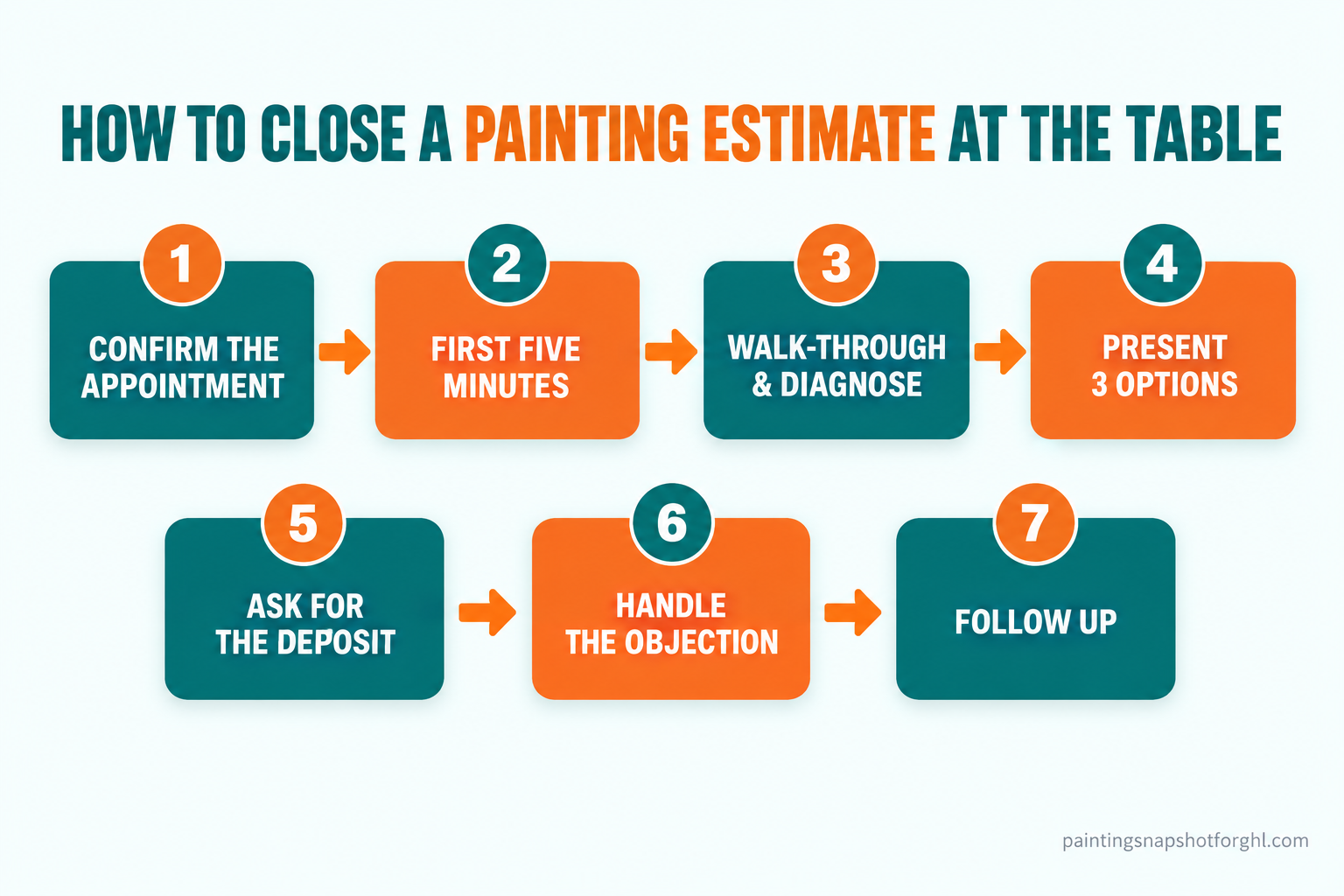
Closing is a sequence, not a talent some guys have. Seven stages run in order: confirm the appointment, win the first five minutes, walk through and diagnose, present three options, ask for the deposit, handle the objection, and follow up.
Stage 1: Book it so they actually show up
The close starts before you arrive. An estimate the homeowner forgot about, or shows up to distracted, is half lost. Book while the interest is live, then protect it with a confirmation the day before and a reminder the morning of. More in how to reduce painting estimate no-shows.
Steal this, the confirmation texts:
Day before: “Hi [Name], looking forward to tomorrow at [time] for your painting estimate. Quick favor: think about which rooms are must-do versus nice-to-do so we use the time well. [Your name], [Company].”
Morning of: “Morning [Name], confirming [time] today. I’ll text when I’m 15 minutes out. Any parking tips for the truck?”
Where it breaks: You book it for “sometime next week” with no set time, so it never hardens into a commitment. Or the reminder comes from a number she does not recognize. Put your name on every message and lock a day and time.
Stage 2: The first five minutes at the door
The homeowner decides whether she trusts you long before she sees your number. Show up on time, wear something with your logo, wipe your boots. Then slow down. The instinct is to start measuring, because it feels like work. Resist it, and ask her to show you the project in her words first.
Steal this, the opener:
“Before I measure anything, walk me through what’s got you thinking about painting this year. What’s bugging you about how it looks now, and what would make this a home run for you?”
That one question tells you what the job really is and what she cares about, which you sell back to her later.
Where it breaks: You walk in and talk about yourself, your years, your awards; she does not care yet. On a decision where professionalism is the tiebreaker, looking and sounding the part is the job.
Stage 3: The walk-through and the questions that matter
Now you measure, but you keep asking. The walk-through uncovers the scope that lets you price confidently later. Diagnose the problems too; that is where your value lives and where the lowballer cuts corners.
Steal this, the discovery questions, ask as you walk:
- “How long since this was last painted, and do you know what was used?”
- “Any spots giving you trouble: peeling, cracking, water stains, nail pops?”
- “Are we matching the current colors or ready for a change?”
- “When would you ideally want this done?”
- “Have you had other painters out, and what did you make of them?”
As you go, point out what a cheaper bid will skip, the loose caulking, the failing exterior wood, the primer the stains need, so she sees what a real job includes.
Where it breaks: You measure in silence and miss the scope, so your “accurate” number is wrong. Or you forget to write down what she cares about. If the stairwell has bugged her for three years, that line goes in your proposal in her words. For the math, our square-foot and labor formula does the heavy lifting.
Stage 4: Present three options, not one number
One number is a yes-or-no, and a scared homeowner with two other bids coming will say “let me think about it.” Give her three options and change the question from “should I hire him?” to “which one do I want?”
| Tier | What it covers | Who it’s for |
|---|---|---|
| Good | The core job done right: proper prep, two coats, quality paint, the must-do rooms | Budget-conscious, still wants it done right |
| Better | Good, plus the extras she flagged: trim, ceilings, premium paint, minor repairs | Most land here; the one you aim for |
| Best | The full transformation: all surfaces, premium products, a repair package, longer warranty | Wants it handled once, completely |
Not just sales folklore: in a controlled INSEAD experiment, showing the top tier first lifted revenue about 10.8% as more buyers chose it. Here is how that broke down when the premium tier led:
Figure: Which tier buyers chose when the top option led (INSEAD experiment).
Source: INSEAD, Ulaga and Mansard controlled pricing experiment. Presenting the top tier first raised revenue about 10.8% versus the standard order. Figures rounded.
Present the middle option as the one most neighbors pick, and anchor on the Best so the Better feels reasonable. Put it on paper or a tablet she can hold, with her own words from the walk-through in the scope.
Where it breaks: You give one number, or you bury the real job in the cheapest tier so she picks Good and you lose the margin. Keep prep and quality in all three; let the tiers differ on scope, never on whether the job is done right.
Stage 5: Ask for the job and take the deposit
Here is the stage most painters skip. They present the options, say “let me know what you think,” and leave. Ask for the work, out loud. It does not have to be pushy: the best close is a calm, assumptive question that treats yes as the natural next step.
Steal this, the close:
“Based on what you showed me, I’d put you in the Better package. It covers the stairwell that’s been bugging you and the trim, and it’s what most folks on this street go with. I’ve got a crew that could start the week of the [date]. If that works, I take a [deposit amount] deposit to hold the date and lock in today’s pricing. Want me to pencil you in?”
Then stop talking; silence does the work. If she says yes, take the deposit on the spot: card, check, or a link you text her right there. A deposit books the job and commits her, so the cheaper bid that lands tomorrow bounces off. Doing it cleanly is its own small system, covered in how to collect deposits.
Where it breaks: You never actually ask, so it ends on a soft “I’ll think about it” with no date. Or you cannot take money in the room, so she finds her checkbook “later,” and later never comes. Have a way to take a deposit on your phone before any estimate.
Stage 6: Handle the four objections every painter hears
Four objections cover almost everything, and each has a calm answer that is not a discount.
“It’s more than I expected.” Do not drop your price on the spot; that teaches her the number was fake. Reframe to scope: “This includes the two coats on the peeling stairwell a cheaper bid skips. If budget’s tight, the Good package gets the must-do rooms done right and we phase the rest.” Offer a smaller yes, not a cheaper job. More in why you keep losing jobs to the cheaper bid.
“I need to talk to my spouse.” Often real. “Totally fair. What will they want to know? I’ll note it here, check in tomorrow evening, and still hold that start date with the deposit.”
“I’m getting other quotes.” Expected. “Smart. As you compare, make sure each one spells out the prep, the number of coats, and who’s actually on your job, because that’s where the differences hide.” You just set the criteria the other bids get judged against.
“Let me think about it.” The most dangerous, because it hides a concern. Surface it: “Of course. Just so I can help, is it the price, the timing, or something about the plan?” Whatever she names is the real objection you can answer, rather than driving home guessing.
Where it breaks: You treat every objection as a cue to cut your price. That trains every future homeowner to grind you. Answer the real concern first; the number is almost never it.
Stage 7: Follow up the ones who don’t sign today
Not everyone signs at the table, and that is fine. What is not fine is letting the quote die in a sent-mail folder; jobs lost after a good appointment are lost to silence, not a better competitor.
Run a multi-touch follow-up whether or not you remember to: a same-day thank-you with the proposal attached, a check-in two days later answering the objection she raised, a day-five nudge with a reason to act, and a soft final close around day ten to fourteen. We lay out the exact cadence and copy in Painting Estimate Follow-Up.
Where it breaks: Follow-up depends on your memory and evening energy, so it runs for two days and stops. The painter who follows up five times beats the one who quit after one, and the only way it happens is to automate it.
How this plays out at three sizes of shop
The seven stages are the same at every size. Who runs them, and what breaks, changes as you grow.
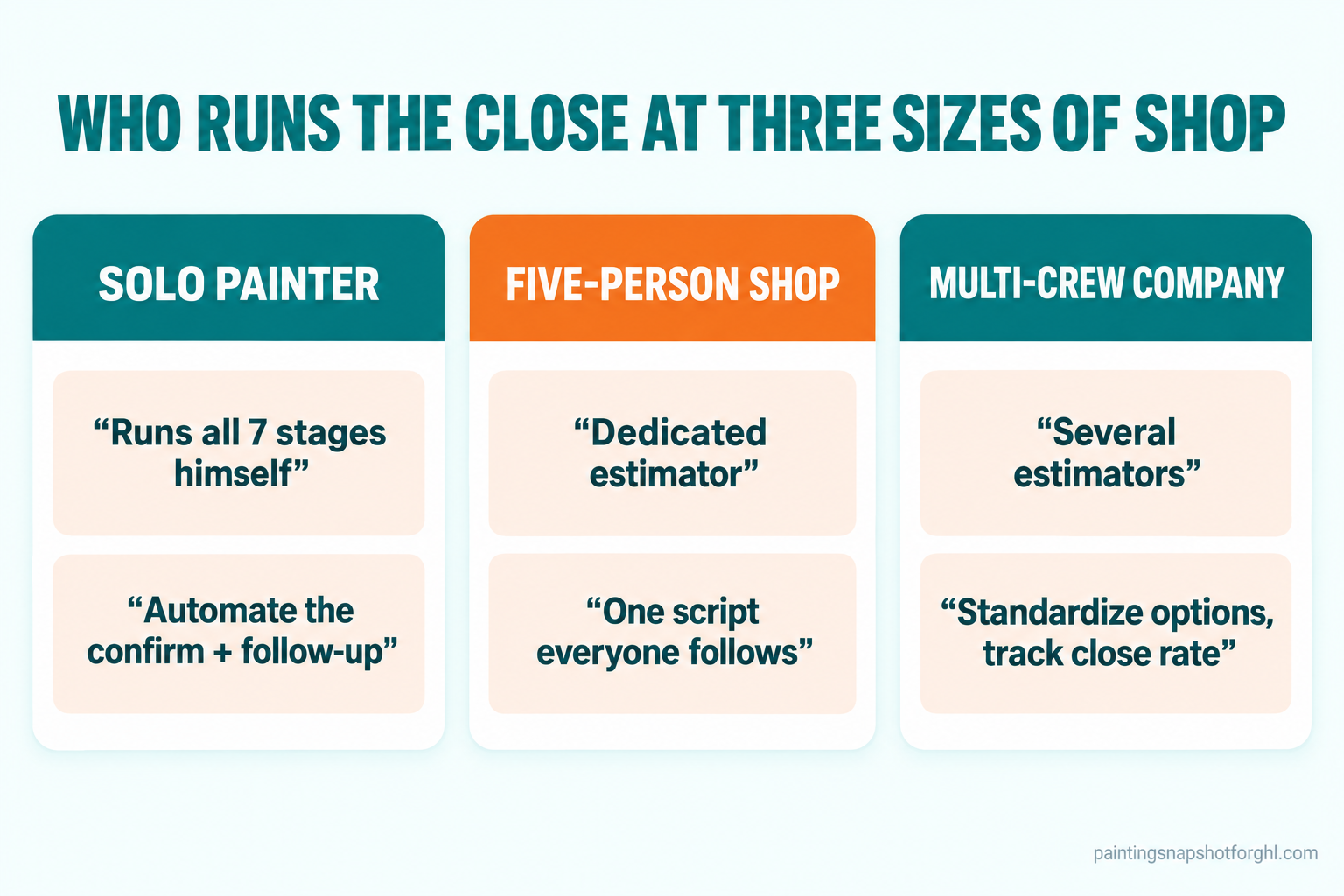
The solo painter. You are the lead, estimator, closer, and crew, and your bottleneck is time. Automate the parts that do not need you in the room, the confirmation texts and the follow-up on unclosed quotes, and give the five stages that need you your full attention. The leak is rarely your close rate in the room; it is the quotes you never chased.
The five-person shop. With an office person and an estimator, the close no longer lives only in your head, and your risk is inconsistency: you close at 50% and a new estimator at 20% because he hands over one number and leaves. Fix it with a written process every estimator runs the same way, same three-tier template and close script.
The multi-crew company. Several estimators, high volume. Now you measure: track close rate by estimator and lead source, and standardize the options so a customer gets the same tiers whether Mike or Dave shows up. A half-point swing in close rate is tens of thousands a year.
The rules that bite you at the door
Two compliance items live inside the estimate appointment, both cheap to get right and expensive to ignore.
The EPA lead-paint pamphlet. On a home built before 1978, and roughly three-quarters of pre-1978 US homes still contain some lead-based paint, federal law requires your firm to give the owner the EPA “Renovate Right” pamphlet before work starts, under the RRP rule at 40 CFR 745.84. The estimate visit is the natural time to hand it over and get a signed acknowledgment; you also need RRP firm certification to do the work.
Consent on your reminder texts. The texts in Stages 1 and 7 need the homeowner’s consent under the TCPA, with an opt-out: a number she gave you, not a scraped list, and honoring STOP. Business texting at volume also runs through A2P 10DLC carrier registration. We cover the full picture in the 2026 compliance guide.
Objections I hear from painters
“I don’t want to be a pushy salesman.” She invited you into her home because she wants her house painted. Asking for the job is service, not pressure. Pushy is calling nine times after a no; asking once, clearly, while you are both looking at the wall, is finishing the conversation she started.
“My jobs are too big to close on the spot.” Big jobs are where the process matters most, because the homeowner is more nervous, not less. You may not get a signature on a $40,000 exterior that night, but you still present options, ask for the next commitment, and leave with momentum. The size changes the deposit, not the process.
“I need to calculate before I can price it.” Fair, so shorten that gap instead of accepting a next-day email. Many painters can price a standard interior at the table with a simple square-foot system. If a job needs an hour of calc, compress it: “I’ll have your three options within the hour and call to walk you through them.” That keeps you inside the same-day window 28% of homeowners expect.
Frequently asked questions
How do I close more painting estimates without lowering my price?
Stop leaving without asking for the job. Confirm the visit, run a real walk-through, present three options instead of one number, and ask for the deposit before you leave. Price only decides when nothing else separates you from the other bids.
Should I give a painting quote on the spot or email it later?
On the spot or the same day whenever you can. ArcSite found 28% of homeowners expect a quote that fast, and momentum is highest while you're both in the room. If a job needs calculation, compress it to within the hour and call to walk them through the options.
What is good-better-best pricing for painting jobs?
You present three tiers: Good (the core job done right), Better (the extras she flagged, where most buyers land), and Best (the full transformation). It changes the question from 'should I hire him?' to 'which option?' An INSEAD experiment found presenting the top tier first lifted revenue about 10.8%.
How much deposit should a painting contractor take?
Enough to secure the date, commonly 10% to 30% depending on job size and local norms, within any limit your state sets. The point is taking it in the room, so the job is booked before a competing bid lands.
How do I handle a homeowner who says 'let me think about it'?
Treat it as a hidden concern, not a decision. Ask whether it's the price, the timing, or the plan. Whatever they name is the real objection you can answer. Then set a next step and offer to hold the start slot with a deposit.
Do I have to give the homeowner anything by law at a painting estimate?
On homes built before 1978 you must give the owner the EPA 'Renovate Right' pamphlet before work begins (RRP rule, 40 CFR 745.84), and your firm needs RRP certification. Reminder texts also need the homeowner's consent under the TCPA with a working opt-out.
Related reading:
- Painting Estimate Follow-Up: The Sequence That Closes Cold Quotes
- Why You Keep Losing Painting Jobs to the Cheaper Bid
- How to Reduce Painting Estimate No-Shows
- How to Price a Painting Job in 2026
- Painting Contractor Compliance in 2026
Painting Snapshot is a GoHighLevel automation product for house painting contractors; we are not a painting company and do not perform painting work or quote project pricing. Figures come from the linked sources (ArcSite, Modernize via Pro Builder, INSEAD, BLS, and the EPA); verify current regulations for your state before relying on them.