

It is 9:15 on a Sunday night. You walked three jobs this week and you are at the table trying to put a number on the last one, a four-bedroom repaint across town. You know the feeling in your gut: too high and she goes with the guy down the road, too low and you are painting for free by Thursday. So you split the difference, text her a round number, and hope. That is not pricing. That is a coin flip you do twelve times a week.
Here is the fix. You price a painting job in two parts. Materials come straight from the square footage and a coverage number you can look up. Labor comes from how long your crew takes times what an hour of that crew actually costs you once you load in taxes, insurance, and overhead. Add a margin on top and you have a number you can defend, repeat, and raise. The guessing stops the night you write the formula down. Here it is, with the coverage math, the loaded-cost labor math, the margin step most painters skip, and worked examples for a solo painter, a crew, and a multi-crew shop.
In this post
- What a guessed price actually costs you
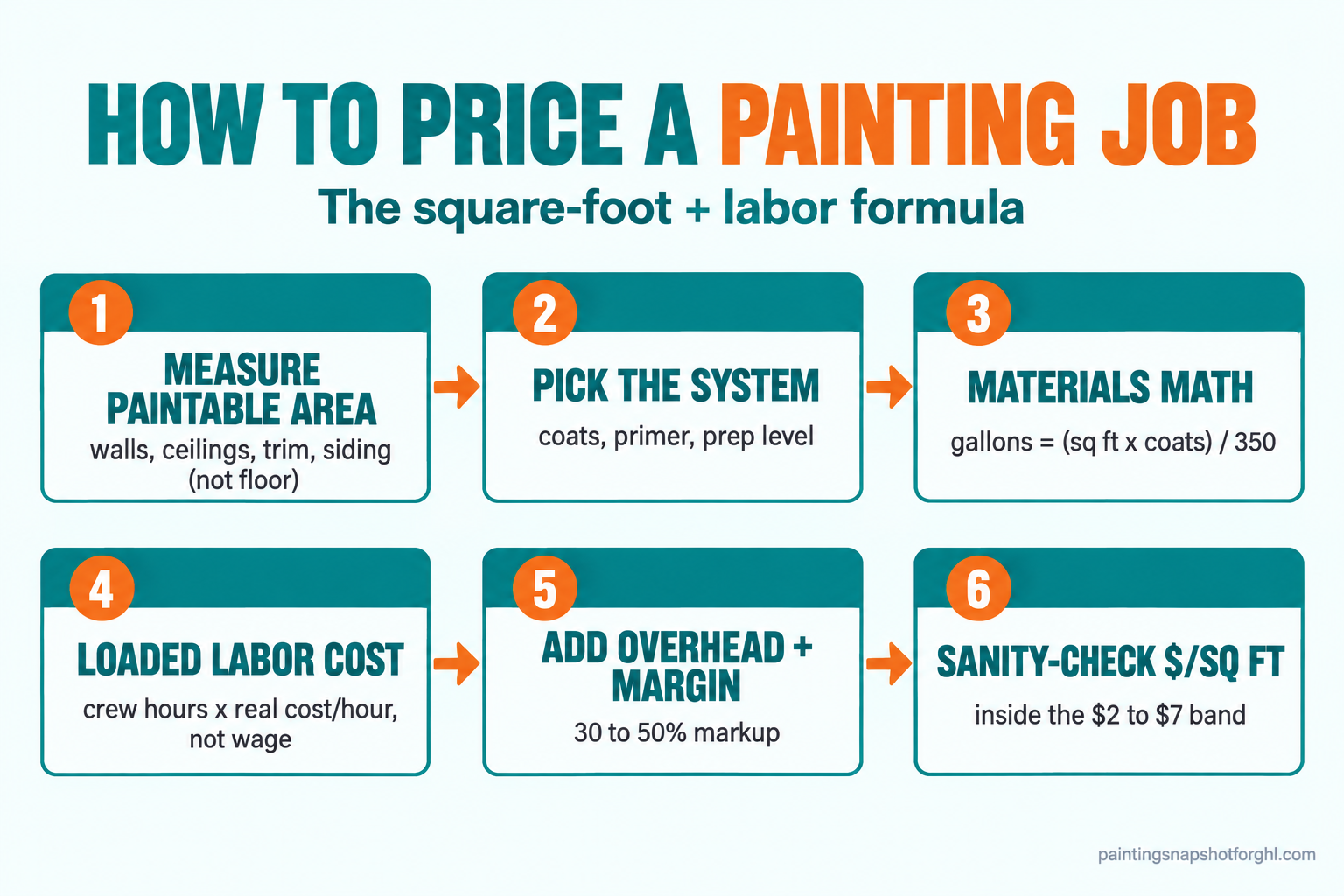
- The formula: six steps to price any paint job
- Steal this: the one-page pricing worksheet
- Worked example: a 1,500 square foot exterior repaint
- The same formula for a solo, a crew, and a multi-crew shop
- The compliance lines that change your number
- Objections I hear every week
- Frequently asked questions
What a guessed price actually costs you
A guessed number misses in two directions, and both bleed money. Price too low and you win the job but lose the margin. On a typical paint job, labor is the dominant cost: industry guides put it at roughly 70 to 85 percent of the total, with materials the smaller 15 to 30 percent share (Inch Calculator, 2026). Underestimate the labor by two days and you painted the back half of the house for free.
Price too high in the wrong way, with a vague number and no breakdown, and you lose the job to someone who looked more prepared, not cheaper. The median annual wage for a U.S. painter is about $49,400, across roughly 326,900 painter jobs in 2025 (U.S. Bureau of Labor Statistics). In a trade that crowded, the painter who can explain his number beats the one with the lowest number.
Approximate split of a professional paint job’s cost. A labor error costs far more than a materials error. Source: Inch Calculator, 2026, and historical HomeAdvisor painting cost data.
Run it on your own shop. Underbid the labor on one in ten jobs you win and you are eating a crew-day a week, five figures a year. Our painting estimate template turns this number into a document that closes.
The formula: six steps to price any paint job
Six steps, interior or exterior, repaint or new work. Build it once as a worksheet or a line-item template in your painting software and you fill in blanks on site instead of staring at a blank text box at night.
Step 1: Measure the real paintable area, not the floor area
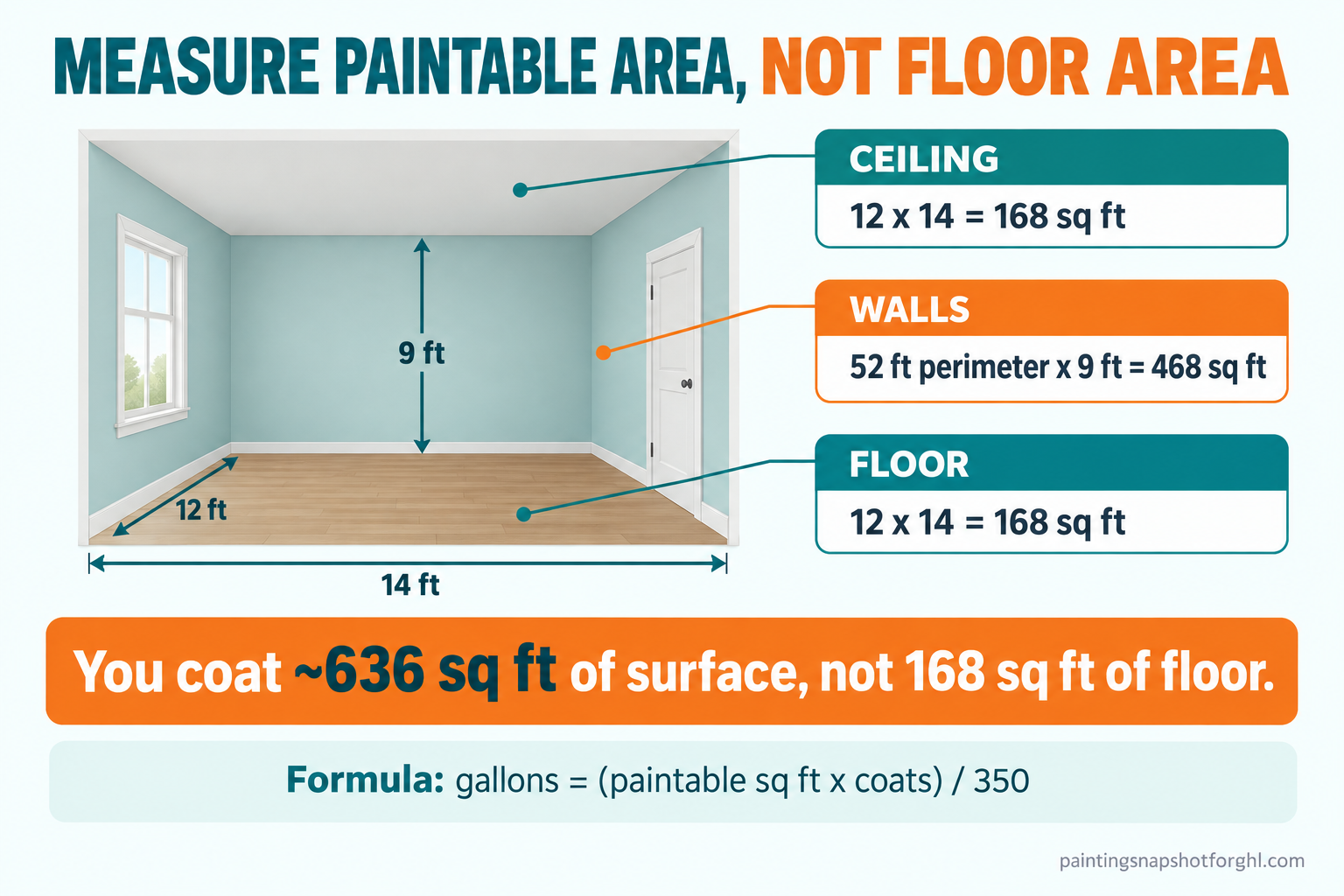
You paint walls, ceilings, trim, and siding, not the floor, and they add up to far more area than a floor plan suggests. For interior walls, add every wall length to get the perimeter, then multiply by the ceiling height. A 12 by 14 room at 9 foot ceilings is a 52 foot perimeter times 9, so 468 square feet of wall. Subtract the big door and window openings. Ceilings are length times width. Trim, doors, and windows you count by the piece, because they eat labor out of proportion to their area.
For exteriors, measure the wall faces the same way and keep siding, trim, soffits, and fascia as separate buckets, because each paints at a different speed, and note anything you reach from a ladder, because access changes the labor more than the area does.
How it breaks: you quote a 300 square foot room as 300 square feet of paint when it is closer to 1,000 square feet of wall and ceiling, and every downstream number is now wrong.
Step 2: Pick the system before you price it
You cannot price what you have not scoped. Decide the system first: how many coats, whether it needs primer, how much prep. Two finish coats are standard, and a color change or a patch almost always needs primer or a third coat. Prep is the sleeper: on a weathered exterior or a wall full of nail holes, scraping, sanding, caulking, and patching can be half the hours on the job, and most painters price it at zero because it is invisible on the finished wall.
How it breaks: you quote two coats and the dark-to-light change needs three, or you quote a clean repaint that needs a day of scraping first. The coats and prep you did not price turn a profitable job into break-even.
Step 3: Do the materials math from coverage
One gallon covers about 350 to 400 square feet in a single coat, per the Sherwin-Williams paint calculator (Sherwin-Williams). Primer covers less, roughly 200 to 300 square feet, because it soaks into bare and patched surfaces. The formula:
Gallons = (paintable square feet × number of coats) ÷ 350.
So 1,000 square feet of wall at two coats is 2,000 square feet of coverage, divided by 350, about 5.7 gallons, so buy 6 (never chase a half gallon mid-job and risk a mismatch). Flat interior paint runs about $25 to $60 a gallon at the pro counter, premium and exterior lines higher (Inch Calculator, 2026). Then add sundries (tape, plastic, caulk, patch, roller covers) as a flat 15 to 25 percent of paint cost so you stop forgetting them.
How it breaks: you buy “about three gallons” by eye, run short on the second coat, and lose an afternoon on a paint-store run.
Step 4: Price the labor off a loaded hour, not a wage
This step separates painters who make money from painters who stay busy and broke. Start with crew hours. You should know your own production rates from job logs, but useful rules of thumb are: rolling open wall runs about 150 to 200 square feet an hour per painter, cutting in and trim is far slower, and spraying exterior siding beats brushing it. Divide your area by the rate, then add prep, setup, and cleanup.
Then cost those hours at a loaded rate, not the wage. A painter you pay $25 an hour costs you more than $25: add payroll taxes, workers’ comp, insurance, the truck, fuel, and the paid hours nobody is painting, and he costs closer to $35 to $45 all in. Contractor billing guides show the gap: interior labor is commonly billed at $20 to $50 an hour and exterior at $25 to $75 (Fieldcamp, 2026), and the spread over the roughly $23 median hourly wage (BLS) is the overhead you have to cover.
How it breaks: you bid labor off the wage, and every job that runs long loses money, because your “profit” was really the overhead you forgot to include.
Step 5: Add overhead and your margin on purpose
Covering your loaded cost is break-even, which is just a job with extra stress. Add two things on top, deliberately: overhead recovery if you did not bury it in the loaded rate (rent, software, advertising, your own salary), and net profit, the margin that is actually yours. A common approach is a target markup on total cost, often 30 to 50 percent for a healthy shop, which lands a net profit of roughly 10 to 25 percent after overhead. The math is simple: a $4,000 loaded cost at a 40 percent markup prices at $5,600.
How it breaks: you price at cost plus a “little extra” that changes with your mood, and the guy with no insurance sets your prices for you. A fixed margin rule, applied every time, keeps the underbidder from dragging your whole market down.
Step 6: Sanity-check against the per-square-foot benchmarks
Pressure-test your number against what the market pays. Interior pros commonly charge about $2 to $6 per square foot of surface, and a full interior with walls, trim, and ceilings runs higher (Angi, 2026). Exteriors land roughly $1.50 to $7 depending on siding, height, and prep. These are guardrails, not your price. If your formula lands far outside the band, you either missed a measurement or found a real reason, like heavy prep or hard access, you can name out loud.
Typical professional price per square foot by job type, 2026 (midpoints). Source: Angi and Improovy, 2026 painting cost data.
Steal this: the one-page pricing worksheet
Copy this into a notebook or spreadsheet tonight. Fill the blanks on site and you have a defensible price before you leave the driveway.
Once the number is set, speed wins the job: a clear, itemized quote sent the same afternoon beats a better number sent three days later. See the real cost of a slow quote response and our estimate follow-up playbook for the chase on the ones that go quiet.
Worked example: a 1,500 square foot exterior repaint
Take a single-story 1,500 square foot home, standard lap siding, a repaint in the same color, moderate prep, two coats. Figures are illustrative, so plug in your own rates.
| Line | Math | Amount |
|---|---|---|
| Paintable area | Siding + trim + soffit/fascia, measured | ~2,400 sq ft |
| Coverage needed | 2,400 × 2 coats | 4,800 sq ft |
| Paint gallons | 4,800 ÷ 350, rounded up | 14 gal |
| Paint cost | 14 × $50/gal | $700 |
| Sundries | 20% of paint | $140 |
| Materials total | $840 | |
| Painter-hours | 2-painter crew, ~3.5 days | 56 hrs |
| Loaded labor cost | 56 × $42/hr | $2,352 |
| Job cost | Materials + labor | $3,192 |
| Quote | Job cost × 1.40 markup | ~$4,470 |
| Sanity check | $4,470 ÷ 2,400 sq ft | ~$1.86/sq ft |
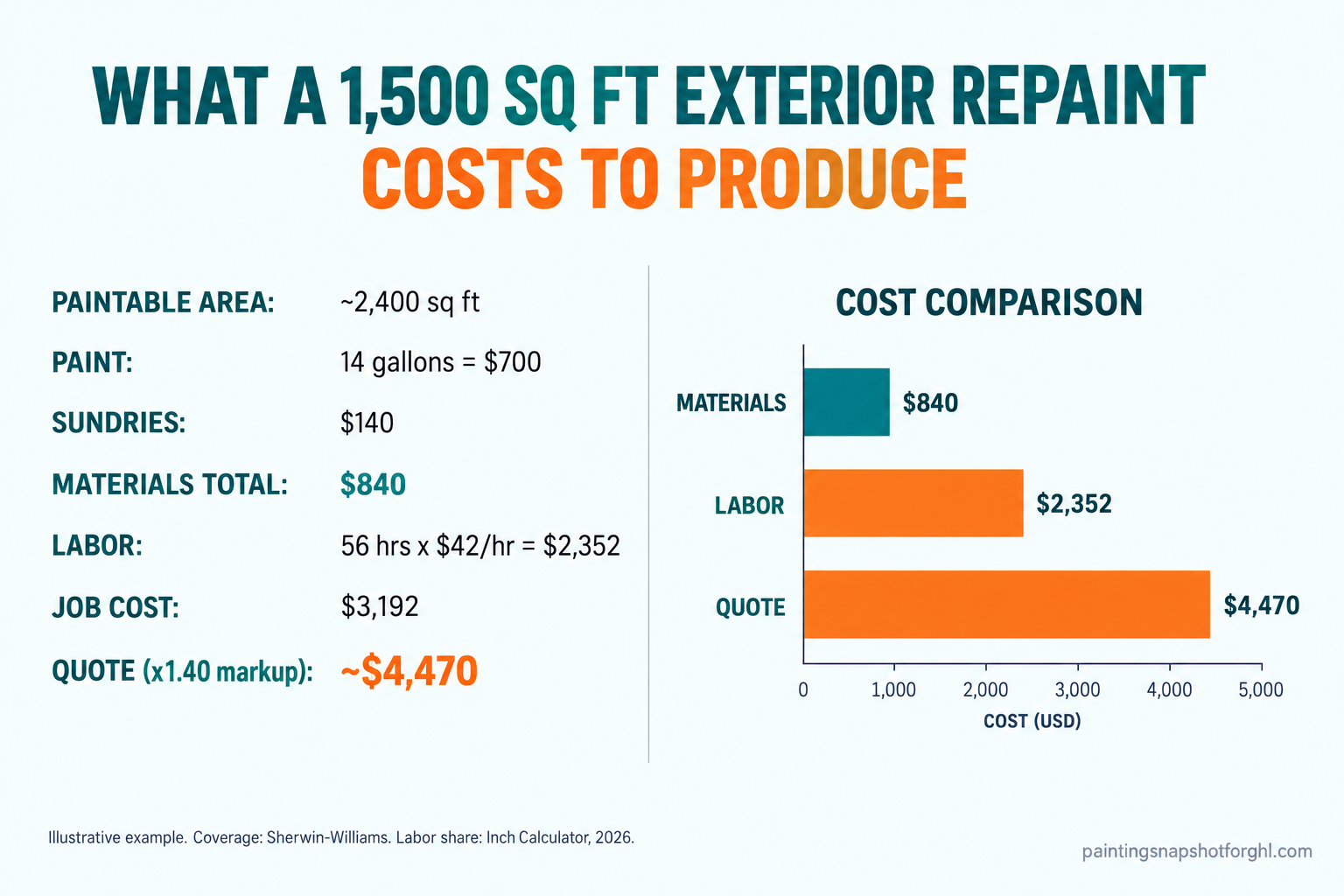
That $1.86 sits at the low end of the exterior band, fitting a same-color repaint with moderate prep. A color change, heavy scraping, or two-story ladder work pushes the number up. Notice too that labor ($2,352) is almost three times the paint ($840), so spend your estimating care where the money is.
The same formula for a solo, a crew, and a multi-crew shop
The formula does not change with the size of your shop. What changes is your loaded cost, your overhead, and the margin you need.
The solo painter
You are the crew, so your “wage” is really your target take-home. The trap is pricing your own hours at zero and calling the leftover “profit.” It is not profit, it is your pay. Set a loaded hourly cost that pays you a real wage plus truck, insurance, and software, then add margin on top. Your overhead is lower than a bigger shop’s, so use that edge to protect your margin, not to justify underbidding.
The five-person crew
Now you carry payroll, workers’ comp, and real downtime between jobs, and your loaded hourly cost makes or breaks the year. This is the shop that most often bids off the wage and wonders where the money went. Build the loaded rate from gross wages plus employer taxes, insurance, vehicles, and the paid hours spent driving, loading, and waiting on weather. If you are moving this out of a notebook, our guide to a painting lead and job system in one place covers the back office around it.
The multi-crew company
With several crews, consistency beats cleverness. The risk is that every estimator prices differently and your margins scatter. The fix is a locked template built into your estimating tool: standard production rates, a standard loaded cost per crew, and a non-negotiable markup, so no one quotes off feel. At this size, a one-point swing in average margin across hundreds of jobs is the difference between a good year and a flat one.
The compliance lines that change your number
Two legal realities can move your price, and ignoring them is how a profitable job turns into a fine.
The big one is lead paint. Any renovation, repair, or painting that disturbs paint in a home built before 1978 falls under the EPA’s Renovation, Repair and Painting (RRP) rule, and the firm has to be lead-safe certified and follow specific containment practices (EPA). This is not rare: about half of homes built before 1978 contain some lead-based paint, and the odds climb with age, to about nine in ten built before 1940 (EPA). The rule exempts truly minor work, but window replacement is never minor. If RRP applies, the extra containment and labor are real line items, so price them in.
The second is advertising. In California, Business and Professions Code 7030.5 requires your contractor license number in all advertising, including your website, trucks, and quotes (California BPC 7030.5), and the state now requires a CSLB license for painting work above $1,000 (CSLB). Those are fixed costs of doing business there, so put them in your overhead. For the full rundown, see our painting contractor compliance checklist.
Objections I hear every week
“I just eyeball it and I do fine.” Maybe on the jobs you know cold. The formula is for the four-bedroom with the two-story gable and the color change, the one your gut misjudges by a crew-day.
“My market won’t pay a formula price.” Your market pays the price you can defend. The formula does not inflate the number, it explains it. When you show a homeowner the square footage, the coats, and the prep, price stops being the only thing she is comparing.
“The underbidder keeps beating me anyway.” Some will, and let them. The painter with no insurance and no idea what his hours cost is slowly going out of business. Your formula lets you walk away from a job that cannot be done for his number without losing money. Chasing him to the bottom is how you join him.
“Isn’t a spreadsheet enough? Do I need software?” A spreadsheet runs the math fine, so start there tonight. Software earns its place at the next step, when the number has to travel: become a clean quote, go out the same afternoon, and chase itself when the customer goes quiet. That is a follow-up problem, not a math problem.
“Should I raise prices on repeat customers?” Price every job on the same formula, repeats included. Loyalty is worth a lot, but not worth painting at a loss because you quoted a number three years ago. If your costs went up, your price goes up, and a good customer gets that when you show the math.
Frequently asked questions
How do I price a painting job per square foot?
Per square foot is a sanity check, not a starting point. Build the price from materials (square footage ÷ coverage × paint cost) plus labor (crew hours × loaded cost) plus margin, then divide the total by paintable square feet to confirm it lands in the market band, roughly $2 to $6 interior and $1.50 to $7 exterior in 2026.
How many gallons of paint do I need for a job?
Divide the paintable square footage by about 350 (the single-coat coverage a gallon gives per the Sherwin-Williams paint calculator), multiply by the number of coats, and round up. So 1,000 square feet of wall at two coats is 2,000 ÷ 350, about 5.7 gallons, so buy 6. Primer covers less, roughly 200 to 300 square feet a gallon.
What percentage of a paint job is labor versus materials?
Labor runs about 70 to 85 percent of a professional paint job and materials the remaining 15 to 30 percent. That is why a labor miss hurts far more than a paint miss, and why you should price labor off a fully loaded hourly cost (wage plus taxes, insurance, truck, and downtime) rather than the raw wage.
How much margin should a painting contractor add?
Covering your loaded cost is break-even. Most healthy shops add a markup of 30 to 50 percent on total job cost, which lands a net profit of roughly 10 to 25 percent after overhead. Pick a number and apply it to every job rather than shaving it under pressure.
Do I have to price lead-paint work differently?
Yes. Any work that disturbs paint in a pre-1978 home falls under the EPA RRP rule, which requires lead-safe certification and specific containment practices. About half of pre-1978 homes contain lead paint, so this is common. Add the extra labor and materials as line items rather than absorbing them.
Related playbooks: The painting estimate template that wins the job · Why instant estimates win more jobs