
The job was a $9,200 interior repaint. You shook hands in the kitchen, texted a one-line quote, and started Monday. Then she decided the ceilings should be done too, the trim color changed twice, and she “thought the deposit covered more than half.” Three weeks later the crew has moved on and you are owed $3,400 you may never see, because the only record of what you agreed to is a text thread and your memory. That is not a billing problem. That is a contract problem.
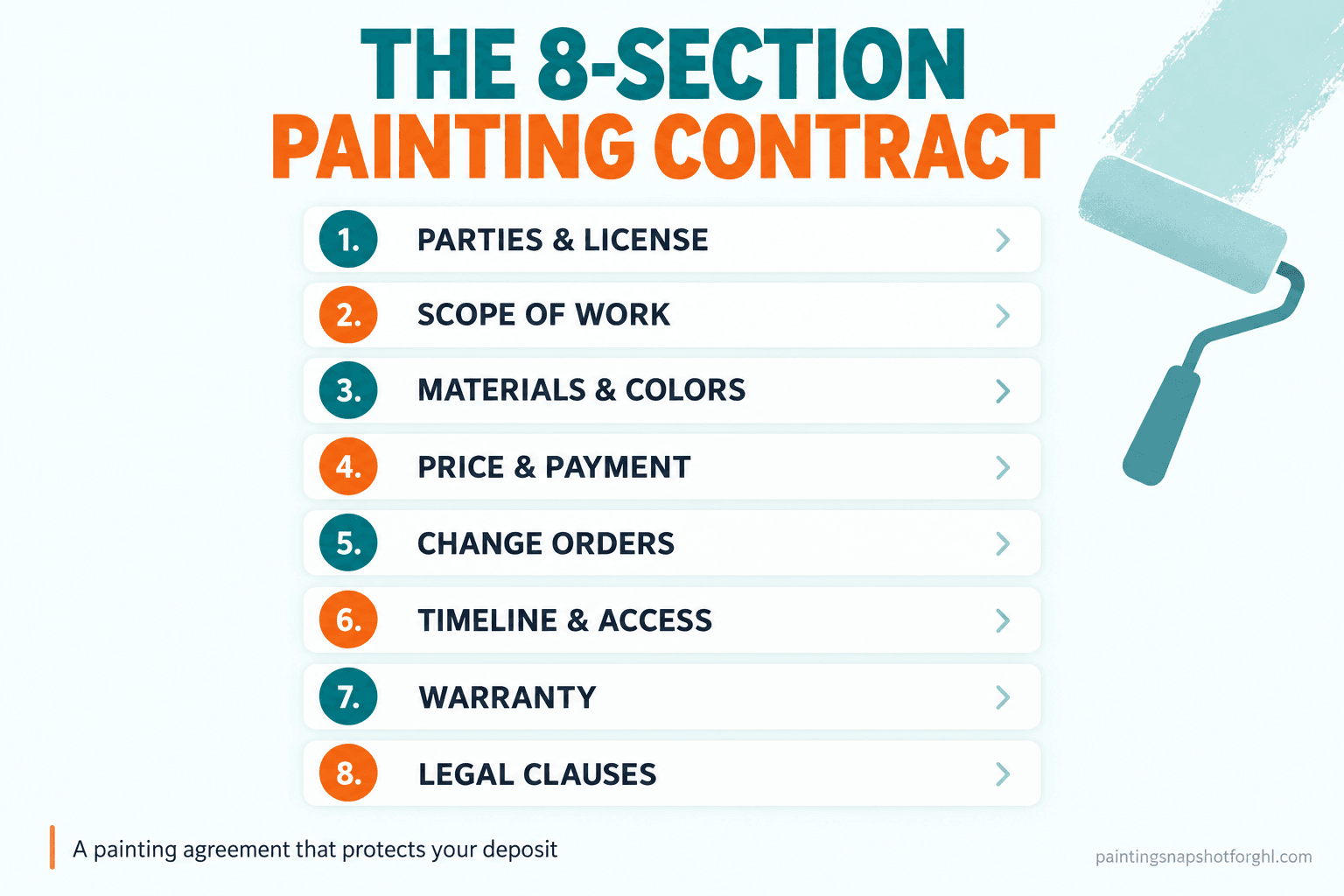
Here is the fix. A painting contract is eight short sections: who the parties are, exactly what gets painted, the materials and colors, the price and payment schedule, how changes get handled, the timeline and access, the warranty, and the legal fine print. Get those eight on paper and signed before a drop cloth comes out, and the arguments stop before they start. This is the template, section by section: the exact language to copy tonight, the failure mode each clause prevents, and the two legal lines most painters regret leaving off.
In this post
- What a missing contract actually costs you
- The eight sections of a painting contract
- Steal this: the full painting contract language
- The payment schedule that protects your cash
- The same contract for a solo, a crew, and a multi-crew shop
- The two legal clauses most painters forget
- Objections I hear every week
- Frequently asked questions
What a missing contract actually costs you
A weak contract, or none at all, bleeds money in three ways, and none show up until the job is half done.
First, scope creep. The homeowner who “assumed” the closets and garage were included is not lying. She heard “paint the inside” and filled the blanks with her wish list. Without a scope clause naming what is in and out, every assumption becomes free work.
Second, the deposit fight. You collected a deposit, bought the paint, and scheduled the crew, then the customer wants it back because “nothing’s really been done yet.” If the contract does not spell out what the deposit covers, you are arguing from memory against someone who wants their money.
Third, the legal exposure, the one that turns a profit into a penalty. Roughly three-quarters of homes built before 1978 still contain some lead-based paint, according to the EPA. Disturb that paint with no lead disclosure in your contract and you are on the wrong side of a federal rule. In a trade with about 326,900 U.S. painter jobs in 2025 (Bureau of Labor Statistics), the painters who last treat the paperwork as part of the job.
Share of U.S. homes built before 1978 that still contain some lead-based paint. Any job that disturbs that paint needs a written disclosure. Source: EPA, Get Lead Safe.
The fix is not a 40-page document from a lawyer. It is one clean, two-page agreement you use on every job: it makes you look professional, removes the arguments before they start, and keeps the deposit you earned. Pair it with a sharp painting estimate template and the number from how to price a painting job travels straight from quote to signed agreement.
The eight sections of a painting contract
Every painting contract is built from the same eight sections, each closing a specific gap. Here is what each does and how it breaks when you skip it.
Section 1: Parties, license, and dates
Name the business (legal name, not just the DBA), the customer, the job address, and the date, plus your contractor license number if your state requires one. This sounds like filler. It is not. In California, Business and Professions Code 7030.5 requires your license number in all advertising and in the contract itself (California BPC 7030.5), and the state requires a CSLB license for work over $1,000. Texas, by contrast, has no state painting license at all.
How it breaks: you sign as “Mike’s Painting” with no legal entity named, the dispute reaches small claims, and the judge cannot tell who is bound.
Section 2: The scope of work
This is the heart of the contract and the part painters shortchange most. Do not write “paint the interior.” Write the rooms, the surfaces in each (walls, ceilings, trim, doors, closets), the prep included (scraping, sanding, caulking, patching, washing), the number of coats, and a short list of what is excluded. The exclusions line protects you: “Does not include garage, exterior, wallpaper removal, or drywall repair beyond minor patching.”
How it breaks: you quote the bedrooms, the customer assumes the whole floor and the stairwell, and you eat a crew-day proving a negative.
Section 3: Materials and colors
Specify the paint brand, line, and sheen for each surface, plus who supplies it. Lock colors by name and code (for example, “Sherwin-Williams Agreeable Gray SW 7029, eggshell, walls”). If colors are not chosen yet, write “colors TBD, up to 3 included, additional colors billed at $X.” A late color addition is real money, not a courtesy.
How it breaks: the customer picks a deep accent after you priced two coats, it needs three coats and a tinted primer, and no line lets you charge for it.
Section 4: Price and payment schedule
State the total price, the deposit, and the progress payments tied to milestones, not dates. “50% on completion of the first floor” is enforceable and fair. “50% on October 15th” punishes you for a rained-out week.
How it breaks: you bill a flat “half now, half later,” the customer disputes “later,” and you have no milestone to point to.
Section 5: Change orders
The single most valuable clause in the document. One sentence: no additional or changed work is performed until it is described in writing, priced, and signed by both parties. That turns every “while you’re here, can you also do the…” into a quick written add instead of unpaid work.
How it breaks: the customer keeps adding small jobs verbally, you keep saying yes to be nice, and at the end she refuses to pay for work that “was never in writing.” She is technically right.
Section 6: Timeline and access
Give a start window and an estimated completion, then protect both with conditions: weather delays on exterior work, customer-caused delays (furniture not moved, colors not chosen), and the access the crew needs (power, water, parking, a clear area). Exterior painters especially need the weather line, because manufacturers specify minimum application temperatures.
How it breaks: you commit to a hard completion date, a week of rain kills the exterior window, and the customer calls a weather delay a breach.
Section 7: Warranty
State what you warranty (workmanship), for how long (one to three years is common), and what is excluded (peeling from moisture, customer-supplied paint, surfaces you flagged as unsuitable, normal wear). A clear warranty is a selling tool and a shield. A vague “we stand behind our work” is a promise the customer reads far more broadly than you meant.
How it breaks: paint fails on a surface you warned was failing, the customer invokes an open-ended verbal guarantee, and you repaint free to protect your reviews.
Section 8: The legal clauses
The fine print that keeps you out of court: the lead-paint disclosure, the customer’s right to cancel, proof of insurance, cleanup terms, and how disputes get handled. Two are not optional; the compliance section below covers them.
How it breaks: you skip the lead disclosure on a 1955 house, or leave off the right-to-cancel notice on a kitchen-table contract, and a routine job becomes a regulatory problem.
Steal this: the full painting contract language
Copy this into a document, add your logo and license number, and you have a contract for every job. Bracketed parts are blanks you fill in on site. This is a practical operator template, not legal advice, so have a local attorney review it once against your state’s rules, then reuse it.
That is two pages, not forty. The language is plain on purpose: a contract the customer actually reads causes far fewer fights than one that scares them into silent resentment. For the step just before this, chasing the quote to a yes, see our estimate follow-up playbook.
The payment schedule that protects your cash
The payment schedule is where a good contract pays you back directly. The goal: never be further out of pocket than the customer is. Structure it with a deposit, one or more progress payments tied to real milestones, and a final balance on completion. A common, fair structure for a residential repaint looks like this. Adjust the split to your cash position and job size.
| Stage | When it is due | Typical share |
|---|---|---|
| Deposit | At signing, before materials | 10% to 25% |
| Progress payment | At a named milestone (e.g. first floor done) | 40% to 50% |
| Final balance | On completion and walkthrough | Remainder |
An illustrative progress-billing split for a residential repaint. Tie each payment to a milestone, not a calendar date. Percentages are a sample structure, not a rule.
Two cautions. First, some states cap your deposit. In California, the down payment on a home improvement contract cannot exceed $1,000 or 10% of the price, whichever is less, per the CSLB consumer guide. Take more than that in California and you have broken the law even if the customer offered, so know your state’s cap before you write a deposit line.
Second, tie progress payments to milestones you can prove, not dates you cannot control. “50% when the first floor is complete” is objective. Photo the milestone, text it to the customer, and request payment the same day. That turns your contract into cashflow instead of a document in a drawer. If deposits are a recurring sore spot, we wrote a whole playbook on collecting deposits as a painting contractor.
The same contract for a solo, a crew, and a multi-crew shop
The eight sections do not change with shop size. What changes is how tightly you enforce them.
The solo painter
You are the salesperson, estimator, and crew, so the temptation is to skip the paperwork and “just get painting.” That is backwards: you have the least cushion to absorb a scope fight or a clawed-back deposit, so the contract protects you the most. Keep a signable version on your phone and collect a signature at the kitchen table before you leave.
The five-person crew
Now the person who sells the job is often not the one swinging the brush, and the risk is the gap between what you promised and what the crew heard. Your contract scope becomes the crew’s work order: print it, hand it to the lead, and the crew paints what is on the page, nothing more. Any “while you’re here” request routes back to you for a written change order. This is the size where a lead and job management system earns its keep, so the contract, schedule, and invoice all speak to each other.
The multi-crew company
With several crews and estimators, consistency is everything. The danger is that each estimator writes a slightly different agreement, so your legal exposure and your margins scatter. The fix is a locked template no one may rewrite: standard scope language, standard payment milestones, a standard warranty, and the legal clauses baked in. Estimators fill blanks, they do not edit terms. One bad warranty clause repeated across hundreds of jobs is a company-wide liability.
The two legal clauses most painters forget
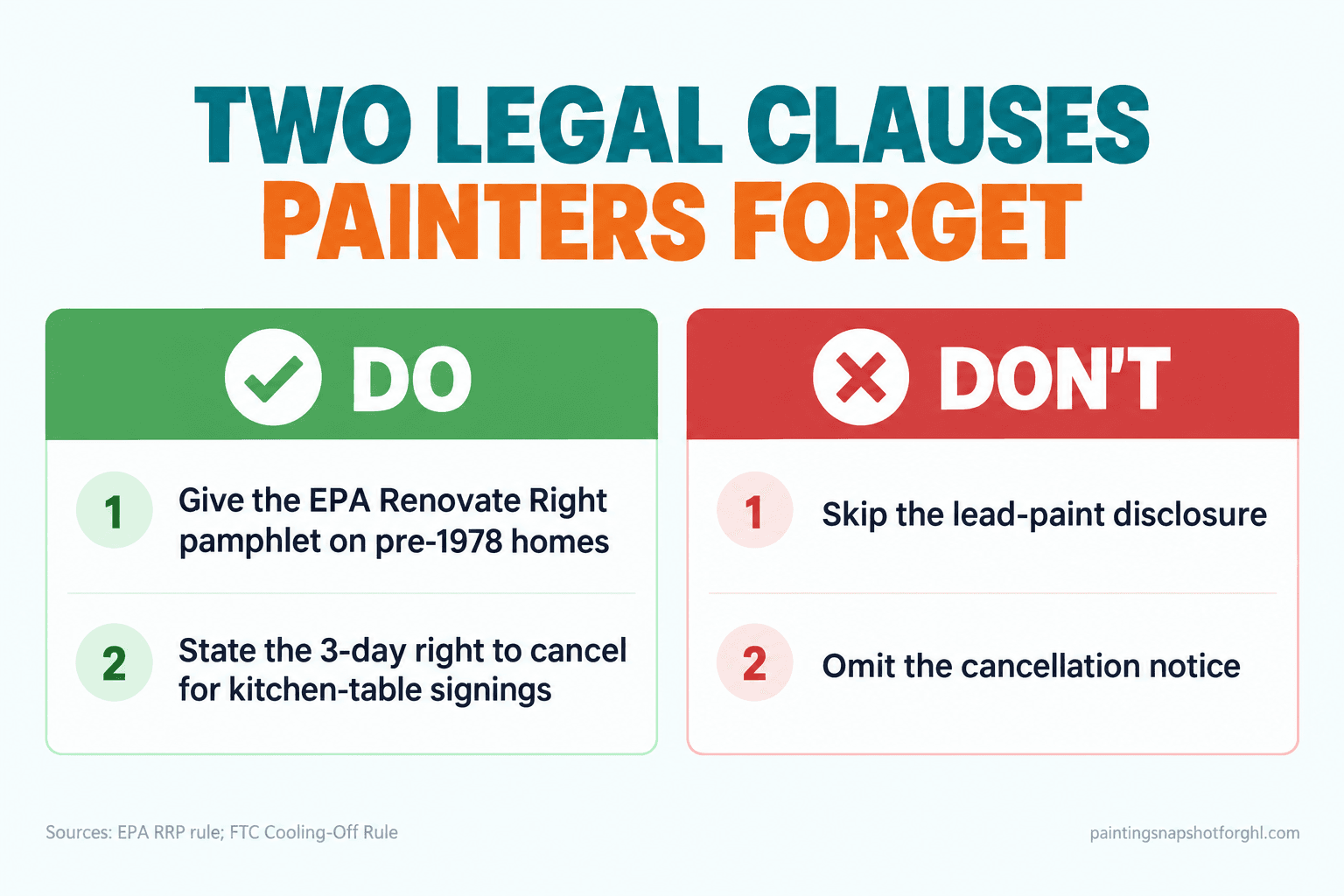
Two clauses in Section 8 are not style choices. Leave them off and a clean job becomes a legal problem.
The first is the lead-paint disclosure. Any painting that disturbs paint in a home built before 1978 falls under the EPA’s Renovation, Repair and Painting (RRP) rule. The firm must be lead-safe certified and, before work begins, give the owner the EPA’s “Renovate Right” pamphlet (EPA RRP program). A firm cannot even advertise or perform covered work without certification (EPA, for contractors). With about three-quarters of pre-1978 homes still carrying lead paint, a big share of your repaint work triggers it. Your contract needs a line where the customer acknowledges receiving the pamphlet.
The second is the right to cancel. Under the FTC’s Cooling-Off Rule, a sale over $25 made at the buyer’s home gives them three business days to cancel, and you must say so in writing. Many states add their own version: California gives three days, and five for buyers 65 or older (CSLB consumer guide). Because you sign most jobs in the kitchen, this applies constantly, and the clause is one line. For the full rundown of licensing, insurance, and SMS rules, see our painting contractor compliance checklist.
Objections I hear every week
“It’s a $900 repaint. Do I really need a contract?” Yes, and it can be short. Small jobs are where verbal scope fights happen most, because nobody wrote anything down. A half-page agreement takes five minutes and saves the afternoon arguing about what “the bedroom” meant.
“A contract makes me look like I don’t trust the customer.” The opposite is true. A clear, plain agreement makes you look like the professional who has done this a thousand times, while the handshake painter looks cheap and risky.
“What if they won’t sign?” Then you learned something valuable before you bought the paint. A customer who refuses to sign a fair, plain agreement is the one most likely to dispute the bill. The contract is a filter as much as a shield.
“Can’t I just use a free template off the internet?” Start there, but most generic templates miss the two clauses that matter most in painting: the lead-paint disclosure and the right to cancel. Add those two lines, specify your real paint and prep language, and have a local attorney glance at it once. That review is the cheapest insurance you will ever buy.
Frequently asked questions
What should a painting contract include?
Eight sections: parties and license number, a detailed scope with surfaces and exclusions, materials and colors, the price and milestone-based payment schedule, a written change-order clause, timeline and access terms, the warranty, and the legal clauses (lead-paint disclosure, right to cancel, insurance, cleanup, and disputes). Get all eight signed before any work starts.
How much deposit can a painter legally ask for?
It depends on your state. In California, the down payment on a home improvement contract cannot exceed $1,000 or 10 percent of the price, whichever is less, per the CSLB. Many states have no specific cap, where a 10 to 25 percent deposit is common. Check your state's rule, because taking too much can break the law even if the customer agreed.
Do I need a lead-paint disclosure in my painting contract?
Yes, for any home built before 1978. The EPA's RRP rule requires a lead-safe certified firm to give the owner the Renovate Right pamphlet before disturbing paint, and your contract should have a line where the customer acknowledges receiving it. About three-quarters of pre-1978 homes still contain some lead-based paint, so this applies to a large share of repaint work.
Can a customer cancel a signed painting contract?
Often yes. Under the FTC Cooling-Off Rule, a sale over $25 signed at the customer's home gives them three business days to cancel, and you must disclose that right in writing. Some states add their own version, such as California's five-day window for buyers 65 and older. Include a right-to-cancel clause as standard.
How do I handle changes once the job has started?
With a written change order. The contract should state that no added or changed work happens until it is described in writing, priced, and signed by both parties. When the homeowner asks you to also do the hallway or switch an accent color, you write a quick add, price it, and get a signature before the crew touches it. That one rule prevents most final-payment disputes.
Is a verbal painting agreement legally binding?
Sometimes, but it is nearly impossible to enforce, and some states require home improvement contracts over a dollar threshold to be in writing. Even where a verbal deal is valid, you cannot prove the scope, price, or payment terms when memories differ, so always put it in writing and get both signatures.
Related playbooks: The painting estimate template that wins the job · How to price a painting job in 2026 · Collecting deposits as a painting contractor